1970s fashion women remains the most searched, revisited, and endlessly reinterpreted style era in modern history, and it is not difficult to understand why. The decade gave women bell bottoms and wide-leg trousers that redefined proportion. It gave them wrap dresses that flattered every figure. It gave them platform shoes, maxi dresses, bohemian fashion rooted in the counterculture, and disco glamour that has never been surpassed for sheer visual impact. As vintage fashion and retro chic continue their dominance across runways, street style, and social media, 70s style women are choosing these looks not as costume but as wardrobe, and wearing them better than ever.
Whether your entry point into 1970s women’s fashion is the powerful cream pantsuit of the women’s liberation era, the free-spirited boho of Woodstock and its aftermath, or the unapologetic Studio 54 sequin and wide-leg trouser, the decade offers a complete wardrobe of identities. Bell bottoms and peasant blouses for the bohemian. Tailored wide-lapel suits and wrap dresses for the professional. Gold cat-eye sunglasses, statement accessories, and draped halter tops for the glamorous. Modern vintage fashion has never offered so many directions simultaneously, which is precisely what makes 1970s outfit ideas so enduringly compelling for women today.
This is the definitive guide to 1970s fashion for women: the history, the key pieces, the best 70s outfit ideas for every occasion, styling advice by body type, seasonal guidance, and exactly how to wear retro fashion now without looking like you have stepped out of a time capsule. Every section is built to be useful, specific, and genuinely better than anything else available on this subject.
What Did Women Wear in the 1970s? Key Fashion Trends Explained
Women in the 1970s commonly wore:
- Bell-bottom jeans and wide-leg trousers
- Wrap dresses and maxi dresses
- Halter tops and peasant blouses
- Tailored pantsuits and safari suits
- Jumpsuits in silk, jersey, and denim
- Midi and maxi skirts in earthy prints
- Platform shoes, wedges, and knee-high boots
- Oversized sunglasses and wide leather belts
These styles reflected a spirit of freedom, individuality, and self-expression, shaped equally by the women’s liberation movement, the disco era, and the enduring counterculture influence of the late 1960s.
Table of Contents
- 1970s Fashion Women: Style at a Glance
- 1970s Women's Fashion: A Complete Overview
- Why 1970s Retro Fashion Is Trending Again
- Key Characteristics of 1970s Fashion and Style for Women
- Black Women's Fashion in the 1970s
- Iconic 1970s Fashion Designers Who Shaped Women's Style
- How 70s Women's Fashion Evolved: From Boho to Disco
- Best 70s Outfit Ideas for Women Today
- 70s Outfit Ideas for Women by Occasion
- Celebrity 1970s Fashion: The Women Who Defined the Decade
- How to Wear 1970s Fashion Without Looking Like a Costume
- Modern vs. Authentic 1970s Women's Fashion — Comparison Table
- 1970s Fashion Style Guide by Body Type
- Best 1970s Fashion Colours for Women: The Complete Palette Guide
- Best 1970s Hairstyles for Women to Pair With Your 70s Outfit
- 1970s Makeup and Beauty Trends for Women
- The Best Accessories to Complete a 1970s Women's Outfit
- How to Build a 1970s Fashion Wardrobe: Shopping Guide
- 1970s Fashion Women: Complete Trend Checklist
- How to Wear 1970s Fashion Women's Outfits Every Season
- 70s Fashion Inspiration: Ideas for Bloggers, Influencers and Stylists
- Why 1970s Women's Fashion Is Worth Embracing Today
- Common 1970s Fashion Mistakes Women Should Avoid
- Expert Tips for Styling 1970s Women's Fashion Today
- Frequently Asked Questions About 1970s Fashion for Women
- Key Takeaways
1970s Fashion Women: Style at a Glance
Quick reference for the most searched 70s fashion terms — save this section.
| Category | Most Popular Options |
|---|---|
| Clothing | Bell bottoms, wrap dresses, maxi skirts, halter tops, pantsuits, peasant blouses, jumpsuits |
| Shoes | Platform sandals, wedges, knee-high boots, platform loafers |
| Colours | Rust, camel, chocolate brown, olive green, mustard yellow, cream, burgundy |
| Accessories | Wide leather belt, hoop earrings, layered gold necklaces, oversized sunglasses, silk scarf |
| Hairstyles | Feathered waves, natural Afro, shag cut, centre parting |
| Makeup | Warm brown eyeshadow, smudged liner, terracotta lip, glowy skin |
1970s Women’s Fashion: A Complete Overview
Quick Definition: 1970s women’s fashion was a pluralistic, liberated movement away from the rigid silhouettes of the 1960s. It encompassed bohemian maxi dresses, power suits, wide-leg trousers, wrap dresses, platform shoes, disco glamour, and earthy natural fabrics, all united by a sense of individual expression and cultural confidence.
The 1970s did not have a single fashion story. It had several happening simultaneously, which is precisely what makes the decade so compelling and so endlessly wearable today.
At the start of the decade, the mini skirt dominance of the 1960s gave way to longer, more fluid hemlines. Women reached for prairie blouses, suede fringe jackets, and maxi skirts in natural earthy tones, an aesthetic deeply influenced by the counterculture and folk music movements of the late 1960s. This bohemian current ran throughout the decade, eventually morphing into the luxe boho of contemporary fashion.
Simultaneously, the women’s liberation movement had a profound effect on fashion. Women entering professional spaces in greater numbers demanded clothing that communicated authority. The pantsuit became a symbol of gender equality. Wide-leg trousers, tailored blazers, and structured separates gave women a wardrobe that said power without sacrificing femininity.
By the mid-decade, Diane von Furstenberg’s wrap dress, launched in 1974, became the single most democratic garment of the era. Easy, flattering, and instantly chic, it remains in constant production because nothing has ever replaced it.
And then came disco. By the late 1970s, Studio 54 had become the cultural centre of glamour. Halston dressed Bianca Jagger in silk and jersey. Jerry Hall wore satin. Women wore sequins to dance floors and liquid-gold blouses to dinner. The 1970s contained multitudes.
Why 1970s Retro Fashion Is Trending Again
1970s fashion never truly left, it simply cycles back with greater urgency every few years. The current resurgence is driven by several converging forces.
Cultural nostalgia plays a role: as Gen X and older Millennials reach positions of cultural influence, the aesthetics of their childhood and adolescence appear in editorial spreads, runway collections, and high-street campaigns.
Sustainability is equally significant. Wide-leg trousers, wrap dresses, and quality tailored separates are inherently investment pieces, not fast fashion. As consumers move toward buying less and wearing more, the 70s wardrobe philosophy aligns perfectly with conscious dressing values.
The return of maximalism after years of minimalist dominance has also accelerated the 70s revival. Statement collars, bold prints, oversized accessories, and rich earth tones satisfy a contemporary appetite for visual richness that minimalism simply cannot meet.
Finally, the runways confirm it. Bottega Veneta, Gucci, Max Mara, and Zimmermann have all drawn directly from 1970s references in recent seasons, translating flared trousers, suede, and statement belts into luxury ready-to-wear that signals the decade’s enduring authority.
Key Characteristics of 1970s Fashion and Style for Women
Wide-Leg Pants and Bell Bottoms
No single silhouette defines the 1970s more immediately than wide-leg trousers and bell bottoms. These were not merely fashion items, they were statements.
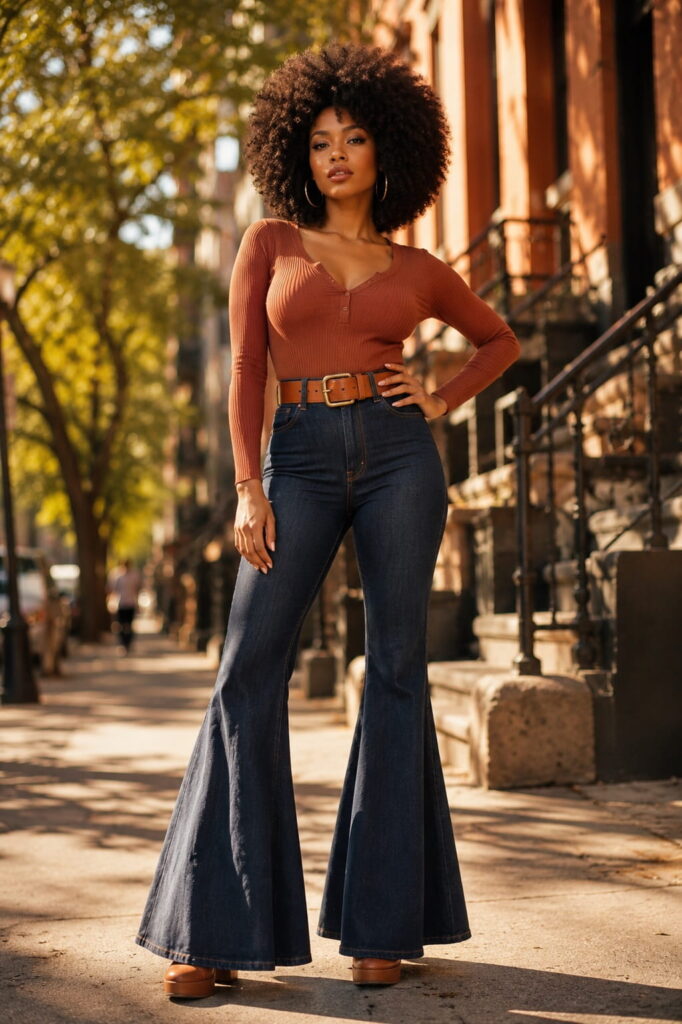
Bell bottoms, fitted at the hip and dramatically flared from the knee down, originated in naval uniforms but became the signature garment of the early 1970s youth movement. They were worn in denim, corduroy, velvet, and printed cotton. The wider the flare, the more committed the wearer.
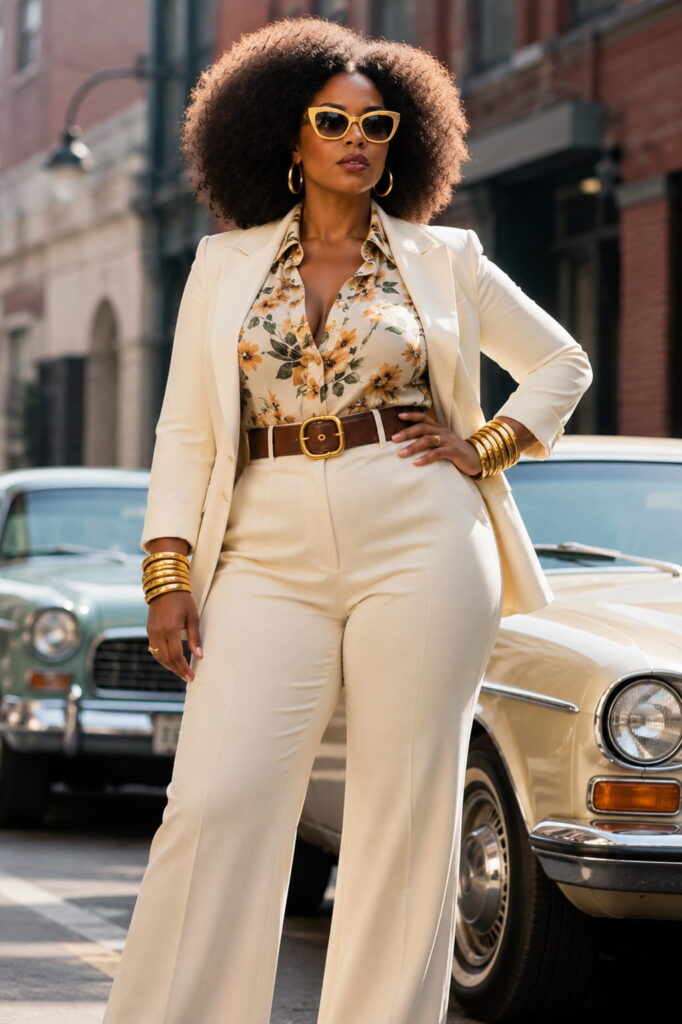
Wide-leg trousers offered the same proportional drama with greater versatility. In wool crepe, satin, or linen, they moved beautifully and photographed even better. The key to both styles is the high waist, it creates the elongating proportion that makes wide-leg silhouettes so flattering and so enduringly popular.
How to wear them now: Choose a high-waist wide-leg in wool, linen, or a fluid crepe. Tuck in a fitted blouse or wear with a cropped knit. Platform sandals or block-heeled mules complete the silhouette correctly, flat shoes visually shorten the leg in proportion.
Tailored Suits and the Power Pantsuit
The 1970s pantsuit deserves rehabilitation as one of fashion’s most important garments. At a moment when women’s right to wear trousers in professional settings was still contested in many workplaces and restaurants, the pantsuit was a radical act.
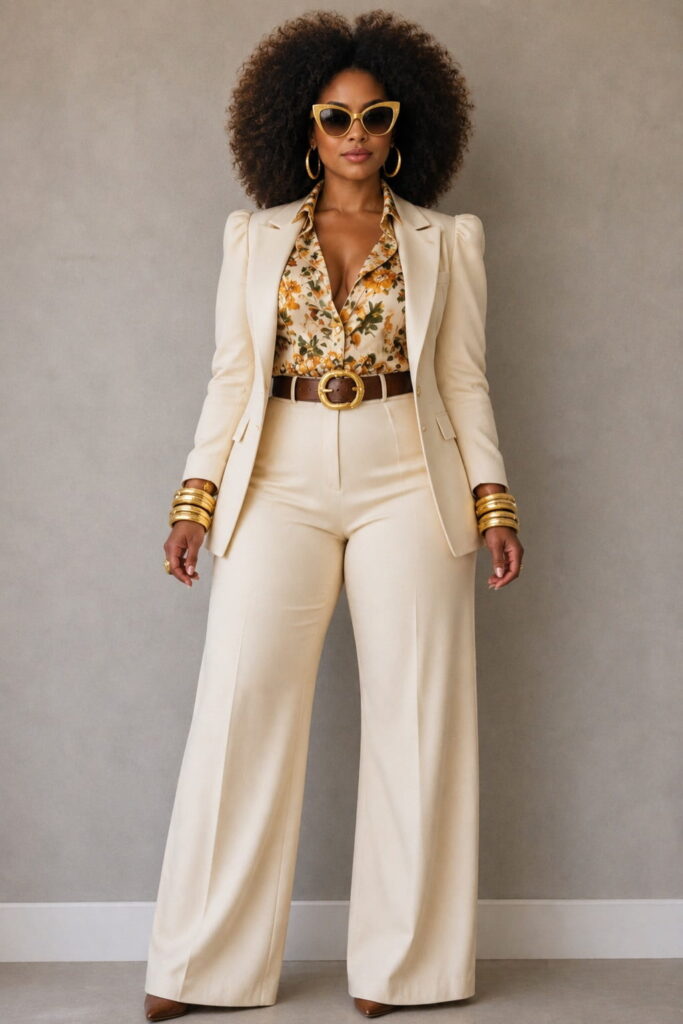
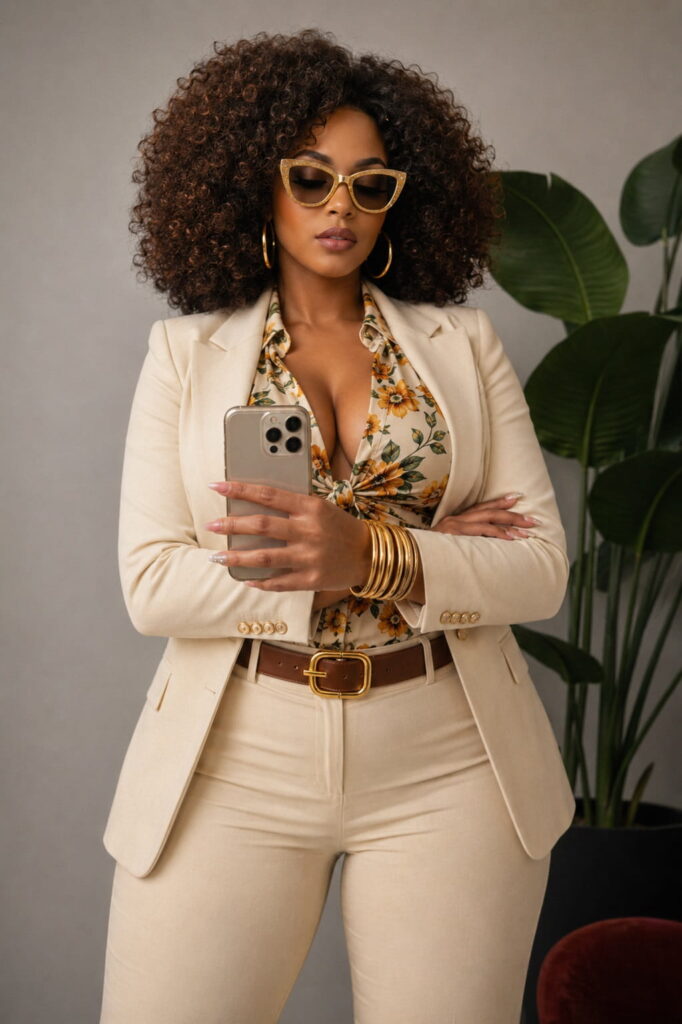
Stylistically, these suits were impeccably cut. Wide lapels, flared trousers, and strong shoulders created a silhouette that was simultaneously powerful and feminine. In cream, ivory, caramel, and tan, the decade’s signature neutrals, they remain some of the most sophisticated ensembles ever worn by women.
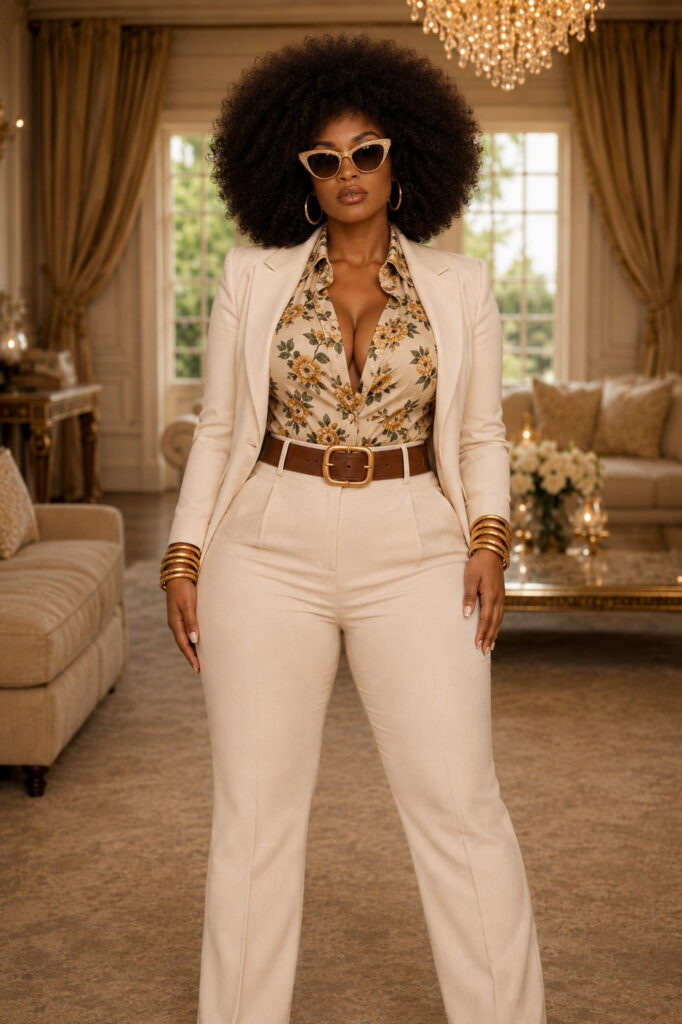
Fabric notes: Original 1970s suits were commonly made in wool, polyester blends, and occasionally velvet for eveningwear. The synthetic fabrics of the era, popular because they were easy-care and affordable, are less desirable today. When shopping vintage or contemporary pieces, prioritise natural fabrics: wool, linen, and cotton blends drape better and age beautifully.
Floral Prints and the Bohemian Blouse
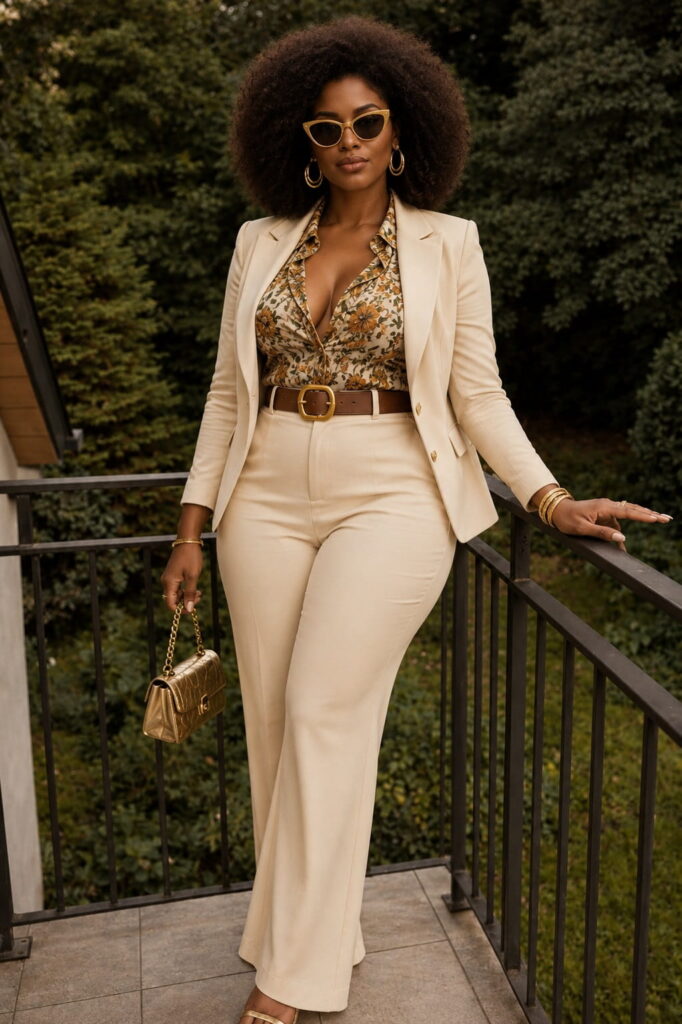
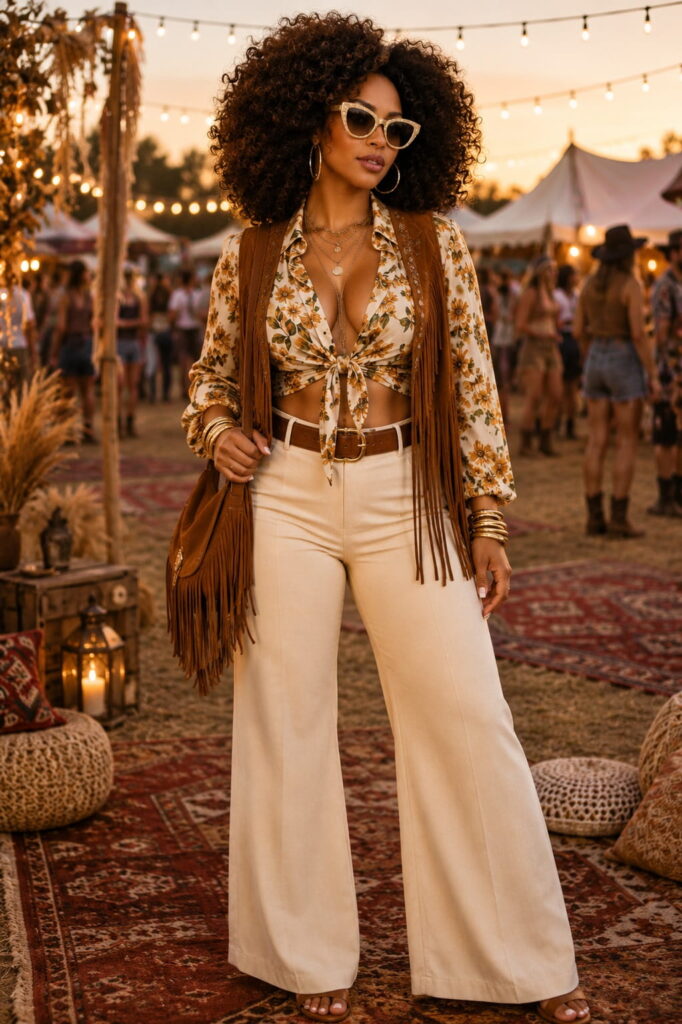
The floral blouse was the workhorse of 1970s boho dressing. Worn tucked into high-waisted trousers, belted over a maxi skirt, or left open over a fitted tee, it appeared in every wardrobe from Topanga Canyon to Kensington Market.
The prints themselves were distinctive: large-scale blooms in warm ochres, rusts, forest greens, and dusty roses. Floaty fabrics, chiffon, crêpe de chine, lawn cotton, gave the blouses their characteristic movement. Details like ruffled collars, puffed sleeves, and contrast piping elevated simple shapes into memorable statements.
Statement Belts
The 1970s elevated the belt from functional accessory to focal point. Wide leather belts in cognac, tan, and chocolate brown cinched maxi dresses, blazers, and knitwear alike. Tooled leather, brass hardware, and woven styles added texture and artisan appeal.
The effect was always the same: instant definition at the waist, which balanced the volume of wide-leg trousers below and billowing sleeves above. If you own just one 70s-inspired accessory, make it a substantial leather belt with quality hardware.

Platform Shoes
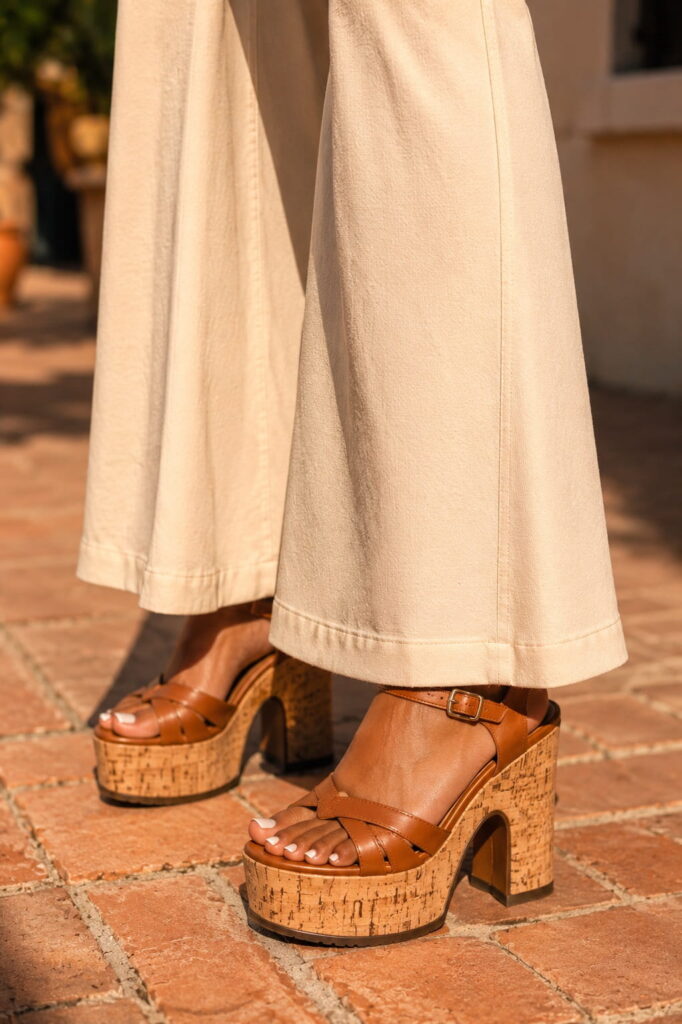
Platforms were not subtle in the 1970s. Whether in cork, wood, or stacked leather, they added inches of height with a theatrical confidence that the era embraced completely.
The most wearable contemporary interpretation is the platform sandal or platform mule, elevated enough to read as authentically 70s without the precariousness of original 5-inch cork wedges. They work particularly well with flared trousers because they create the clean, continuous line from waist to floor that defines the 70s silhouette.
Oversized Sunglasses
Cat-eye frames, oversized oval lenses, and tinted aviators defined 1970s eyewear. Jackie Kennedy’s enormous square frames set an early benchmark; by mid-decade, the frames had become extravagantly large and deeply tinted in amber, brown, and green.
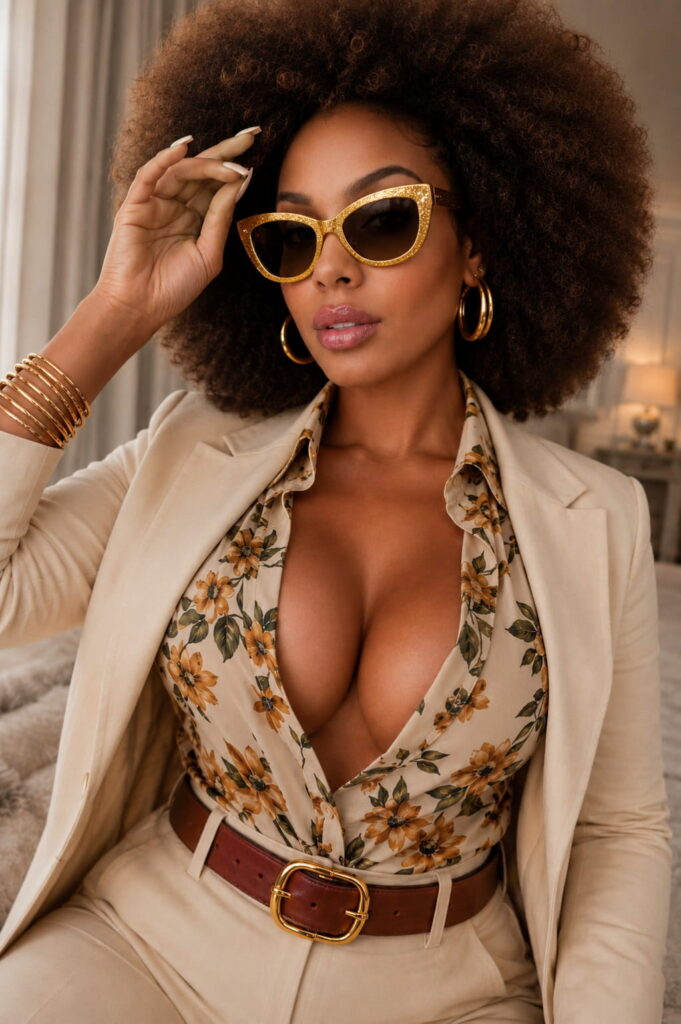
Today, the tortoiseshell oversized frame remains the most versatile and wearable 70s eyewear reference. It works with everything from a white linen suit to a printed wrap dress.
Afro Hairstyles and Natural Hair
The 1970s represented a landmark moment for natural Black hair. The Afro, worn with pride, intention, and political significance, became one of the decade’s most powerful visual statements, embraced by activists, musicians, and everyday women alike.
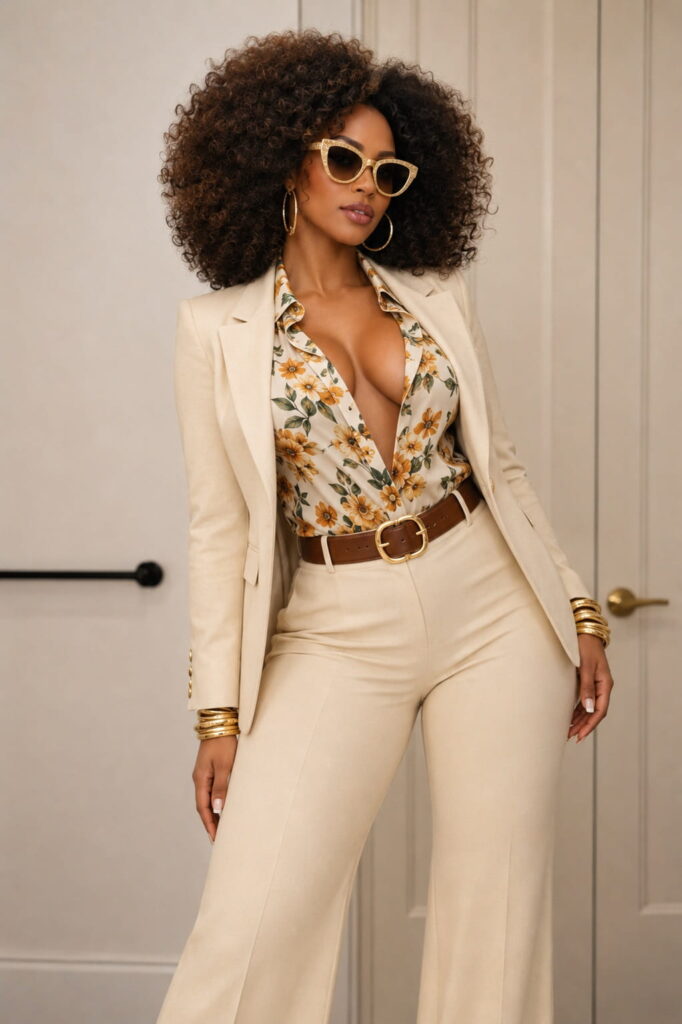
The cultural significance of natural hair in the 1970s cannot be separated from the civil rights movement and Black Power aesthetic. For Black women specifically, choosing the Afro was an act of radical self-affirmation during a period when Eurocentric beauty standards dominated media and fashion.
Gold Accessories
Layered gold chains, hoop earrings, charm bracelets, and medallion pendants defined 1970s jewellery. The aesthetic ranged from delicate to extravagant, from Elsa Peretti’s organic sculptural pieces for Tiffany to the enormous statement earrings worn on the Studio 54 dance floor.
The contemporary approach: stack fine gold chains at different lengths, wear one large statement earring, or layer beaded and chain bracelets together. Gold, not silver, is the metal of the 1970s, and its warm tone complements the decade’s earth-toned palette perfectly.
Black Women’s Fashion in the 1970s
The 1970s was a transformative decade for Black women’s fashion, not as a subcategory of mainstream style, but as a powerful, distinct, and deeply influential force in its own right.
The Black Power and civil rights movements of the late 1960s carried directly into 70s fashion aesthetics. Natural hair, the Afro in particular, became a political statement and a beauty ideal simultaneously. For Black women, the decision to wear natural hair was inseparable from a broader assertion of cultural identity and self-determination at a moment when dominant beauty standards reflected exclusively Eurocentric ideals.
Pam Grier brought a new archetype to popular culture, the powerful, confident, physically formidable Black woman, whose style was simultaneously glamorous and functional. High-waisted jeans, fitted tops, suede coats, and gold jewellery defined her on-screen aesthetic, and her influence on Black women’s dressing throughout the decade was profound.
Cicely Tyson embodied a different dimension of Black 70s style: regal, considered, and deeply connected to African heritage. Her use of Afrocentric textiles, head wraps, and sculptural accessories brought African design traditions into mainstream American fashion conversation at a moment of significant cultural importance.
Diana Ross — already covered in the celebrity section, represented maximum glamour: enormous Afros, dramatic sequined gowns, and a stage presence that translated directly into influence on Black women’s evening and special-occasion dressing.
Dashikis and Afrocentric fashion were central to Black cultural expression throughout the decade. The dashiki, a loose, brightly coloured West African garment, became widely worn in the late 1960s and early 1970s as an explicit marker of African heritage and cultural pride. Ankara prints, kente cloth, and other African textiles appeared in everyday dressing as Black women asserted a fashion identity rooted in their own heritage rather than European fashion traditions.
Angela Davis and other political figures demonstrated that fashion and politics were inseparable. The Afro, the turtleneck, the leather jacket, and the beret created a visual language of resistance and solidarity that remains one of the most powerful style statements of the entire decade.
The influence of Black women’s 70s fashion on contemporary style is immeasurable, from the natural hair movement to the resurgence of Afrocentric textiles in contemporary fashion, the 1970s represents a watershed moment for Black women’s self-expression in dress.
Iconic 1970s Fashion Designers Who Shaped Women’s Style
The 1970s produced a remarkable concentration of design talent, each designer with a distinct aesthetic that contributed to the decade’s pluralistic fashion landscape. Understanding these names gives your 70s dressing greater authority and specificity.
Diane von Furstenberg launched the wrap dress in 1974 and changed women’s dressing permanently. Her philosophy, that a woman should feel as good as she looks, was embedded in the garment’s design: adjustable, flattering, easy, and inherently confident. She remains in active production because nothing has ever replaced it.
Halston (Roy Halston Frowick) defined American luxury minimalism. His work in bias-cut jersey, silk, and cashmere created garments of extraordinary simplicity and extraordinary expense. His Studio 54 social circle, Bianca Jagger, Liza Minnelli, Andy Warhol, wore his clothes as a social uniform. The Halston aesthetic: nothing excess, everything perfect.
Yves Saint Laurent brought literary and artistic intelligence to 70s fashion. His 1976 Russian collection, his Mondrian-inspired pieces, his Le Smoking tuxedo suit for women, all represented fashion as intellectual and cultural argument. His influence on women’s suiting and tailored androgyny runs directly through contemporary menswear-inspired women’s dressing.
Ossie Clark was the poet of 70s British fashion. His collaboration with textile designer Celia Birtwell produced some of the most beautiful printed garments of the century — fluid crêpe and chiffon dresses in Birtwell’s distinctive botanical prints. A vintage Ossie Clark piece remains one of the most desirable finds in any vintage market.
Thea Porter brought Eastern exoticism into luxury dressing. Her use of silk brocades, embroidery, and richly layered textiles from the Middle East and Central Asia created an opulent bohemian aesthetic that influenced high-end 70s evening wear and continues to inspire contemporary designers.
Bill Blass represented American elegance, tailored, wearable, and quietly confident. His pantsuits, blazers, and evening wear dressed the professional American woman of the 1970s with a practicality and polish that was distinctly different from European couture.
Betsey Johnson occupied the playful, irreverent end of the decade’s design spectrum. Her youthful, printed, body-conscious pieces brought rock-and-roll energy to women’s fashion and created a template for independent, personality-driven design that influenced decades of American fashion.

How 70s Women’s Fashion Evolved: From Boho to Disco
Era Timeline at a Glance
| Period | Style Era | Defining Aesthetic | Key Pieces |
|---|---|---|---|
| 1970–1973 | Boho / Hippie | Earthy, romantic, anti-establishment | Maxi dresses, peasant blouses, fringe jackets, patchwork denim |
| 1974–1976 | Tailored Chic | Polished, professional, democratised glamour | Wrap dresses, pantsuits, safari suits, structured separates |
| 1977–1979 | Disco Glamour | Theatrical, sensual, celebratory | Sequins, halter tops, satin jumpsuits, platform heels |
Early 1970s (1970–1973): The Boho Era
The early 70s was defined by the hangover of the late 1960s counterculture and the continuation of hippie aesthetics into mainstream fashion. Midi and maxi hemlines dominated as a deliberate rejection of the 60s mini. Peasant blouses, fringe suede jackets, patchwork denim, and floral prairie dresses created a look that was romantic, earthy, and deliberately anti-establishment.
Key fabrics: cotton lawn, suede, denim, velvet, and crêpe. The palette was warm and earthy, burnt orange, ochre, avocado green, rust, and brown.
The influence of global travel and counterculture is visible throughout: Indian block prints, Moroccan embroidery, and Afghan coats all appeared in early 70s wardrobes.
Mid-1970s (1974–1976): Power and Polish
By 1974, fashion had shifted. Diane von Furstenberg launched her wrap dress. Roy Halston Frowick, known simply as Halston, was dressing New York’s elite in spare, sculptural jersey and silk. Yves Saint Laurent introduced his celebrated “Russian collection” in 1976, bringing rich embroidery, boots, and layered skirts to the haute couture stage.
Women’s professional dressing became more considered. The pantsuit evolved from a statement into a wardrobe staple. Earth tones remained dominant but were joined by richer hues: burgundy, teal, and warm camel.
This was also the era of the iconic wrap dress, a garment that democratised flattering dressing across body types and became shorthand for 1970s elegance.
Late 1970s (1977–1979): Disco and Drama
Saturday Night Fever arrived in 1977 and disco culture exploded into mainstream consciousness. Studio 54’s aesthetic, sequins, satin, plunging necklines, and liquid jersey, became the dominant visual of the era’s final years.
Simultaneously, punk emerged from London as a direct counter-narrative. Safety pins, torn fabric, leather, and radical silhouettes created an aggressive opposition to disco glamour that was nonetheless deeply influential on contemporary fashion.
The late 70s ended with the first hints of the 1980s power aesthetic: stronger shoulders, bolder colours, and a more aggressive use of proportion.
Best 70s Outfit Ideas for Women Today
1. The Earth Tone Suit
Look: High-waisted wide-leg trousers in caramel or tan, worn with a matching blazer and a simple ribbed knit vest.
Where to wear it: Office, client meetings, gallery openings, lunches.
Who it suits: All body types. Particularly elongating for petite frames when worn in a single tone.
Styling tips: Wear a narrow leather belt over the blazer to define the waist. Choose platform loafers or block-heeled mules.
Seasonal advice: Ideal for autumn and winter in wool; switch to linen for spring and summer.
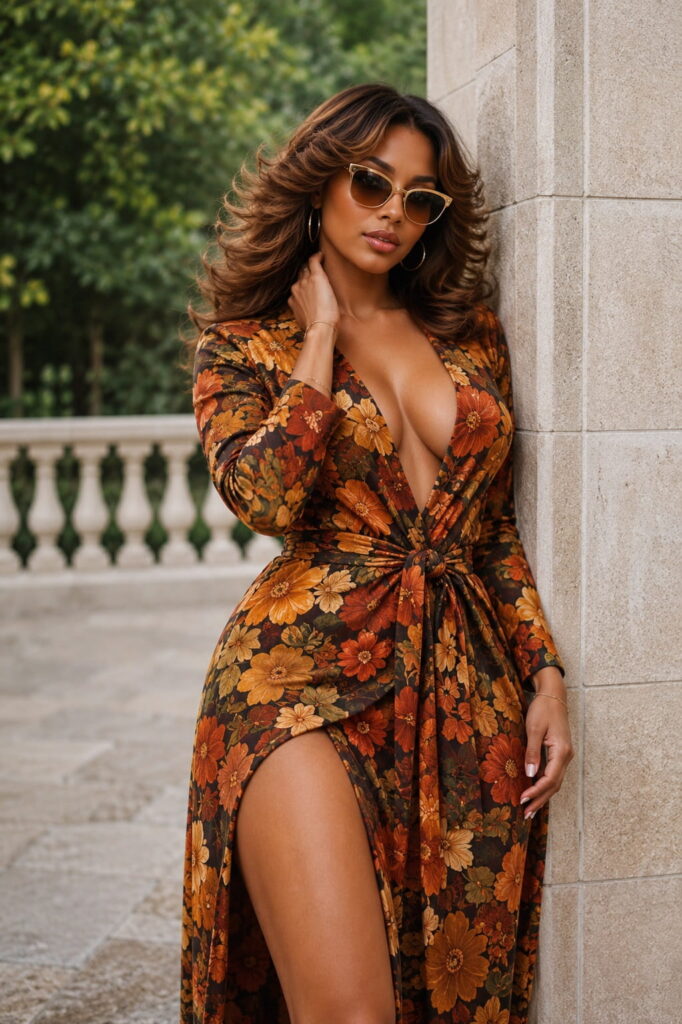
2. The Wrap Dress
Look: A true wrap dress. not a faux wrap, in a warm-toned floral or geometric print.
Where to wear it: Dates, brunches, garden parties, work (styled professionally), travel.
Who it suits: Universally flattering. The adjustable wrap creates a custom fit that works beautifully on curvy, petite, and tall figures.
Styling tips: Wear with platform wedges or heeled sandals. Add a wide leather belt if the dress’s own wrap tie feels too casual.
Seasonal advice: In silk or crêpe for summer; in jersey or lightweight wool blend for autumn and winter.
3. High-Waisted Flares and a Fitted Turtleneck
Look: Dark denim flares or wide-leg cords, tucked-in ribbed turtleneck in cream, rust, or camel.
Where to wear it: Casual weekends, creative workplaces, dinner with friends.
Who it suits: Particularly flattering for athletic and tall figures. The turtleneck and flare creates a long, lean, defined silhouette.
Styling tips: Tuck the turtleneck completely and smooth it down to keep the waistband visible. Boots, ankle or knee-high, work best here.
Seasonal advice: A core autumn/winter look. Switch to a lightweight knit top for early spring.
4. The Maxi Skirt and Peasant Blouse
Look: A flowing maxi skirt in an earthy print, worn with a loose-collared peasant blouse or broderie anglaise top.
Where to wear it: Festivals, weekend markets, coastal holidays, bohemian social events.
Who it suits: Particularly good for curvy and plus-size figures, the volume of the maxi skirt is comfortable and dramatic.
Styling tips: Always add a wide belt or define the waist with a knot at the front of the blouse. Flat sandals or low wedges work here; high heels would undercut the casual spirit.
Seasonal advice: Peak spring/summer styling. Layer with a suede jacket or knit cardigan for cooler days.
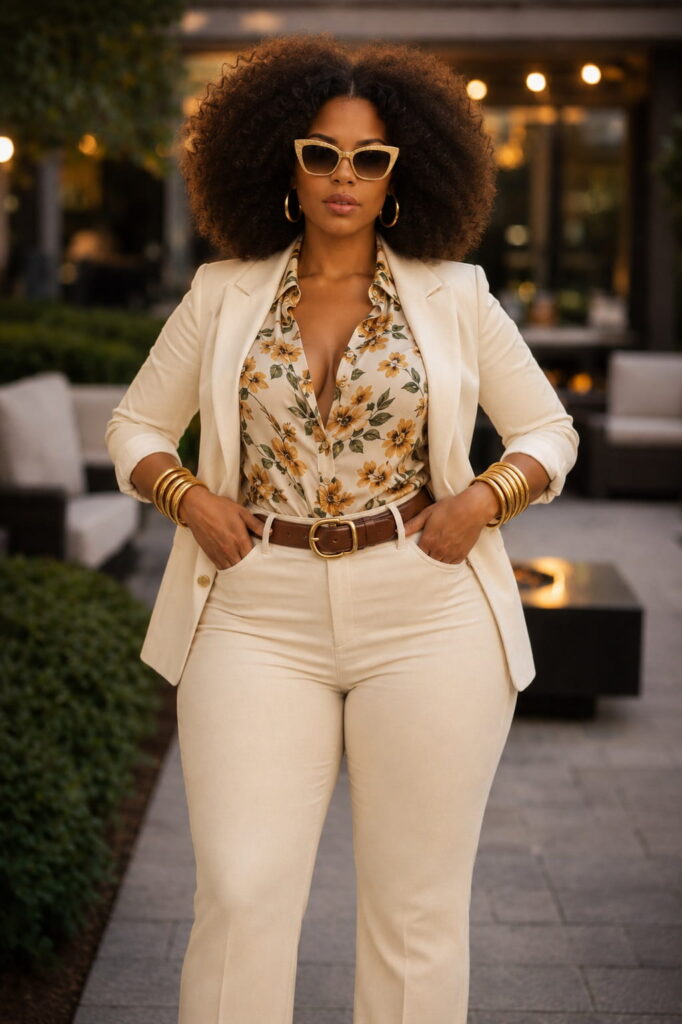
5. The Cream Power Suit
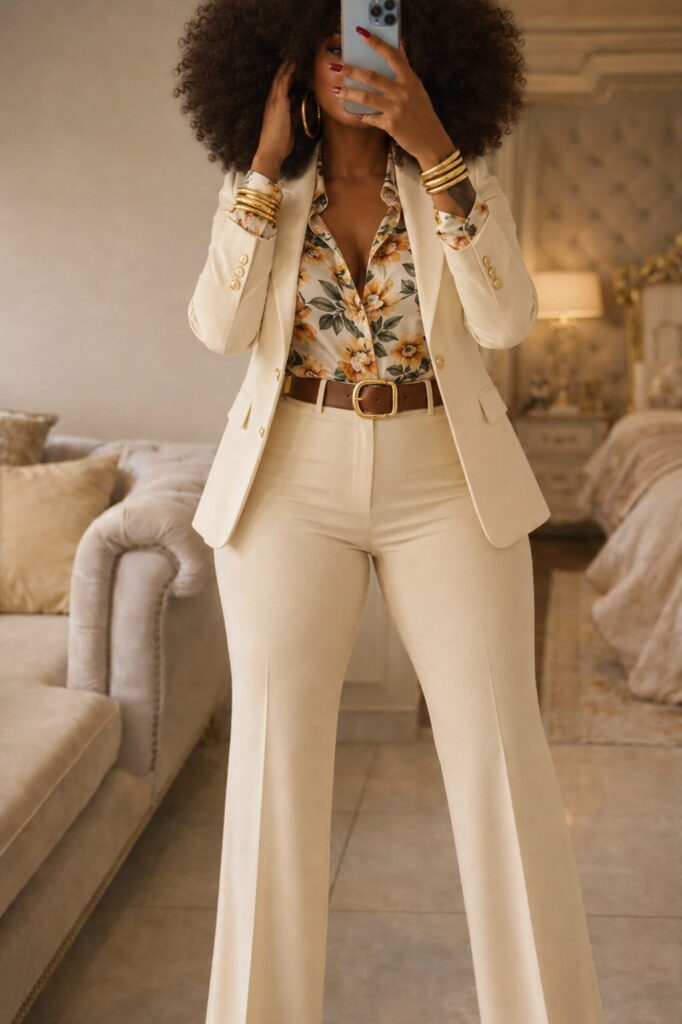
Look: A cream or ivory wide-lapel blazer with matching wide-leg trousers, worn with a silk camisole underneath.
Where to wear it: Professional environments, conferences, evening events, formal dinners.
Who it suits: All body types. Elongates petite frames when worn as a single-colour look.
Styling tips: The camisole underneath should be in cream, gold, or a warm nude, never white. Add gold jewellery and platform heels. Keep the blazer open.
Seasonal advice: Year-round in different fabrics. Linen for summer; wool or ponte for autumn and winter.
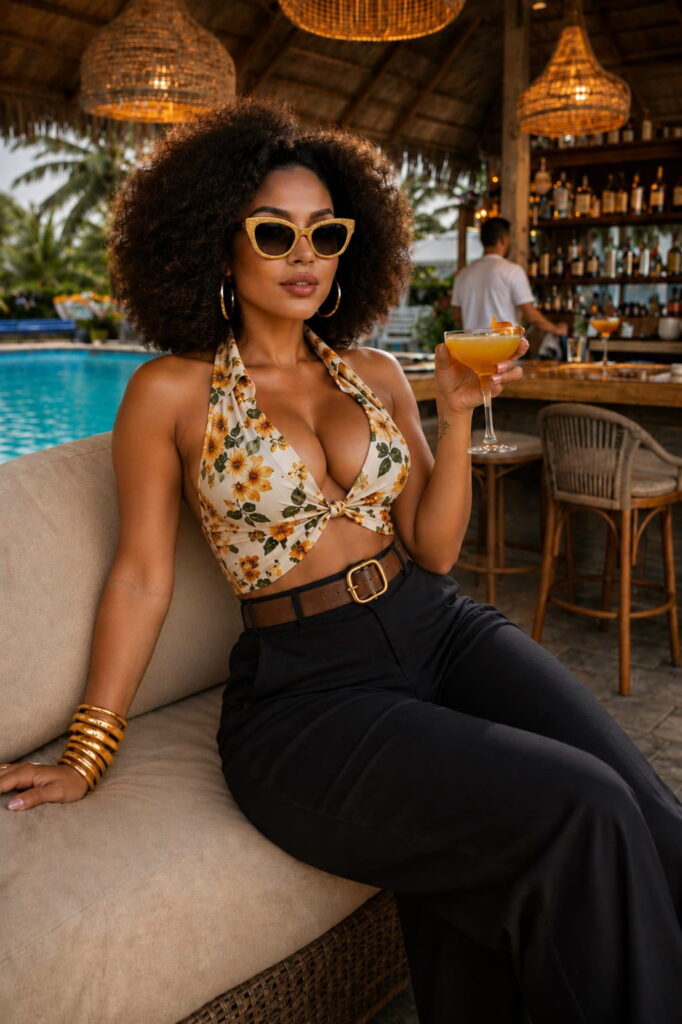
6. The Halter Top and Palazzo Pants
Look: A tied halter top in a bold print or solid jewel tone, worn with palazzo trousers in a complementary colour.
Where to wear it: Evening events, holidays, summer parties, resort settings.
Who it suits: Excellent for tall figures. Works beautifully for athletic builds by creating curves at the hip. Curvy women should choose palazzo trousers with a clean, flat front.
Styling tips: Keep accessories minimal, the halter and palazzo combination is inherently dramatic. One pair of large gold hoop earrings and a platform sandal is sufficient.
Seasonal advice: Summer only, or evening styling in warmer climates.
7. The Suede Midi Skirt and Turtleneck
Look: A tan or chocolate suede midi skirt (A-line or pencil cut), worn with a cream or ivory turtleneck and knee-high boots.
Where to wear it: City dressing, weekend brunches, cultural events, early evening.
Who it suits: Excellent for petite and slim figures. Curvy women should choose the A-line cut for balance.
Styling tips: Tuck the turtleneck neatly, allowing the skirt waistband to show. Add a structured crossbody bag in camel or tan. A long pendant necklace layered over the turtleneck adds an authentic 70s detail.
Seasonal advice: Autumn and winter exclusively.
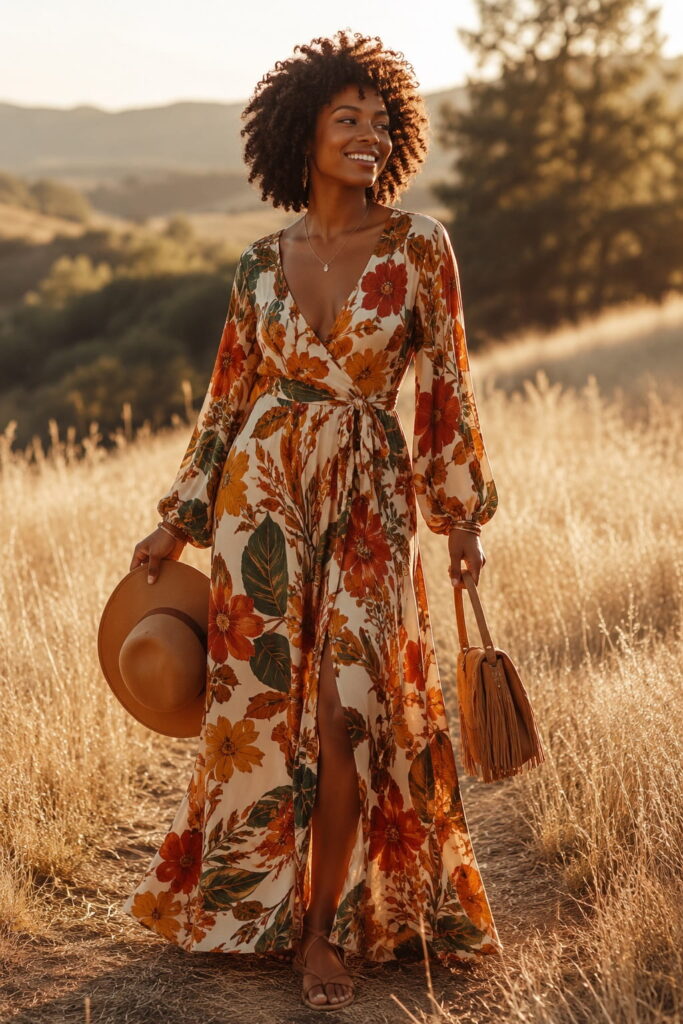
8. The Bohemian Maxi Dress
Look: A flowing maxi dress in a warm floral or geometric print, prairie collar, long sleeves, or sleeveless depending on the season.
Where to wear it: Outdoor events, festivals, summer holidays, picnics, creative social settings.
Who it suits: All body types. The maxi length creates a dramatic, elongating effect regardless of height.
Styling tips: Belt at the waist with a wide leather belt to prevent the look from becoming shapeless. Flat sandals or wedge espadrilles. Layer with a denim jacket or suede waistcoat for cooler days.
Seasonal advice: Spring through early autumn.
9. The Disco Sequin Look
Look: A sequined top or midi slip dress in gold, silver, or bronze, worn with wide-leg trousers or a pencil skirt.
Where to wear it: Evening events, parties, concerts, celebrations.
Who it suits: All figures, choose your silhouette based on proportion preference. The sequined top with wide-leg trouser is universally flattering.
Styling tips: Keep daytime accessories off. This look needs minimal but impactful jewellery, one statement earring, nothing else. Platform shoes only.
Seasonal advice: Evening wear, year-round.

10. The Safari Suit
Look: A belted safari jacket in khaki or tan, worn over high-waisted wide-leg trousers or a midi skirt in the same tone.
Where to wear it: Casual professional settings, weekend styling, travel, outdoor events.
Who it suits: Excellent for tall and athletic figures. The structured silhouette and belted waist work well for all body types.
Styling tips: The waist belt is non-negotiable, the safari jacket without definition reads as a shapeless anorak. Add a silk scarf tied at the neck and leather loafers.
Seasonal advice: Spring through early autumn.
11. Patchwork Denim
Look: Patchwork denim jeans or a patchwork jacket, worn with a simple white tee or a fitted ribbed knit.
Where to wear it: Casual settings, creative environments, weekend outings.
Who it suits: Works on all body types, choose the right cut for your figure (straight leg, wide leg, or bootcut).
Styling tips: Keep the rest of the outfit simple. Patchwork denim is inherently statement-making. White tee, ankle boots, and one piece of gold jewellery.
Seasonal advice: Year-round.
12. The Boho Knit Set
Look: A matching crochet or open-knit set, crop top and midi skirt, or vest and wide-leg trouser, in cream, tan, or a warm neutral.
Where to wear it: Summer events, beach destinations, festivals, outdoor parties.
Who it suits: Best for slim and tall figures. Petite women should choose a shorter skirt length to avoid appearing overwhelmed by fabric.
Styling tips: Wear over a simple bodysuit or bikini top for beach settings. Add platform sandals and layered gold necklaces.
Seasonal advice: Summer only.
13. The Velvet Blazer and Flares
Look: A rich velvet blazer in burgundy, forest green, or midnight blue, worn over a silk blouse with matching wide-leg trousers or dark denim flares.
Where to wear it: Evening events, dinner parties, date nights, autumn/winter occasions.
Who it suits: All body types. The velvet blazer adds visual warmth and texture that works beautifully on every frame.
Styling tips: The velvet blazer is the hero piece, keep the rest of the outfit simple. A silky blouse underneath, statement earrings, and platform heels.
Seasonal advice: Autumn and winter.
14. The Wrap Blouse and Midi Skirt
Look: A tie-neck or wrap blouse in a warm print, worn with a solid-colour midi skirt in a toning colour.
Where to wear it: Office, lunches, gallery visits, cultural events, professional-casual settings.
Who it suits: Universally flattering. The wrap blouse creates shape at the waist while the midi skirt balances the proportion below.
Styling tips: Tuck the blouse fully into the skirt. Add a narrow leather belt if the skirt has a defined waistband. Block-heeled court shoes or heeled mules.
Seasonal advice: Year-round in different fabrics.
15. The Luxe Boho Evening Look
Look: A silk or satin wide-leg jumpsuit in gold, caramel, or a rich jewel tone, cinched with a thin gold belt.
Where to wear it: Formal evening events, black-tie alternatives, celebratory occasions.
Who it suits: Tall and slim figures are most flattered by the jumpsuit silhouette. Curvy women can choose a wide-leg jumpsuit with a defined waist, the key is the correct size at the widest point.
Styling tips: Platform heels are essential, they provide the proportion the jumpsuit demands. Minimal jewellery: one statement earring or a cuff bracelet.
Seasonal advice: Evening wear, year-round.
70s Outfit Ideas for Women by Occasion
Casual Everyday 70s Outfit
High-waisted wide-leg jeans or cords, a fitted ribbed knit or floral blouse tucked in, a wide leather belt, and platform sandals or flat mules. This is the simplest, most repeatable 70s daily look, earthy, effortless, and completely wearable in any casual context from errands to coffee with friends. Add oversized tinted sunglasses and one gold necklace to finish.

70s Office Outfit
A tailored wide-leg trouser in camel, cream, or chocolate brown, worn with a tie-neck or wrap blouse and a structured blazer. Block-heeled court shoes or platform loafers, minimal gold jewellery, and a sleek leather bag. This look communicates polish and authority while remaining unmistakably 70s in its proportions and palette. The pantsuit version, matching blazer and wide-leg trouser in a single tone, is equally appropriate and even more powerful.

70s Date Night Outfit
A wrap dress in a rich jewel-toned or warm floral print, worn with platform heeled sandals and layered gold necklaces. Alternatively: a silk halter top in cognac or gold, paired with wide-leg silk trousers and one statement earring. Both looks balance glamour with ease, exactly the 70s combination that never fails for an evening setting.
70s Party Outfit
A sequined top (gold, bronze, or copper) with wide-leg trousers in black or ivory. Or a backless halter mini dress in satin. Platform shoes, dramatic hoop earrings, and glossy amber-tinted lips. This is Studio 54 energy, commit fully and keep the accessories to one impactful statement piece rather than layering everything.
70s Wedding Guest Outfit
A flowing maxi dress in a warm floral or geometric print, chiffon or silk for warmer months, a jersey wrap dress for cooler ones. Platform wedge sandals, a suede or satin clutch, and soft gold jewellery. Alternatively, a cream or ivory wide-leg suit with a silk camisole underneath reads as an elegant, modern-vintage wedding guest look that photographs beautifully.
70s Photoshoot Outfit
For editorial and fashion photography, the 70s offers extraordinary visual drama. Wide-leg palazzo trousers in movement, a knit vest with nothing underneath for a strong silhouette, a belted maxi dress in a bold print, or the luxe jumpsuit are all strong photoshoot choices. The 70s silhouette, long lines, dramatic volume, strong accessories, translates exceptionally well to both studio and location photography.
70s Festival Outfit
A crochet or macramé top over a printed maxi skirt, or denim flares with an embroidered peasant blouse and a suede fringe vest. Flat leather sandals, a wide-brimmed hat, layered beaded necklaces, and an armful of bangles. This is the boho festival look at its most authentic, simultaneously archival and completely contemporary.
Celebrity 1970s Fashion: The Women Who Defined the Decade
The 1970s produced a generation of women whose style remains a direct reference point for designers, editors, and stylists working today. Understanding these figures gives your own 70s-inspired dressing greater depth and intention.
Bianca Jagger defined Studio 54 glamour. Her white equestrian suit at her 1971 wedding to Mick Jagger, a tailored, wide-lapel suit with a wide-brim hat and no blouse, remains one of the most referenced fashion moments of the decade. Her look: impeccable tailoring, maximum confidence, and the understanding that restraint is the highest form of glamour.
Diana Ross embodied the maximalist 70s at its most joyful, dramatic Afros, sequined gowns, bold prints, and extraordinary stage presence that blurred the line between fashion and performance. Her influence on Black style and self-expression throughout the decade is immeasurable.
Farrah Fawcett gave the world the feathered wave, the hairstyle so associated with the late 1970s that it still bears her name in popular culture. Her off-screen style was equally iconic: high-waisted jeans, fitted knits, and the effortless California cool that defined the decade’s casual dressing.
Cher treated fashion as art. Her collaborations with Bob Mackie produced some of the most extraordinary stage and red-carpet looks of the era, beaded, embroidered, embellished, and unapologetically theatrical. Her influence on maximalism and self-expressive dressing extends directly into contemporary fashion.
Jane Fonda demonstrated the range of 70s dressing at its most intellectually engaged. Her casual dressing, the shag haircut, wide-leg jeans, fitted turtlenecks, embodied the progressive, natural aesthetic of the early decade. Her later aerobics aesthetic influenced an entirely different fashion moment.
Debbie Harry occupied the intersection of punk and glamour, bleached hair, tight dresses, leather, and an approach to personal style that was simultaneously confrontational and deeply stylish. Her influence runs through every musician, model, and fashion icon who followed.
Lauren Hutton represented the natural, gap-toothed, unconventional beauty standard that the 70s embraced over the more polished looks of earlier decades. Her modelling work, and her personal style of blazers, wide-leg trousers, and minimal jewellery, defined a certain patrician 70s cool that remains enormously influential.
Ali MacGraw in Love Story (1970) and The Getaway (1972) established the early 70s casual aesthetic: peasant blouses, wide-leg trousers, knit hats, and a natural, unfussy beauty that felt revolutionary after the heavily styled 1960s.
Gloria Steinem brought feminist intent to fashion. Her aviator glasses, turtlenecks, and practical, confident dressing demonstrated that political conviction and personal style were not mutually exclusive, and that the 70s wardrobe could be a vehicle for self-determination.

How to Wear 1970s Fashion Without Looking Like a Costume
The most common fear with 70s fashion is wearing too much of it at once. Here is the expert approach.
The One Statement Rule: Choose one hero 70s piece, the wide-leg trouser, the wrap dress, the platform shoe, the oversized tinted sunglasses, and build the rest of the outfit around contemporary pieces. One vintage-reference item reads as fashion. Five reads as fancy dress.
Fabric is everything: Original 70s synthetics looked appropriate in the 1970s. Today, choose natural fabrics, linen, silk, cotton, wool, in 70s silhouettes. You get the shape without the dated quality.
Fit comes first: The 70s was a decade of precision tailoring at the waist combined with drama elsewhere. Wide-leg trousers must be the right length. Wrap dresses must be tied correctly. Blazers must sit on the shoulder seam. Fit elevates 70s pieces from fancy dress to fashion.
Edit the accessories: 70s accessories were numerous and layered. Contemporise the look by editing down, choose one strong accessory (the belt, the earrings, the sunglasses) and let it do the talking.
Mix eras deliberately: A 70s wide-leg trouser with a contemporary minimal tank top creates a more interesting outfit than a head-to-toe 70s ensemble. Deliberate era-mixing is what separates stylists from costume designers.
Modern vs. Authentic 1970s Women’s Fashion — Comparison Table
| Element | Authentic 1970s | Modern Interpretation |
|---|---|---|
| Fabric | Synthetic blends, polyester, cotton | Natural fabrics: linen, silk, wool, cotton |
| Trousers | Bell bottoms, dramatic flare | Wide-leg, moderate flare, palazzo |
| Shoes | Platform clogs, wedges up to 5 inches | Platform sandals, block heels, mules |
| Prints | Large-scale florals, geometric, psychedelic | Warm-toned florals, abstract prints, earthy geometric |
| Sunglasses | Oversized, deeply tinted, round or oval | Large tortoiseshell, cat-eye, lightly tinted |
| Jewellery | Heavy layering, chunky gold, beads | Curated layering, fine gold chains, one statement piece |
| Silhouette | High waist, volume above and below | High waist, balanced volume, clean proportions |
| Colours | Avocado, harvest gold, burnt orange, brown | Camel, cognac, warm white, rust, sage |
| Hair | Feathered, Afro, centre-parted | Effortless waves, natural texture, face-framing layers |
| Makeup | Heavy liner, warm browns, frosted lips | Warm brown liner, glowy skin, amber eyeshadow |
1970s Fashion Style Guide by Body Type
Petite Figures
For petite women, the 70s silhouette requires careful proportion management. The wide-leg trouser, worn in a single colour from waist to shoe with a platform heel, is genuinely elongating, but only when the length is correct (it should skim the floor). Avoid maxi-length anything that breaks at mid-calf; it shortens the leg visually.
Best 70s pieces: Wide-leg trousers in a single tone, cropped blazers, wrap dresses (they hit a natural midi on shorter frames), halter tops that elongate the torso, platform shoes.
Avoid: Ankle-length flares without heels, heavily layered looks that overwhelm the frame, voluminous palazzo trousers without a defined waist.

Curvy Figures
The 1970s is one of the most naturally curvy-friendly decades in fashion history. The wrap dress, the high-waisted wide-leg trouser, the belted maxi skirt, all of these silhouettes celebrate an hourglass figure beautifully. The key is always waist definition.
Best 70s pieces: Wrap dresses (universally flattering), high-waisted wide-leg trousers with a tucked blouse, A-line midi skirts, belted maxi dresses, tailored blazers that skim the hip.
Avoid: Unbelted oversized tunics (remove the waist entirely), low-rise bootcut jeans (a different era’s mistake), extremely voluminous sleeves without waist balance.
Tall Figures
Tall women wear 1970s fashion effortlessly. The long maxi hemlines that can look overwhelming on petite figures are genuinely beautiful on tall frames. The palazzo trouser, the full-length maxi dress, the dramatically flared bell bottom, all of these find their ideal wearer in a tall woman.
Best 70s pieces: Palazzo trousers, maxi dresses and skirts, full-length jumpsuits, dramatic bell bottoms, oversized blazers, layered boho looks.
Avoid: Nothing specific, tall women have the most latitude with 70s silhouettes. The only caution is proportional: don’t add volume at both top and bottom without defining the waist.
Plus-Size Figures
The 70s ethos of flowing, comfortable, expressive dressing translates particularly well to plus-size styling. The key is choosing the right 70s silhouette within the decade’s diverse offerings rather than defaulting to shapeless or oversized.
Best 70s pieces: Wrap dresses (the definitive plus-size flattering garment), high-waisted wide-leg trousers with a tucked blouse, A-line maxi skirts with a defined waistband, tailored wide-lapel blazers, statement belt to define the waist, platform shoes to add height.
Styling approach: The 70s principle of waist definition combined with volume above and below creates a balanced, flattering silhouette for every figure. Always start with waist-defining pieces.
Athletic Figures
The 70s celebrates the athletic figure through its love of structured tailoring, the pantsuit, the halter top, and the wide-leg trouser. The challenge is creating the visual impression of curves where the body is naturally straighter.
Best 70s pieces: Wrap dresses (creates the waist and hip curve the garment naturally suggests), ruffled blouses and tops (add visual volume at the chest), high-waisted wide-leg trousers (create hip width), tailored blazers, halter tops (emphasise the shoulder and create definition at the neck).
Key technique: Use prints and ruffles at the chest and hip to add visual dimension. Avoid excessively fitted pieces that emphasise a straight silhouette.
Best 1970s Fashion Colours for Women: The Complete Palette Guide
The 1970s colour palette is one of the most distinctive and cohesive in fashion history, warm, earthy, and rooted in the natural world. Understanding it is essential to dressing authentically in the decade’s spirit.
| Color | Why It Was Popular | Best Used For |
|---|---|---|
| Rust | Central to the earth-tone movement; warm, organic, universally flattering | Blouses, maxi skirts, knitwear, accessories |
| Camel | Associated with luxury tailoring and natural fabrics; endlessly versatile | Suits, coats, trousers, leather accessories |
| Burnt Orange | Counterculture influence; the most immediately recognisable 70s colour | Statement pieces, prints, accessories |
| Mustard Yellow | Pervasive in 70s home and fashion design; warm and bold | Knitwear, printed pieces, accessories |
| Chocolate Brown | Natural aesthetic; the decade’s neutral anchor | Suede, leather, base wardrobe pieces |
| Olive Green | Military and safari influence; deeply earthy | Utility pieces, outerwear, trousers |
| Cream / Ivory | Power dressing and luxury; the decade’s sophisticated neutral | Suits, silk blouses, evening wear |
| Burgundy | Late 70s sophistication; rich, deep, and dramatic | Velvet blazers, evening pieces, accessories |
| Forest Green | Nature-inspired; romantic and versatile | Maxi dresses, velvet, printed pieces |
| Avocado | The decade’s most polarising colour; deeply period-specific | Use sparingly in accessories or prints |
The practical colour guide for today: Start with camel, cream, and rust as your foundational 70s palette. they are the most wearable and contemporary of the decade’s tones. Build in chocolate brown and olive green for depth. Reserve burnt orange and mustard for accent pieces and accessories rather than full outfits if you’re new to the palette.

Best 1970s Hairstyles for Women to Pair With Your 70s Outfit

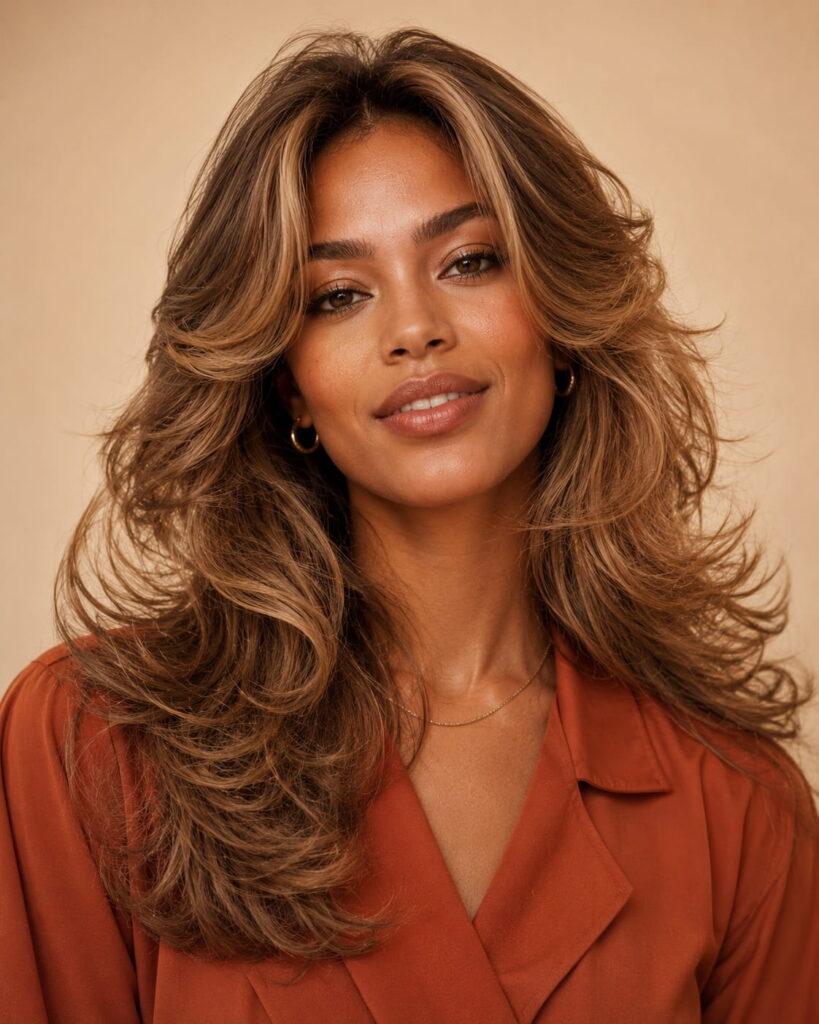
Feathered Layers (The Farrah): Long, face-framing layers blow-dried back from the face with volume at the crown. The defining hairstyle of the late 1970s, still highly flattering on most face shapes. Requires length past the shoulder and a diffuser or round brush.
The Centre Part: The early 70s favoured a precise centre part with long, straight hair, the opposite of the Farrah. Deeply simple and deeply cool, this works on all hair textures and lengths past the shoulder.
The Natural Afro: Worn close or widely shaped, the natural Afro was a defining beauty statement of the decade. For Black women choosing to wear this style, it is simultaneously historically resonant and beautifully contemporary.
The Shag Cut: Popularised by Jane Fonda, the shag is a heavily layered, textured cut with a fringe and movement throughout. Deeply 70s and perpetually fashionable, it works on straight and wavy hair alike.
The Gibson Tuck / Updo: For eveningwear, a loose, low updo with face-framing pieces, imprecise, romantic, and effortlessly glamorous. Pair with statement earrings.
Braids: Particularly relevant for Black women in the 70s, braided styles, from simple plaits to more elaborate cornrows, have deep cultural resonance from this era.
1970s Makeup and Beauty Trends for Women
The 1970s makeup palette is warm, earthy, and deeply flattering on every skin tone, which is precisely why it translates so well today.
The Skin: Natural, glowy skin was the 70s foundation. The decade moved away from the heavily powdered, matte finish of the 1960s toward a luminous, almost bareface aesthetic. Today’s skin tints, tinted moisturisers, and illuminating primers perfectly replicate this.
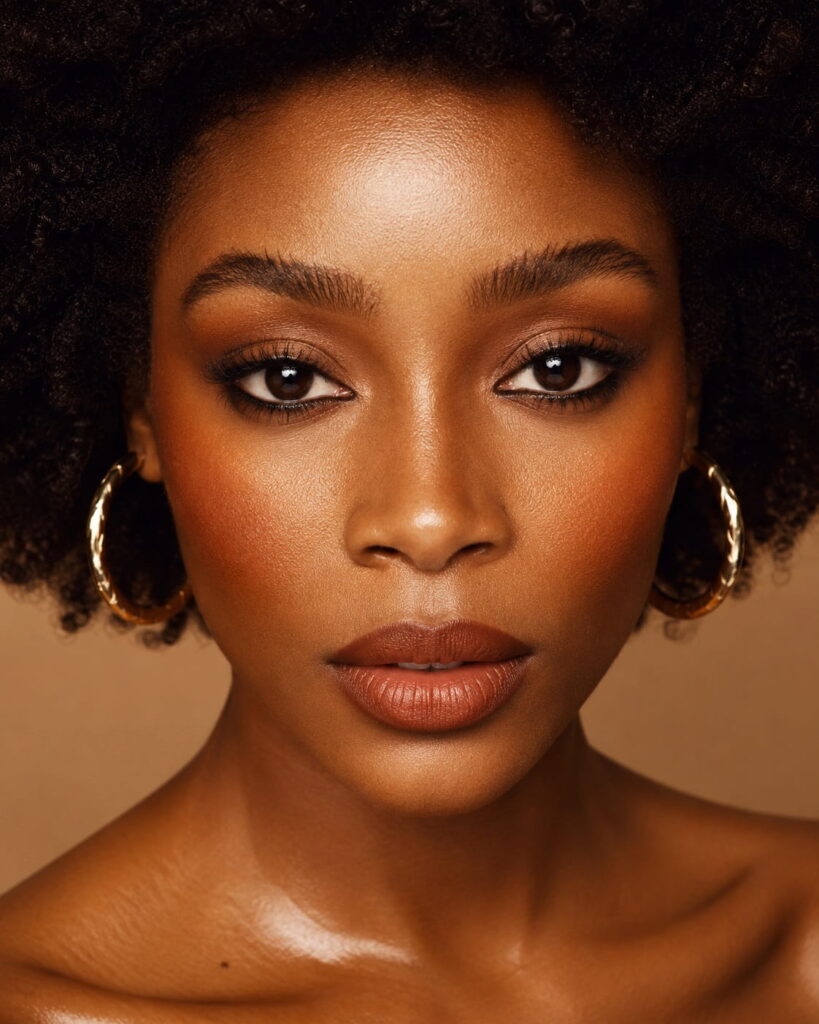
The Eyes: Warm brown and amber eyeshadow, applied in a wash from lid to brow. A soft brown liner (pencil, not liquid) smudged along the upper and lower lash lines. Mascara, lots of it, for that natural-lash-but-longer 70s effect. The 70s did not use harsh black liner, everything was softer and warmer.
The Brows: Full, natural, slightly brushed-up brows, the antithesis of the thin, arched brow of earlier decades. This is one of the most flattering aspects of 70s makeup, and modern brow products make it achievable for everyone.
The Lips: The 70s favoured a warm, natural lip. Terracotta, brown-nude, warm rose, and brick red were the decade’s signature lip colours. Frosted lip gloss appeared on the disco floor, pale pink or champagne gloss over a nude lip is both authentic and contemporary.
The Blush: Warm, peachy-bronze blush swept over the cheekbones, not heavily contoured, but warm and sun-kissed. Cream blush in apricot or warm peach replicates this most accurately.
The Best Accessories to Complete a 1970s Women’s Outfit
The Wide Leather Belt: The most important 70s accessory. In cognac, tan, or chocolate brown with quality brass hardware. Wear it over everything, blazers, knitwear, dresses, and coats.
Layered Gold Necklaces: Fine to medium gold chains at varying lengths, collarbone, mid-chest, and sternum. Mix different textures: flat link, rope chain, and a single pendant. The key is three or four pieces layered, not a single statement chain.
Large Gold Hoop Earrings: The quintessential 70s earring. Medium to large hoops in plain gold, polished or slightly hammered. Universally flattering and universally appropriate.
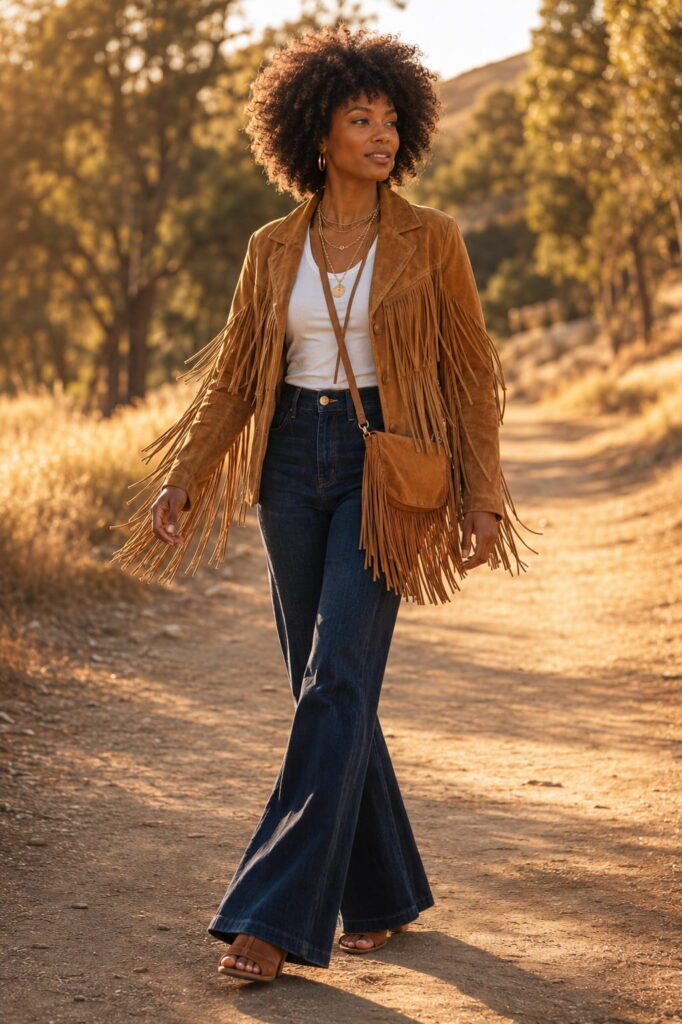
The Suede Fringe Bag: A shoulder bag or crossbody in tan suede with fringe detail. Not subtle, and not meant to be.
Silk Scarves: Tied at the neck, worn as a headband, used as a bag accent, or worn loose as a belt. The Hermès scarf in warm geometric prints is the luxury version; vintage silk scarves from markets offer the same visual impact for less.
Platform Shoes: Already discussed above, but worth emphasising that the right shoe is the silhouette-defining accessory in 70s dressing. No other choice has the same impact.
Oversized Sunglasses: In tortoiseshell or amber-tinted frames. The ultimate finishing touch for any 70s-inspired look.

How to Build a 1970s Fashion Wardrobe: Shopping Guide
You don’t need to overhaul your wardrobe to dress in the 70s spirit. You need the right five pieces, chosen carefully, in quality fabrics, and the rest follows.
Start With These 5 Pieces
1. High-Waisted Wide-Leg Trousers The single most transformative 70s purchase. Choose a neutral tone, camel, cream, chocolate brown, or olive, in a quality fabric (wool, linen, or a fluid crêpe). This piece will do more work than anything else in the wardrobe. Fit priority: the waist must sit at your natural waist, and the hem must graze the floor with your chosen shoe.
2. A Wrap Dress In a warm-toned floral or geometric print. True wrap, not faux, the adjustable tie creates a genuinely custom fit. This is your most versatile 70s piece: wear it to work, on dates, to weddings, on weekends. In silk or crêpe for warmth; in jersey for year-round ease.
3. Platform Shoes A platform sandal for warmer months; a platform loafer or block-heeled boot for cooler ones. The correct shoe is not decorative, it defines the silhouette of every wide-leg trouser and maxi dress you own.
4. A Wide Leather Belt In cognac, tan, or chocolate brown with quality brass hardware. This single accessory transforms blazers, wrap dresses, knitwear, and coats into clearly 70s-defined looks. Buy the best quality you can afford, leather quality is visible at a glance.
5. Oversized Sunglasses In tortoiseshell or amber frames. The finishing touch for any 70s look, and the fastest way to add the decade’s sensibility to an otherwise contemporary outfit.
Next-Level Pieces (Once Your Foundation Is Set)
| Piece | Why to Add It | Best Season |
|---|---|---|
| Silk or satin jumpsuit | Instant evening glamour | Year-round (eveningwear) |
| Halter top | Summer and resort essential | Spring/Summer |
| Maxi skirt in a warm print | Maximum boho impact | Spring/Summer |
| Suede jacket or gilet | Autumnal texture and warmth | Autumn/Winter |
| Velvet blazer in a rich tone | The most luxurious 70s piece | Autumn/Winter |
| Crochet top or knit set | Festival and holiday dressing | Summer |
| Wide-leg corduroy | Cold-weather texture | Autumn/Winter |
Where to Shop
For contemporary 70s-inspired pieces: Look to brands known for fluid, natural-fabric dressing — Reformation, & Other Stories, Sézane, and Reiss all produce excellent wide-leg trousers and wrap dresses in quality fabrics at accessible price points.
For authentic vintage: ASOS Marketplace, Depop, Vestiaire Collective, and Etsy’s vintage sellers are the most accessible online options. In-person: specialist vintage boutiques, charity shops in affluent areas, and estate sales.
Investment labels for contemporary 70s dressing: Bottega Veneta, Max Mara, Zimmermann, and Isabel Marant all produce current-season pieces with direct 70s references in quality fabrics.
Best Stores for 1970s-Inspired Fashion
Budget (under £50 / $60): ASOS, H&M, & Other Stories diffusion lines, Zara, and Mango regularly produce wide-leg trousers, wrap dresses, and platform sandals in 70s-appropriate silhouettes and colour palettes. Quality varies, prioritise natural fabric content labels and avoid very thin synthetic pieces.
Mid-Range (£50–£200 / $60–$250): Reformation, Sézane, Reiss, Whistles, and Free People offer genuine quality in 70s-inspired pieces. These are the brands most likely to produce wide-leg linen trousers, silk wrap blouses, and suede accessories in the correct fabrics and proportions. Worth the investment for core wardrobe pieces.
Luxury (£200+ / $250+): Zimmermann (wrap dresses, printed maxi skirts, linen suiting), Isabel Marant (suede, wide-leg denim, bohemian knitwear), Max Mara (the definitive camel coat, wide-leg tailoring), and Toteme (fluid wide-leg trousers, wrap silhouettes in quality fabrics) are the contemporary labels most consistently aligned with the 70s aesthetic at a luxury price point.
Authentic Vintage: For the most authentic 70s pieces, prioritise: Depop and Etsy (searchable, curated, global vintage sellers); ASOS Marketplace (broad UK-based vintage); Vestiaire Collective (authenticated luxury vintage, including original Halston and YSL pieces); and in-person vintage markets in major cities, London’s Portobello Road, New York’s Brooklyn Flea, Paris’s Marché aux Puces. The investment in authentic vintage rewards both authenticity and sustainability.
1970s Fashion Women: Complete Trend Checklist
Use this as your 70s wardrobe audit tool, or as a quick reference for building a look from scratch.
✓ Clothing
- Bell-bottom jeans
- High-waisted wide-leg trousers
- Wrap dress (true wrap, adjustable tie)
- Maxi dress in a warm floral or geometric print
- Silk or jersey jumpsuit
- Halter top (tied or structured)
- Peasant blouse with ruffled collar or puffed sleeves
- Tailored wide-lapel blazer
- Matching pantsuit (blazer and wide-leg trouser)
- Midi or maxi skirt in an earthy print
- Crochet or knit top
- Velvet blazer in a jewel tone
- Suede jacket or gilet
- Wide-leg corduroy trousers
- Denim flares or patchwork denim
✓ Shoes
- Platform heeled sandals
- Platform loafers or flatform shoes
- Cork or wooden wedges
- Knee-high leather or suede boots
- Block-heeled mules
✓ Accessories
- Oversized sunglasses (tortoiseshell or amber tint)
- Wide leather belt with brass hardware
- Layered gold necklaces (two to four chains)
- Large gold hoop earrings
- Silk scarf (worn at neck, as headband, or on bag)
- Suede fringe bag or structured shoulder bag in tan
- Stack of bangle bracelets or a gold cuff
✓ Hairstyles
- Feathered, face-framing layers (the Farrah)
- Natural Afro (for those it suits culturally and texturally)
- The shag haircut (heavily layered with fringe)
- Centre parting with long straight hair
- Loose low updo with face-framing pieces
✓ Makeup
- Warm brown or amber eyeshadow
- Smudged brown pencil liner (upper and lower lash lines)
- Full, natural, brushed-up brows
- Warm peachy-bronze blush
- Terracotta, brown-nude, or warm rose lip colour
- Glowy, luminous skin — cream or skin tint base
How to Wear 1970s Fashion Women’s Outfits Every Season
Spring
Spring is the season for the 70s boho wardrobe. Floral maxi dresses, wide-leg linen trousers, wrap blouses, and embroidered peasant tops work beautifully in the warming light of spring. Pair with flat sandals or wedge espadrilles. A lightweight knit cardigan or a denim jacket layers over any spring look for cooler mornings.
Key spring pieces: Floral wrap dress, wide-leg linen trousers, embroidered blouse, suede sandals, oversized sunglasses.
Summer
Summer in the 70s wardrobe is resort-ready: halter tops and palazzo trousers, crochet sets, printed maxi dresses, and silk jumpsuits for evenings. Platform sandals, layered gold jewellery, and a wide-brimmed hat complete the look. The 70s summer palette, warm whites, coral, burnt orange, and sea glass green, is one of the most beautiful in fashion history.
Key summer pieces: Halter top, palazzo trousers, crochet top, maxi dress, platform sandals, wide-brimmed hat, silk scarf.
Autumn
Autumn is the season where the 70s wardrobe truly thrives. The earth tones of the decade, rust, ochre, chocolate brown, forest green, and caramel, align perfectly with the season’s natural palette. Wide-leg corduroy trousers, velvet blazers, suede skirts, and knit turtlenecks create a richly layered 70s autumn wardrobe.
Key autumn pieces: Wide-leg corduroy, velvet blazer, suede midi skirt, ribbed turtleneck, knee-high boots, wide leather belt.

Winter
The 70s winter look centres on the power suit and the luxe knitwear. A cream wool pantsuit, a richly textured mohair sweater over wide-leg trousers, or a dramatic velvet maxi skirt with a silk blouse are all deeply 70s and deeply appropriate for winter. Add a shearling coat or a suede-effect wrap coat for outerwear.
Key winter pieces: Wool pantsuit, wide-leg cords, velvet midi skirt, silk blouse, shearling coat, platform boots.
70s Fashion Inspiration: Ideas for Bloggers, Influencers and Stylists
For Fashion Bloggers
The 70s offers an inexhaustible content well: styling challenges (“10 ways to wear wide-leg trousers”), era-specific outfit recreations, vintage market hauls and how to style vintage finds, decade comparisons, and sustainable styling content (vintage as eco-conscious dressing).
For Influencers and Content Creators
70s fashion translates exceptionally well to video content, the movement of palazzo trousers, the drama of platform shoes, and the richness of suede and velvet photograph and film beautifully. Reel concepts: “Get ready with me: 70s inspired,” “Styling wide-leg trousers 5 ways,” or “70s vs now: how trends have changed.”
For Models
The 70s silhouette, high-waisted trousers, elongating flares, wrap dresses, creates strong, dynamic shapes for editorial photography. The era’s use of dramatic accessories makes for impactful styling that reads clearly on camera.
For Stylists
Key references: Halston for luxury minimalism; Ossie Clark for fluid printed elegance; Yves Saint Laurent for tailored androgyny; Diane von Furstenberg for accessible glamour. Understanding these distinct aesthetic streams within the decade allows for precise, educated styling.
For Vintage Enthusiasts
Priority shopping list for authentic 70s pieces: wide-leg corduroy trousers (look for original 70s label construction), silk or crêpe blouses in warm prints, suede accessories, original platform shoes (if in good condition), and silk scarves. Avoid synthetic polyester pieces unless in exceptional condition.
Why 1970s Women’s Fashion Is Worth Embracing Today
Timelessness: 70s pieces don’t look like trend purchases because they’ve been cycling back every decade since the 1970s ended. A quality wide-leg trouser purchased today will be relevant in ten years.
Versatility: The 70s wardrobe crosses contexts effortlessly, the same wrap dress works for work, weekends, and evenings.
Sustainability: Investing in classic 70s-inspired pieces, or authentic vintage, reduces fast fashion consumption. The decade’s emphasis on quality natural fabrics means well-made pieces last decades.
Flattery across body types: The high waist, wrap silhouettes, and flowing proportions of 70s fashion are genuinely flattering for most body types. This is not a style that works for one figure only.
Cultural richness: Wearing and understanding 70s fashion connects you to a decade of significant cultural change — women’s liberation, civil rights, disco culture, global style influences, and an extraordinary flowering of design talent.
Confidence: There is an inherent authority in 70s dressing, the pantsuit, the wide-leg trouser, the dramatic platform shoe, that translates directly to how the wearer moves and presents herself.
Common 1970s Fashion Mistakes Women Should Avoid
Going head-to-toe 70s in one look: The costume mistake. Choose one strong 70s piece and build around contemporary items.
Wrong shoe for wide-leg trousers: Flat shoes visually shorten the leg against a wide-leg silhouette. You need at least a small heel, or a platform, to create the correct proportion.
Incorrect trouser length: Wide-leg trousers should graze the floor with the correct shoe. Too short and the whole silhouette collapses.
Overstyling the accessories: The 70s did layer accessories, but not all of them at once. Choose your statement piece and edit everything else.
Choosing the wrong fabric: Cheap polyester in a 70s cut reads as costume. Natural fabrics in the correct silhouette read as fashion.
Ignoring waist definition: The 70s is not an unstructured decade. The waist is always present, in the wrap, the high waist, or the belt. Remove the waist definition and the look falls apart.
Confusing 70s with 80s: The 70s silhouette is high-waisted, fluid, and earth-toned. The 80s is power-shouldered, body-conscious, and neon. They are not interchangeable.
Expert Tips for Styling 1970s Women’s Fashion Today
Keep one 70s piece in every outfit category, casual, professional, and evening. This ensures your wardrobe has constant 70s relevance without requiring a complete wardrobe overhaul.
Invest in quality leather accessories first. A wide leather belt and a pair of platform sandals will transform more outfits than any clothing purchase.
Approach prints selectively. The 70s used print in specific, warm-toned, large-scale ways. Modern florals in blush pink or grey are not the same as the burnt orange, ochre, and rust prints of the actual decade.
When shopping vintage, prioritise pieces in natural fabrics and check for fabric content labels (usually sewn inside the waistband or collar). Silk, cotton, and wool pieces from the 70s remain beautiful and wearable. Synthetic pieces are often discoloured or misshapen.
Think in proportions, not individual pieces. The 70s works on a principle of balance, volume on top balanced by volume below, with a defined waist in between. Every outfit decision should consider this proportional equation.
Frequently Asked Questions About 1970s Fashion for Women
Q1: What defines 1970s fashion for women?
The 1970s is defined by high-waisted silhouettes, wide-leg trousers and bell bottoms, wrap dresses, bohemian maxi lengths, earth-toned palettes (rust, ochre, camel, brown), suede and natural fabrics, platform shoes, and a diverse range of aesthetics from boho to disco glamour.
Q2: What are the most wearable 70s pieces today?
The most versatile and contemporary 70s pieces are: high-waisted wide-leg trousers, the wrap dress, oversized tortoiseshell sunglasses, a wide leather belt, platform sandals, and layered gold jewellery.
Q3: How do I wear 70s fashion without looking like a costume?
Choose one strong 70s reference piece and combine it with contemporary items. Avoid wearing more than two 70s-specific pieces in one outfit. Prioritise fit and natural fabrics.
Q4: What shoes should I wear with wide-leg trousers?
Platform heels, block-heeled mules, platform sandals, or heeled loafers. The trouser should graze the floor with the shoe on, this is the correct proportion for the silhouette.
Q5: What colours define 1970s fashion?
Earth tones dominate: burnt orange, ochre, rust, chocolate brown, camel, forest green, avocado, and warm white. For disco-era styling: gold, silver, and jewel tones in burgundy, teal, and emerald.
Q6: What fabrics were used in 1970s women’s fashion?
Natural fabrics, cotton, wool, suede, silk, and linen — were used alongside synthetic polyester and nylon blends. For contemporary dressing, choose natural fabrics in 70s silhouettes.
Q7: What is the most iconic 1970s garment for women?
The wrap dress, popularised by Diane von Furstenberg in 1974, is widely considered the most iconic and enduring garment of the decade.
Q8: How do I style a 70s outfit for the office?
A wide-leg trouser in a neutral tone (camel, cream, or grey) with a tailored blazer and a silk blouse is the ideal professional 70s look. Add a wide leather belt, platform loafers, and minimal gold jewellery.
Q9: What hairstyles complement 70s outfits?
Feathered waves (the Farrah Fawcett), a centre parting with long straight hair, the natural Afro, the shag cut, or a loose low updo for eveningwear.
Q10: What makeup looks work with 70s outfits?
Warm brown and amber eyeshadow, smudged brown liner, full natural brows, warm peachy blush, and a terracotta or brown-nude lip. Glowy, luminous skin, not matte.
Q11: Can petite women wear 70s wide-leg trousers?
Yes, with the correct length (skimming the floor) and a platform or heeled shoe. Wearing a single-colour look from waist to shoe maximises the elongating effect.
Q12: What accessories define a 70s outfit?
A wide leather belt, layered gold necklaces, large hoop earrings, oversized tinted sunglasses, platform shoes, and a silk scarf.
Q13: Is 70s fashion sustainable?
Inherently. The 70s wardrobe philosophy emphasises quality pieces worn repeatedly, wide-leg trousers, wrap dresses, and quality tailoring are investment items, not disposable fashion. Buying authentic vintage extends this further.
Q14: What is the difference between early and late 70s fashion?
Early 70s (1970–1973): bohemian, earthy, folk-influenced, peasant blouses, maxi lengths, natural fabrics. Late 70s (1977–1979): disco-influenced, glamorous, sequinned, satin, Studio 54 aesthetic. The mid-decade saw the rise of the wrap dress, professional dressing, and tailored separates.
Q15: Where can I find authentic 1970s clothing?
Vintage markets, charity shops, specialised vintage boutiques, estate sales, and reputable online vintage platforms. Prioritise pieces in natural fabrics and check label construction for authenticity. Key labels to look for: Halston, Diane von Furstenberg, Ossie Clark, Bill Blass, and Yves Saint Laurent.
Q16: Did women wear jeans in the 1970s?
Yes, extensively. Denim was central to 70s women’s dressing, particularly in the boho era. The dominant cuts were bell bottoms (dramatically flared from the knee), high-waisted wide-leg jeans, and patchwork or embroidered denim for more decorative styling. Low-rise, skinny, or straight-leg jeans are not 70s silhouettes, these belong to later decades.
Q17: What jewellery was popular in the 1970s?
Gold dominated. Large hoop earrings, layered fine gold chains, medallion pendants, chunky bangles and cuff bracelets, charm bracelets, and statement rings in gold or natural stone settings. Elsa Peretti’s organic sculptural designs for Tiffany defined the luxury end of the decade’s jewellery aesthetic. Coral, turquoise, and natural stone beading appeared in boho and Afrocentric jewellery throughout the decade.
Q18: What jackets were popular in the 1970s?
Several distinct jacket styles defined the decade: the suede fringe jacket (early boho era), the safari jacket (worn belted in khaki or tan), the wide-lapel blazer (core to the power dressing mid-decade), the Afghan coat (a heavily embroidered sheepskin coat from the counterculture wardrobe), denim jackets (worn with everything), and the shearling coat for autumn and winter. The velvet blazer in a jewel tone appeared in both mid and late-decade dressing for evening occasions.
Key Takeaways
- The 1970s offered women multiple distinct fashion identities simultaneously, boho, power dressing, and disco glamour, which is why the decade remains endlessly wearable.
- The four essential 70s wardrobe investments are: high-waisted wide-leg trousers, a wrap dress, a wide leather belt, and platform shoes.
- Waist definition is the non-negotiable principle of 70s dressing. Without it, the look loses its proportional logic.
- Natural fabrics (silk, linen, wool, suede) in 70s silhouettes read as fashion. Cheap synthetics in 70s silhouettes read as costume.
- The One Statement Rule prevents costume dressing: one strong 70s piece, built around contemporary items.
- The 70s is one of the most body-type-inclusive decades in fashion history, its silhouettes flatter petite, curvy, tall, plus-size, and athletic figures when styled correctly.
- Earth tones are the backbone of the 70s palette, rust, camel, ochre, chocolate brown. Master these and the rest of the wardrobe follows naturally.
Related Posts: