The “A Is for Apple” song is one of the first alphabet songs most children ever hear. Simple, catchy, and packed with early literacy value, it introduces the letter A through a familiar object — an apple — that even the youngest learners already know.
This guide covers everything parents and teachers need: the full song lyrics, the phonics and developmental benefits behind the song, practical classroom and home activities, and tips for making sing-alongs more effective.
What Is the “A Is for Apple” Song?
“A Is for Apple” is a children’s alphabet nursery rhyme that pairs the letter A with the word apple. It follows the classic ABC song tradition of using a concrete, recognizable object to anchor each letter in a child’s memory.
The song appears in many versions — from simple chants to full animated videos with 26-letter sequences. The most widely recognized format presents the alphabet one letter at a time, with a matching word and sometimes a corresponding action or picture.
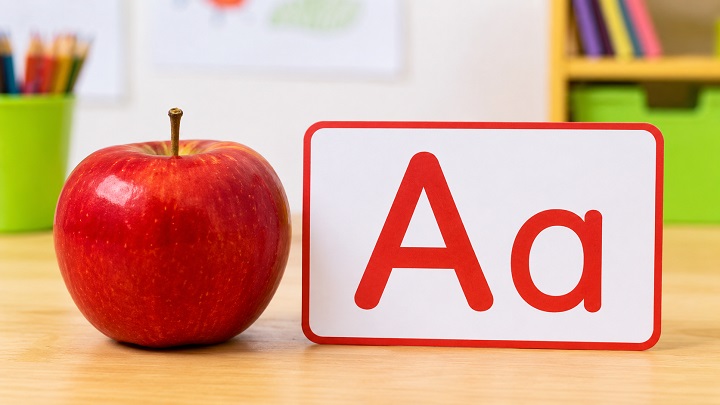
It’s used in preschool classrooms, kindergartens, early childhood programs, and at home by parents during reading readiness routines. Its repetitive structure is not accidental — that repetition is doing real developmental work.
A Is for Apple Song Full Lyrics
The “A Is for Apple” song exists in many versions. Below are the most common lyrics used in classrooms and children’s educational videos:
Version 1: Simple Chant (Most Common Classroom Version)
A is for Apple, A A A
B is for Ball, B B B
C is for Cat, C C C
D is for Dog, D D D
E is for Elephant, E E E
F is for Fish, F F F
G is for Grapes, G G G
H is for Hat, H H H
I is for Igloo, I I I
J is for Juice, J J J
K is for Kite, K K K
L is for Lion, L L L
M is for Monkey, M M M
N is for Nest, N N N
O is for Orange, O O O
P is for Pencil, P P P
Q is for Queen, Q Q Q
R is for Rainbow, R R R
S is for Sun, S S S
T is for Tiger, T T T
U is for Umbrella, U U U
V is for Violin, V V V
W is for Watermelon, W W W
X is for Xylophone, X X X
Y is for Yak, Y Y Y
Z is for Zebra, Z Z Z
Now I know my ABCs,
Next time won’t you sing with me!
Version 2: A-Only Focus (Great for Toddlers Just Starting Out)
A is for Apple, A A A
A makes the sound /æ/
Apple, apple, A A A
Let’s all say it together today!
This shorter version is designed for very young learners (ages 2–3) who are being introduced to the letter A before moving through the full alphabet.
The Educational Meaning Behind the “A Is for Apple” Song
Every element of “A Is for Apple” is intentional from a learning design perspective.
The letter-object pairing is drawn from phonics methodology. The word apple starts with a short /æ/ vowel sound — the most common pronunciation of the letter A in everyday English words. This makes it an ideal anchor word for the letter.
The repetition of the letter sound (“A A A”) immediately after the word gives children a phonemic pattern to latch onto. Research in early literacy consistently shows that children learn letter-sound associations faster when they hear them in a musical, rhythmic context.
The use of a familiar object matters enormously. Children as young as 18 months can recognize an apple. By choosing a word the child already knows, the song shifts cognitive load from “what is this thing?” to “what letter does it start with?” — exactly the right level of challenge for early learners.
How Children Learn from “A Is for Apple” Song
Music is one of the most powerful memory tools available to young learners. Here’s what happens cognitively when a child sings “A Is for Apple”:
1. Phonemic Awareness Develops Naturally
Children begin to hear that apple and the letter name “A” share a sound. This awareness — that spoken language is made of individual sounds — is the foundation of reading. Singing makes this connection without formal instruction.
2. Letter-Sound Correspondence Is Reinforced
Each repetition of “A A A” after the word apple trains the brain to connect the visual symbol (the letter) with its sound. This is the core mechanic of phonics learning.
3. Vocabulary Is Expanded in Context
Many children encounter new words through alphabet songs — igloo, xylophone, yak. The song provides context (a letter) and a visual (usually a picture or video), which together help words stick.
4. Working Memory Gets Practice
Remembering the full sequence of 26 letter-word pairs is a genuine cognitive exercise. Children who learn alphabet songs develop stronger sequential memory, which supports not just reading but mathematics and language in general.
5. Confidence Builds Through Participation
Singing is low-stakes. A child who gets a letter wrong doesn’t “fail” — the song keeps going. This creates a psychologically safe environment for practice, which encourages more attempts and faster learning.
Phonics and Alphabet Learning Benefits
| Skill | How the Song Builds It |
|---|---|
| Letter recognition | Seeing/hearing the letter name repeatedly |
| Phonemic awareness | Identifying the starting sound of each word |
| Letter-sound correspondence | Linking “A” to the /æ/ sound in “apple” |
| Vocabulary | Introducing new nouns (igloo, xylophone, etc.) |
| Sequencing | Learning A–Z in order builds pattern recognition |
| Oral language fluency | Repeating words clearly develops articulation |
| Print motivation | Songs make reading feel fun, not like work |
The /æ/ sound in “apple” is particularly valuable because it’s a short vowel — one of the five core vowel sounds children must master before decoding CVC words (consonant-vowel-consonant words like cat, hat, map). Starting with this sound gives learners a head start.
Age-by-Age “A Is for Apple” Song Learning Guide
Different ages engage with this song differently. Here’s what to expect and focus on at each stage:
Ages 1–2: Sound Exposure
At this stage, children aren’t expected to learn letters — they’re absorbing sound patterns. Play the song during daily routines. They’ll begin to recognize the melody and anticipate certain words.
Focus on: Enjoyment, rhythm, and hearing clear vowel sounds.
Ages 2–3: Word Recognition
Toddlers start recognizing the words in the song, especially familiar ones like apple, ball, and cat. Point to pictures as you sing.
Focus on: Matching pictures to words, repeating key words aloud.
Ages 3–4: Letter Introduction
Preschoolers can begin connecting letter names to their sounds. Use alphabet cards alongside the song. Pause on the letter A and ask, “What does this letter say?”
Focus on: A–E letter-sound connections, uppercase letter recognition.
Ages 4–5: Full Alphabet Mastery
Kindergarten-ready children can work through the full alphabet song and begin identifying letters out of sequence — the true test of letter knowledge.
Focus on: Lowercase letters, writing practice, identifying letters in print.
“A Is for Apple” Sing-Along Tips for Parents
You don’t need any musical training to make this song effective. A few simple strategies can dramatically improve how much your child gets out of it:
Slow it down. Most children’s alphabet songs are recorded at a pace too fast for genuine learning. When singing at home, go slow enough that your child can repeat each word clearly.
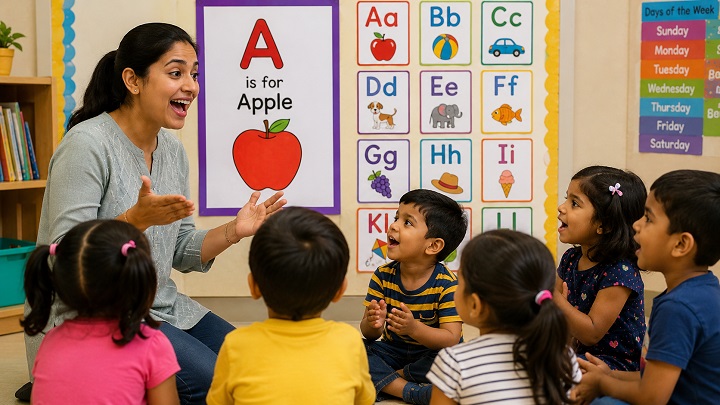
Point as you sing. Keep an alphabet chart on the wall or hold up letter cards as you reach each letter. The visual connection to the physical letter is crucial.
Pause and ask questions. After singing “A is for Apple,” hold up an apple (real or pictured) and ask: “What sound does apple start with?” Let them answer before moving on.
Let them fill in the blanks. After a few repetitions, pause before the word and let your child supply it: “A is for…” This transforms passive listening into active recall.
Sing in different settings. In the car, at bath time, during meals — varied contexts help reinforce memory. The brain retains information better when it’s learned across multiple environments.
Match the song with hands-on items. An apple for A, a ball for B, a toy cat for C. Physical objects create multisensory learning experiences that outlast passive video watching.
Classroom Activities for Teachers
Activity 1: Alphabet Anchor Chart
What you need: Large paper, markers, magazine cutouts or printed pictures
How it works: As a class, build an alphabet wall chart one letter per day. Each day features the letter from the song, its sound, and 3–5 pictures of things that start with it. Return to it daily while singing.
Learning goal: Letter recognition, sound-symbol correspondence, vocabulary
Activity 2: Sound Sorting Bins
What you need: Small bins labeled A–Z, a collection of small objects or picture cards
How it works: Sing the song, then have children sort picture cards or objects into the correct letter bin based on their starting sound.
Learning goal: Phonemic awareness, categorization, active listening
Activity 3: Pass the Apple
What you need: A plastic or real apple
How it works: Sit in a circle. The teacher starts singing “A Is for Apple” and passes the apple. When the song pauses, whoever holds the apple says a word that starts with A. Restart with the next letter.
Learning goal: Oral vocabulary, phonemic awareness, turn-taking
Activity 4: Letter of the Week Spotlight
What you need: Alphabet song, craft materials, storybooks featuring the target letter
How it works: Dedicate one week per letter. Monday: introduce the letter with the song. Tuesday: find that letter in a picture book. Wednesday: craft activity (e.g., paint an apple for A week). Thursday: writing practice. Friday: student presentations of their own “A Is for ___” word.
Learning goal: Deep letter learning, writing readiness, expressive language
Activity 5: Freeze Dance Phonics
What you need: Music, alphabet flashcards
How it works: Play the alphabet song and let kids dance. Pause the music and hold up a letter card. Children must shout the letter name and a word that starts with it before the music restarts.
Learning goal: Letter recognition, quick recall, active engagement

Home Learning Ideas on “A Is for Apple” Song
Parents don’t need a classroom setup to reinforce what the song teaches. These ideas work with everyday materials:
Apple exploration: Cut an apple in half and look at the shape together. Point out that the word “apple” starts with A. Draw the letter A and stick it on the fridge next to a photo of an apple.
Letter hunt: Print out a simple page of text and give your child a red crayon. Ask them to circle every letter A they can find. Start with uppercase, then add lowercase once they’re confident.
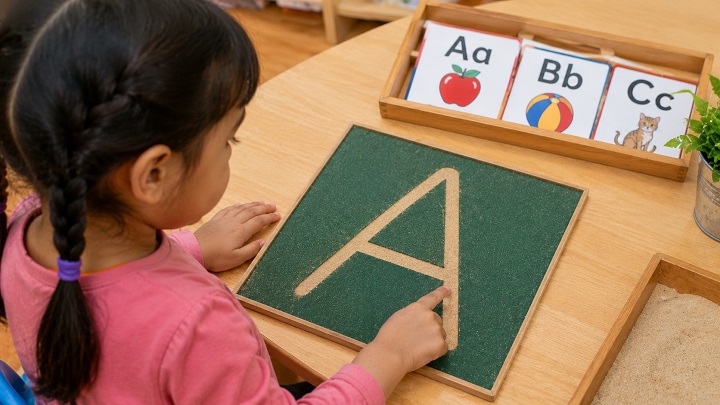
Alphabet sensory tray: Fill a baking tray with sand, salt, or rice. Call out a letter from the song and let your child trace it with their finger. The tactile experience reinforces memory.
DIY alphabet book: Staple together 26 sheets of paper, one per letter. Each week, cut out magazine pictures of things starting with that letter and glue them in. Sing the corresponding section of the song while you work.
Playlist habit: Add a few different versions of the “A Is for Apple” song to a playlist and rotate them. Slightly different melodies help the brain process the information more deeply than one repeated version.
Comparison: “A Is for Apple” Song Versions
| Version | Best For | Song Speed | Visual Support | Full Alphabet? |
|---|---|---|---|---|
| Super Simple Songs | Ages 2–5 | Moderate | Yes (animated video) | Yes |
| Classic classroom chant | Ages 3–6 | Slow | No (teacher-led) | Yes |
| Phonics-focused version (A only) | Ages 1–3 | Slow | Often yes | No (single letter focus) |
| A–Z action song variants | Ages 3–5 | Fast | Yes | Yes |
| Montessori sound games | Ages 3–6 | N/A (spoken) | Yes (objects) | One letter at a time |
The right version depends on the child’s age and current letter knowledge. For children just beginning, a slower, A-only focus is more effective than rushing through all 26 letters.
FAQ: “A Is for Apple” Song
What age is “A Is for Apple” appropriate for?
The song is suitable from around 12 months onward for passive listening, and from age 2–3 for active singing and learning. Children can work toward full alphabet mastery between ages 4 and 6.
What does the letter A sound like in “apple”?
In “apple,” the letter A makes the short vowel sound /æ/ — the same sound you hear in cat, hat, and man. This is different from the long A sound in words like cake or play.
Is singing the alphabet song enough to teach letter recognition?
Singing alone builds phonemic awareness and letter-sound associations, but letter recognition — knowing what the letter looks like — requires visual practice too. Combine singing with letter cards, tracing, and reading to get the full benefit.
How many times should a child hear the song before they learn it?
Research suggests children need 8–12 meaningful exposures to a new language concept before it sticks. For a song, that might mean singing it daily for one to two weeks. Vary the context — sing it at home, in the car, at mealtimes — to speed up retention.
Why do alphabet songs start with A is for Apple?
The letter A is the first letter of the English alphabet, so it’s the natural starting point. The word apple is used because it’s universally familiar to young children, starts with the clearest short-A sound, and pairs well visually with the letter’s shape (some teachers even note that a sliced apple looks a bit like the letter A).
What’s the difference between alphabet songs and phonics songs?
Alphabet songs teach the names of letters in order. Phonics songs teach the sounds letters make. “A Is for Apple” bridges both — it names the letter (“A”) and models its primary sound (“apple”). For complete reading readiness, children need both types of exposure.
Can this song help children who are learning English as a second language?
Yes. The concrete object pairings (letter + familiar word + picture) make alphabet songs especially useful for ESL learners. The repetitive structure also reduces cognitive load, giving language learners a manageable entry point into English phonics.
How can I tell if my child is actually learning from the song?
Ask them to identify a letter out of sequence — point to an “A” in a book and ask what it is. If they can answer without singing through the whole alphabet first, they’ve internalized that letter. True mastery means recognition, not just recitation.
Final Thoughts: “A Is for Apple” Song
“A Is for Apple” has lasted for generations because it works. It’s not just a catchy tune — it’s a carefully structured learning tool that delivers phonemic awareness, letter recognition, vocabulary, and sequential memory in a format that children genuinely enjoy.
The song is a starting point, not a finishing line. Pair it with physical activities, books, and hands-on exploration to give children the richest possible foundation for reading. Whether you’re a parent singing during bath time or a teacher building a week-long alphabet unit, this song earns its place in every early literacy routine.
Related reading: How I Finally Got My Toddler to Learn the Alphabet Using the “A is for Apple” Song
Related Posts:


