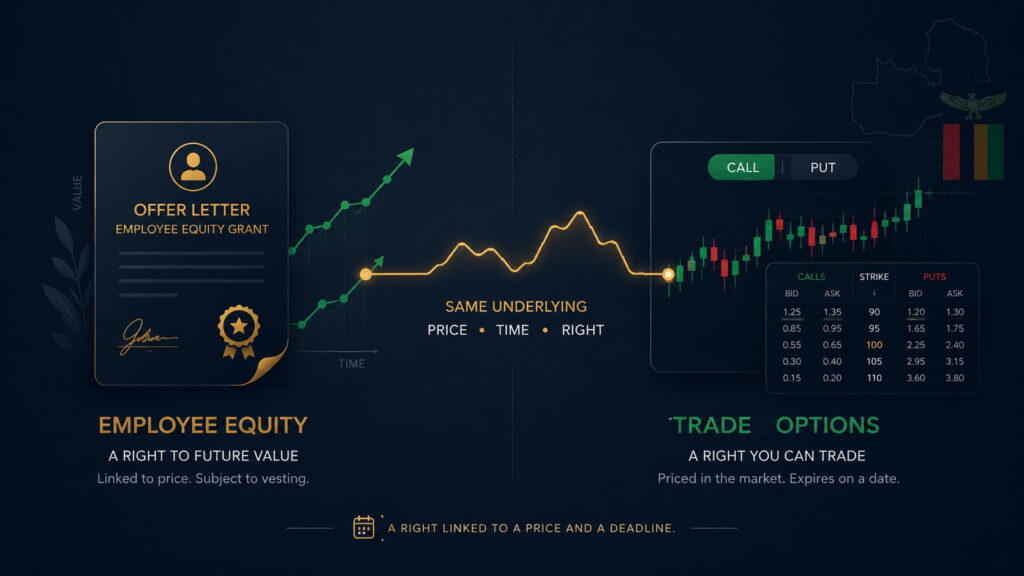
Someone tells you, “My company just gave me stock options.” Someone else says, “I bought a call option on Tesla.” Both people used the same term: stock option. But they are not describing the same thing.
This confusion is the reason so many people give up halfway through learning about stock options. This guide clears it up from the start, then walks through both meanings step by step, in plain language, with real numbers, so you understand exactly what a stock option is, how it works, and how money is actually made or lost.
Quick answer: A stock option gives its holder a right, generally not an obligation, to buy or sell an underlying asset at a specified price, under defined conditions. In employee compensation, stock options usually give an employee the right to buy company shares at a fixed exercise price after a vesting period. In options trading, a call gives the buyer the right to buy a stock, and a put gives the buyer the right to sell it, both at a fixed strike price before or at expiration.
Key takeaways
- Stock options are rights, not automatic ownership. Receiving or buying an option is not the same as owning shares.
- Employee stock options and traded stock options share some vocabulary, but they are different instruments with different mechanics.
- A call generally gives the right to buy; a put generally gives the right to sell.
- Premium, strike price, and expiration drive most of an option’s economics, and being “in the money” does not by itself mean a profit.
- Options can expire worthless, and some strategies, especially writing uncovered options, carry substantial risk.
- U.S. tax rules around equity compensation, including QSBS and AMT planning for ISOs, changed meaningfully in 2025; don’t assume older guidance you’ve seen elsewhere still applies without checking current IRS rules.
What you’ll learn
What a stock option is · Employee stock options, from grant to exercise, including 409A valuations, early exercise, and 83(b) elections · How options trading works, including calls, puts, premium, and time decay · Full worked examples with profit and loss · Stock options vs shares vs RSUs vs ESPPs · Risks and common myths · How stock options are taxed, including QSBS and recent U.S. tax law changes
Table of Contents:
- What Is a Stock Option?
- Who Needs to Understand Stock Options?
- Stock Option Meaning in Simple Terms
- How Do Stock Options Work?
- Stock Option Terms You Need to Know
- Part 1: Employee Stock Options
- Employee Stock Options Explained
- What Is a Stock Option Grant?
- The Difference Between a Plan, a Grant, and an Agreement
- Understanding the Exercise Price
- What Is Vesting?
- How Employee Stock Options Become Valuable
- How Do You Exercise Employee Stock Options?
- Cash Exercise vs Cashless Exercise
- What Is Early Exercise?
- What Is an 83(b) Election?
- Blackout Periods and the Post-Termination Exercise Period (PTEP)
- What Happens When an Employee Leaves the Company?
- Why Vested Stock Options May Still Be Difficult to Turn Into Cash
- Startup Stock Options
- What Happens to Stock Options When a Company Is Acquired?
- Part 2: Stock Options in the Stock Market
- What Is a Stock Option Call?
- What Is a Put Option?
- American vs European Options
- Contract Size: What One Option Contract Actually Represents
- What Is an Options Premium?
- What Is a Strike Price?
- In the Money, At the Money, and Out of the Money
- Break-Even: Does "In the Money" Mean I Made Money?
- Do You Have to Exercise a Stock Option?
- How Do You Close an Options Position?
- What Is Time Decay?
- What Is Implied Volatility?
- What Are the Options Greeks?
- What Is the Bid-Ask Spread?
- What Is an Options Chain?
- Exercise vs Assignment
- Stock Option Example (Employee)
- Stock Option Example (Call, With Full Profit/Loss Table)
- Stock Option Example (Put, With Full Profit/Loss Table)
- Call vs Put
- What Is Options Trading?
- How Options Trading Differs From Buying Shares
- Comparing the Instruments
- Stock Options vs Shares
- Stock Option vs RSU
- Employee Stock Options vs RSUs vs Shares
- Stock Options vs an Employee Stock Purchase Plan (ESPP)
- Why, Risks, and Common Problems
- Why Do People Use Stock Options?
- Risks of Stock Options
- Common Stock Option Myths
- Common Stock Option Mistakes
- What Is Stock Option Backdating?
- Stock Option Dilution
- Stock Option Pool
- Taxes
- How Are Stock Options Taxed?
- Stock Option Glossary
- Frequently Asked Questions
- Sources
What Is a Stock Option?
A stock option is a contract or compensation arrangement that gives someone the right, generally not the obligation, to buy (or in some cases sell) shares of a company at a set price, within a defined time frame. Cornell Law School’s Legal Information Institute defines a stock option in similar terms: a contract allowing the purchase of shares at a set exercise or strike price for a defined period, most commonly used as employee compensation. There are two distinct uses of the term, and this article covers both.
| If you mean… | It usually refers to… |
|---|---|
| Employee stock option | The right to buy employer shares under a company equity plan, after meeting conditions such as vesting |
| Call option | The right to buy an underlying stock at a fixed price |
| Put option | The right to sell an underlying stock at a fixed price |
| Strike price / exercise price | The fixed price written into the option |
| Premium | The price paid to acquire a traded option contract |
| Vesting | The point at which employee options become exercisable |
| Expiration | The deadline for exercising or closing the option |
Employee stock options vs traded stock options
- Employee stock option: part of a compensation package that lets an employee buy company shares at a fixed exercise price after meeting conditions, such as vesting. Granted directly by an employer under an internal equity plan.
- Traded stock option: a derivative contract for calls and puts. Exchange-traded options are standardized contracts bought and sold through an organized options exchange. OTC (over-the-counter) options are privately negotiated between two parties and are not standardized. Most of what retail investors encounter, and most of what this article covers under “traded options,” refers to standardized, exchange-traded contracts.
Although employee options and traded options share some basic concepts, such as a strike or exercise price, an expiration date, and the idea of a right rather than an obligation, their mechanics and terminology differ in important ways. An employee stock option is a workplace benefit governed by a company plan. A traded option is a financial instrument governed by exchange rules and continuously changing market pricing. The rest of this article treats them separately wherever the mechanics genuinely diverge.
Who Needs to Understand Stock Options?
Employees. You received stock options as part of a job offer or compensation package and want to know what you actually have, and when.
Investors. You are considering buying or selling options contracts and want to understand the mechanics and risks before placing a trade.
Founders and business owners. You are considering using equity compensation to attract or retain talent and want to understand grants, plans, and dilution.
Stock Option Meaning in Simple Terms
Think of an option as a reserved right, not a done deal. If a venue lets you reserve a table for Friday at a fixed price, you are not obligated to show up. You can use the reservation, let it lapse, or in some cases pass it on. That is the essence of an option: a right that can be used under specific conditions, rather than a commitment you must follow through on.
In finance, that “reservation” is tied to a stock. The option holder has the right to buy (or sell) the stock at an agreed price by a certain date. Whether that right turns out to be valuable depends on what the stock actually does in the meantime, and on how much was paid for the right in the first place.
How Do Stock Options Work?
Every stock option involves a version of the same basic building blocks:
- Underlying stock: the company shares the option is based on.
- Option holder: the person who owns the right created by the option.
- Employer (employee options) or option writer (traded options): for employee options, the company granting the award; for traded options, the party who sells the contract and takes on the corresponding obligation if it is exercised.
- Strike price or exercise price: the fixed price at which the holder can buy (or sell) the shares.
- Expiration date: the date after which the option can no longer be used.
- Premium: the price paid to buy a traded option contract. Employee stock options typically do not involve a premium in this sense; the employee’s cost is the exercise price, paid later.
- Right versus obligation: the option holder can choose whether to act. The writer of a traded option, by contrast, can be obligated to fulfill the contract if the holder exercises it.
Stock Option Terms You Need to Know
A short glossary before going further, since these words recur throughout the article:
- Underlying asset: the stock the option is based on.
- Exercise: using the right created by the option, generally by paying the exercise or strike price.
- Assignment: the flip side of exercise. When a holder exercises, the corresponding option writer is “assigned” the obligation, for example the obligation to deliver or buy shares.
- Intrinsic value: the built-in value an option would have if exercised right now.
- Time value (extrinsic value): the portion of the premium above intrinsic value, reflecting the chance the option becomes more valuable before expiration.
Part 1: Employee Stock Options
Employee Stock Options Explained
An employee stock option is a form of equity compensation. Instead of, or alongside, salary and bonus, a company gives an employee the right to buy a specific number of shares at a fixed exercise price, once certain conditions are met.
Companies grant options for a few practical reasons:
- To attract talent without paying entirely in cash, which matters especially for startups with limited cash flow.
- To align employee incentives with company performance, since a rising share price can make the options more valuable.
- To encourage retention, since options are usually earned gradually over time.
Receiving an option grant is not the same as owning shares. The employee typically must wait for the options to vest, then choose to exercise the vested options by paying the exercise price. Only at that point does the employee actually hold shares.
What Is a Stock Option Grant?
A stock option grant is the award of a specific number of stock options to an employee under the terms of the company’s equity compensation plan.
A grant typically specifies the number of options awarded, the grant date, the exercise price (often the stock’s fair market value on the grant date), the vesting schedule, and the expiration date.
The Difference Between a Plan, a Grant, and an Agreement
These three terms are closely related but describe different layers:
Stock Option Plan → the company-wide rulebook: who is eligible, how many shares are reserved, how grants are approved ↓ Stock Option Grant → your individual award: how many options, at what price, on what vesting schedule ↓ Stock Option Agreement → your specific contract: the exact terms that apply to you, including what happens if you leave
What Is a Stock Option Plan?
The formal program a company adopts that sets out the rules for issuing stock options, including who is eligible, how many shares are reserved for the option pool, how grants are administered, and general rules for vesting, exercise, and expiration.
What Is a Stock Option Agreement?
The document laying out an individual employee’s specific terms: number of options, exercise price, vesting schedule, expiration, rules on termination, and the company’s exercise procedure. Agreements are not identical across companies, or even always identical within the same company across different grant years, so read your own agreement rather than assuming a standard structure.
Understanding the Exercise Price
The exercise price is the fixed price at which the option holder is allowed to buy the underlying shares, as set out in the option’s terms. This term is closely related to “strike price,” used more often in options trading; “exercise price” is the term used more often in employee compensation. For an employee option, it is generally set by the company, often equal to the stock’s fair market value on the grant date, and it stays fixed regardless of how the share price later moves.
How is the exercise price set at a private company?
For U.S. private companies, tax rules generally require the exercise price to be at or above the stock’s fair market value on the grant date. Companies typically establish that value through an independent appraisal known as a 409A valuation, named after the relevant section of the U.S. tax code. A 409A valuation is usually lower than the price investors pay for preferred shares in a funding round, since preferred shares often carry extra rights and protections that the common stock underlying employee options does not have. Setting the exercise price below fair market value can trigger unfavorable tax consequences for the employee, which is part of why private companies take 409A valuations seriously. This is a U.S.-specific mechanism; other countries use different rules to establish a fair exercise or issue price.
What Is Vesting?
Vesting is the process of earning the right to exercise stock options (or receive RSU shares) over time, rather than all at once.
- Cliff vesting: no options vest until a set point, commonly one year, after which a portion vests immediately.
- Graded (gradual) vesting: options vest in increments, for example monthly or annually, over the vesting period.
Hypothetical example: a grant of 4,000 options vesting over four years, with a one-year cliff. After the first year, 1,000 options (25%) vest at once. The remaining 3,000 then vest gradually, for example monthly, over the following three years. If the employee leaves before the one-year cliff, none of the options vest.
How Employee Stock Options Become Valuable
An employee option has built-in value once the current share price rises above the exercise price. Suppose an option’s exercise price is $10 and the shares are now worth $25. Exercising and immediately selling would capture roughly $15 per share before taxes and costs. If the shares are trading below $10, there is no economic reason to exercise, and the option would typically be left unused.
How Do You Exercise Employee Stock Options?
- Confirm the options are vested.
- Check the exercise price.
- Check the expiration date and any post-termination exercise window.
- Review the company’s specific exercise procedure.
- Determine how the exercise will be funded.
- Submit the exercise request through the company’s designated process.
- Pay the required exercise cost and any applicable withholding or fees.
- Receive the resulting shares, or sell them, according to the applicable process.
This is a different process from a listed option, which settles through exchange and brokerage mechanics rather than an internal HR process.
Cash Exercise vs Cashless Exercise
- Cash exercise: paying the exercise price directly, in cash. Hypothetical example: 1,000 options with a $10 exercise price require a $10,000 payment (1,000 × $10).
- Cashless exercise: using a broker-assisted arrangement to sell enough of the resulting shares to cover the exercise cost (and sometimes taxes), without paying cash upfront.
- Same-day sale: a specific form of cashless exercise where all resulting shares are sold immediately.
Not every company plan offers every method; some only permit cash exercise. Check your specific plan.
What Is Early Exercise?
Some private-company option grants allow early exercise, meaning the employee can exercise options before they have fully vested, immediately receiving restricted shares that are still subject to the original vesting schedule (the company generally retains a right to buy back unvested shares if the employee leaves). Early exercise is not offered by every company, and it is not automatically the right choice; it involves paying the exercise price, and potentially taxes, well before the shares are liquid, which increases financial risk if the company’s value later falls.
What Is an 83(b) Election?
An 83(b) election is a U.S. tax filing that lets someone who early-exercises stock options (or otherwise receives restricted stock subject to vesting) choose to be taxed on the value of the shares now, at the time of exercise, rather than as they vest later. If the shares are worth little at the time of exercise, this can lock in a low starting tax basis and, if requirements are met, allow future appreciation to qualify for long-term capital gains treatment rather than ordinary income treatment. An 83(b) election must generally be filed with the IRS within 30 days of exercise, with no extensions available, which makes timing critical. This is a significant, largely irreversible decision with real financial consequences if the company’s value later declines, so it should be made with the help of a qualified tax professional, and it is a U.S.-specific mechanism.
Blackout Periods and the Post-Termination Exercise Period (PTEP)
Even a vested option is not always available to exercise or sell on any given day. Many public companies impose blackout periods, windows during which insiders and sometimes all employees are restricted from trading company stock, often around earnings announcements. Vested options can also have a limited post-termination exercise period, commonly abbreviated PTEP, and this deadline is not always the same as the option’s original expiration date. Historically many companies used a short PTEP, often around 90 days after leaving; some companies, particularly newer startups, now offer considerably longer windows. A departing employee should confirm both the PTEP and the original expiration date directly with their company rather than assuming either applies automatically.
What Happens When an Employee Leaves the Company?
Outcomes depend entirely on the company’s plan and the individual’s agreement. Typical patterns include:
- Vested options may remain exercisable for a limited window after departure, often weeks or months.
- Unvested options are generally forfeited.
- Options may expire if not exercised within the post-termination window.
- Special provisions can apply for retirement, disability, death, or an acquisition of the company.
Review your actual plan documents and agreement, and ideally consult the company’s equity administrator, before a departure date.
Why Vested Stock Options May Still Be Difficult to Turn Into Cash
Vested does not mean liquid. A private company’s shares generally have no public market, so an employee can hold 10,000 fully vested, in-the-money options and still have no straightforward way to convert them into cash. Selling may depend on a company-approved secondary transaction, a tender offer, or eventually an IPO or acquisition, none of which are guaranteed to happen on any particular timeline, or at all. This is one of the most important practical realities for startup and private-company employees to understand before treating a large option grant as equivalent to cash compensation.
Startup Stock Options
Startups frequently rely on stock options as a core part of compensation because cash is often limited early on, options can help attract talent willing to accept lower salaries for potential upside, vesting encourages employees to stay through key growth periods, and the exercise price is often very low early on, reflecting the company’s early valuation.
What happens if the company never goes public?
An IPO is not required for options to eventually have value. Possible paths include:
- The company stays private indefinitely, and shares remain largely illiquid outside occasional secondary transactions.
- The company is acquired, and options are treated according to the deal terms (see below).
- The company completes an IPO, creating a public market for the shares.
- The company fails, and the options become worthless.
Startup equity compensation should be treated as a high-risk, potentially high-reward component of pay, not a guaranteed benefit.
What Happens to Stock Options When a Company Is Acquired?
Treatment depends on the specific transaction and the terms of the relevant plan and agreements. Common outcomes include conversion into equivalent options or shares in the acquiring company, assumption of the existing options by the acquirer, a cash-out based on the deal price, accelerated vesting of some or all unvested options, cancellation of out-of-the-money options with no payout, or replacement with new equity awards. No single outcome applies universally; review your specific plan documents and any deal-related communications.
Part 2: Stock Options in the Stock Market
The second meaning of “stock option” refers to exchange-traded (or privately negotiated) derivative contracts. These are financial instruments whose value is linked to an underlying stock, and they are not a form of employment compensation.
What Is a Stock Option Call?
A call option gives the holder the right, but not the obligation, to buy the underlying stock at the strike price. Whether it can be exercised before expiration, or only at expiration, depends on the option’s exercise style (covered below).
What Is a Put Option?
A put option gives the holder the right, but not the obligation, to sell the underlying stock at the strike price, subject to the same exercise-style distinction.
American vs European Options
Not every option can be exercised at any time.
- American-style options can generally be exercised any time before expiration.
- European-style options can generally be exercised only at expiration itself.
Most U.S. retail equity options are American-style, but this is not a universal rule for every contract or every market, so it is worth confirming the exercise style of any specific contract before trading it.
Contract Size: What One Option Contract Actually Represents
A standard U.S. equity option contract typically represents 100 shares of the underlying stock, although contract specifications can vary, particularly for adjusted contracts or different types of underlying assets. This matters directly for cost: a quoted premium of $2 per share generally means a total contract cost of $2 × 100 = $200, not $2.
What Is an Options Premium?
The premium is the price paid by the buyer to acquire an option contract, and received by the seller (writer) in exchange for taking on the corresponding obligation. It is generally quoted per share and then multiplied by the contract size to find the actual cost.
Premium = intrinsic value + time value (extrinsic value)
Intrinsic value vs extrinsic value, with numbers
Suppose a stock trades at $60, and a call has a strike price of $50.
- Intrinsic value = $60 − $50 = $10 (the built-in value if exercised right now)
- If the option’s actual premium is $13, then extrinsic (time) value = $13 − $10 = $3
That $3 reflects the market’s assessment of how much additional value the option could gain before expiration, driven mainly by time remaining and expected volatility.
What Is a Strike Price?
The strike price is the fixed price set in an options contract at which the holder can buy (call) or sell (put) the underlying stock. It stays constant for the life of the contract, while the stock’s market price moves independently. “Strike price” and “exercise price” describe essentially the same concept; strike price is the term used more often in trading, exercise price more often in employee compensation.
In the Money, At the Money, and Out of the Money
| Term | Call Option | Put Option |
|---|---|---|
| In the money | Stock price is above the strike price | Stock price is below the strike price |
| At the money | Stock price is roughly equal to the strike price | Stock price is roughly equal to the strike price |
| Out of the money | Stock price is below the strike price | Stock price is above the strike price |
Being “in the money” does not automatically mean a profit. The premium originally paid still needs to be recovered first, which is the idea behind break-even, covered next.
Break-Even: Does “In the Money” Mean I Made Money?
Not necessarily. The premium paid matters.
- Call option break-even (at expiration): strike price + premium paid
- Put option break-even (at expiration): strike price − premium paid
Example: stock price $60, call strike $50, premium paid $13. Intrinsic value is $10, but the trader paid $13. At expiration: $10 − $13 = a $3 per-share loss, even though the option finished in the money.
This is the expiration break-even specifically. Actual results can differ if the option is sold before expiration, since it may still carry time value at that point.
Do You Have to Exercise a Stock Option?
No. A traded option holder generally has three choices:
- Exercise the option, buying or selling the underlying shares at the strike price.
- Sell the option itself before expiration to close the position, capturing whatever value it still holds without ever touching the underlying stock.
- Let it expire, in which case an out-of-the-money option simply becomes worthless.
Most retail options traders close positions by selling before expiration rather than exercising them, particularly for pure directional bets, since selling captures remaining time value that exercising would forfeit.
How Do You Close an Options Position?
- Buy to close: used by someone who originally sold (wrote) an option and now wants to exit that obligation by buying an equivalent option back.
- Sell to close: used by someone who originally bought an option and now wants to exit by selling it, rather than exercising or letting it expire.
What Is Time Decay?
An option has a limited lifespan. As expiration approaches, less time remains for a favorable price move to happen, so, all else equal, an option’s time value tends to decline as expiration nears, even if the underlying stock price does not move at all. This effect is often referred to using the Greek letter theta, and it works against option buyers while generally working in favor of option sellers, all else equal.
What Is Implied Volatility?
Implied volatility reflects how much price movement the market is currently pricing into an underlying stock’s future. Higher implied volatility generally means higher option premiums, because greater expected movement increases the chance the option becomes more valuable before expiration. Implied volatility says something about the expected size of a future move, not its direction; a stock can have high implied volatility whether the market anticipates a large move up or a large move down.
What Are the Options Greeks?
You do not need to master the Greeks to understand what a stock option is, but traders use them to describe how an option’s price responds to changes in the market.
| Greek | What it broadly measures |
|---|---|
| Delta | How much an option’s price may change when the underlying stock moves |
| Gamma | How quickly delta itself changes as the stock moves |
| Theta | How much time decay affects the option as expiration approaches |
| Vega | How sensitive the option’s price is to changes in implied volatility |
What Is the Bid-Ask Spread?
An options chain (below) typically shows two prices for every contract: the bid, the highest price someone currently offers to pay, and the ask, the lowest price someone is currently willing to accept. The difference between them is the spread. A wide spread can make entering and exiting a position more expensive, since a market order effectively buys at the ask and sells at the bid.
What Is an Options Chain?
An options chain is the trading screen listing available contracts for a given underlying stock: strike prices, expiration dates, whether each row is a call or a put, along with bid, ask, volume, open interest, and implied volatility for each contract. You don’t need to know how to trade from a chain to understand what a stock option is, but recognizing the layout helps make sense of real quotes once you start looking at one.
Volume and open interest
- Volume is how many contracts of a specific option traded during a given period, such as the current day.
- Open interest is how many contracts of that option remain outstanding and have not yet been closed, exercised, or expired.
Both are commonly used as rough indicators of how actively and easily a specific contract can be traded.
Exercise vs Assignment
Exercise is the holder using their right. Assignment is what happens to the writer on the other side of that contract. If you buy a call and exercise it, you are exercising your right to buy the shares. The writer of that call may then be assigned the obligation to deliver the underlying shares at the strike price, whether or not that is convenient for them at that moment. This asymmetry, defined risk for a buyer, potentially open-ended obligation for a writer, is central to understanding options risk.
Stock Option Example (Employee)
Suppose a company grants an employee options to purchase 1,000 shares at a hypothetical exercise price of $10 per share, vesting over four years. If, after vesting, the shares trade at $25, exercising would cost $10,000 (1,000 × $10) to acquire shares worth $25,000, roughly $15,000 of built-in value before taxes and costs. If the shares instead fell to $6, exercising at $10 would make no economic sense. These figures are entirely hypothetical.
Stock Option Example (Call, With Full Profit/Loss Table)
Suppose: stock price $50, call strike $50, premium $3 per share, one standard contract (100 shares), total cost $300.
| Stock price at expiration | Option value at expiration | Result before fees |
|---|---|---|
| $40 | $0 | −$300 |
| $50 | $0 | −$300 |
| $52 | $200 | −$100 |
| $53 | $300 | $0 (break-even) |
| $60 | $1,000 | +$700 |
This one table shows intrinsic value, premium, break-even, and how a relatively small percentage move in the stock (from $50 to $60, a 20% move) produced a much larger percentage change in the option’s outcome. That amplification is what “leverage” means in this context, and it cuts both ways.
Stock Option Example (Put, With Full Profit/Loss Table)
Suppose: stock price $50, put strike $50, premium $2 per share, one standard contract (100 shares), total cost $200.
| Stock price at expiration | Option value at expiration | Result before fees |
|---|---|---|
| $60 | $0 | −$200 |
| $50 | $0 | −$200 |
| $48 | $200 | $0 (break-even) |
| $45 | $500 | +$300 |
| $40 | $1,000 | +$800 |
Call vs Put
| Call | Put | |
|---|---|---|
| Basic right | Buy the underlying stock | Sell the underlying stock |
| Often benefits from | A rising underlying price | A falling underlying price |
| Buyer’s risk | Limited to the premium paid, subject to contract terms | Limited to the premium paid, subject to contract terms |
| Seller’s (writer’s) risk | Can be substantial, and for uncovered positions theoretically very large, depending on the position | Can be substantial depending on the position, generally bounded by the stock’s price floor of zero |
What Is Options Trading?
Options trading refers to buying and selling options contracts, typically through a brokerage account connected to an options exchange. The SEC’s Investor.gov bulletin on options basics is a useful primary-source starting point for understanding listed options mechanics and risk. Common approaches include buying calls, generally used to benefit from an expected rise in a stock’s price with defined downside risk; buying puts, generally used to benefit from an expected decline or to hedge an existing position; selling (writing) options, which can generate premium income but can carry significant risk, particularly when not backed by ownership of the underlying stock; hedging, using options to offset risk elsewhere in a portfolio; and speculation, taking a directional view with a defined upfront cost. This article covers the foundations only; specific strategies deserve dedicated coverage rather than being compressed into a beginner overview.
How Options Trading Differs From Buying Shares
| Feature | Shares | Options |
|---|---|---|
| Ownership | Usually direct ownership of the company | Not necessarily; depends on exercise |
| Expiration | Usually none | Usually yes |
| Leverage | Generally lower | Can be substantial |
| Complexity | Generally lower | Generally higher |
| Maximum loss | Depends on the position; can be the full investment | Depends on the strategy; buyers generally risk the premium, sellers can face larger losses |
| Income | Dividends possible, depending on the company | Premium income possible through selling strategies, with associated risk |
| Voting rights | Generally available to shareholders | Generally not available to option holders |
Comparing the Instruments
Stock Options vs Shares
| Feature | Stock Option | Shares |
|---|---|---|
| Ownership | No ownership until exercised (employee) or settled (traded) | Direct ownership of the company |
| Right to buy | Right to buy at a fixed price under specific conditions | Already own the stock |
| Voting rights | Generally none until shares are actually held | Generally yes, for common shares |
| Dividends | Generally none while holding only the option | Often eligible, depending on the company |
| Expiration | Has an expiration or exercise deadline | Does not expire |
| Risk | Can become worthless if unexercised or if the stock underperforms the strike/exercise price | Value moves with the stock; typically no total loss unless the company fails |
Stock Option vs RSU
| Feature | Stock Options | RSUs |
|---|---|---|
| What you receive | The right to buy shares at a set exercise price | A promise of actual shares once vesting conditions are met |
| Exercise required | Yes | No, shares are typically delivered automatically at vesting |
| Exercise price | Yes, a fixed price applies | None |
| Vesting | Options vest before they can be exercised | Units vest before shares are delivered |
| Value at vesting | Depends on whether the stock price exceeds the exercise price | Has value as long as the stock has any value at all |
| Downside if share price falls | Can become worthless if the stock falls below the exercise price | Still has some value as long as the stock price is above zero |
| Tax treatment | Varies by jurisdiction and option type | Varies by jurisdiction; often taxed at vesting |
Employee Stock Options vs RSUs vs Shares
| Feature | Stock Options | RSUs | Shares |
|---|---|---|---|
| Ownership at grant | None | None | Full ownership |
| Exercise needed | Yes | No | Not applicable |
| Vesting | Typically yes | Typically yes | Not applicable unless separately restricted |
| Exercise price | Yes, fixed | None | Not applicable |
| Potential upside | Tied to appreciation above the exercise price | Full value of vested shares | Full value of shares held |
| Downside | Can become worthless if the stock stays below the exercise price | Retains some value as long as the stock has value | Value falls with the stock, down to zero in a worst case |
| Dividends | Generally none before exercise | Sometimes, depending on plan terms | Often, depending on the company |
| Voting rights | Generally none until shares are held | Generally none until shares are delivered | Generally yes |
Actual treatment varies by company and jurisdiction; these tables reflect general patterns, not universal rules.
Stock Options vs an Employee Stock Purchase Plan (ESPP)
A related but distinct benefit is an employee stock purchase plan, or ESPP, common at publicly traded companies. An ESPP lets employees buy company shares, often at a discount to market price, through regular payroll deductions over a set offering period, rather than through a granted right at a fixed exercise price tied to a vesting schedule. A stock option is a conditional right granted to an individual employee under an equity plan; an ESPP is a broad-based purchase program most employees can opt into. The two are sometimes confused because both fall under “equity compensation,” but the mechanics, eligibility, and tax treatment differ.
Why, Risks, and Common Problems
Why Do People Use Stock Options?
Employee stock options: compensation, retention through vesting, a sense of alignment with company performance, and potential upside if shares appreciate.
Traded options: hedging existing positions, speculating on price direction with a defined upfront cost, generating income through premium-selling strategies, and managing overall portfolio exposure.
Stock options are not simply “a way to make money.” Each use comes with meaningful trade-offs and risks.
Risks of Stock Options
- Expiration risk: unexercised or unused options can become worthless.
- Loss of premium: traded option buyers can lose the entire premium paid.
- Leverage: amplifies both potential gains and potential losses.
- Volatility: larger price swings in the underlying stock affect option value significantly.
- Liquidity: thinly traded options can be harder to buy or sell at a fair price, often reflected in a wide bid-ask spread.
- Assignment risk: option writers can be required to fulfill the contract if it is exercised against them.
- Exercise risk: employees may face cash outlay and tax obligations when exercising, even before selling any shares.
- Dilution: issuing employee stock options increases total shares outstanding, which can dilute existing shareholders.
- Concentration risk: holding a large amount of employer stock, through options or shares, reduces diversification.
- Tax consequences: can be significant and vary widely by jurisdiction, option type, and timing.
- Employer-specific risk: for employee options, value depends heavily on one company’s fortunes. When the current share price falls below the exercise price, the options are commonly described as underwater, and this can happen even after previously trading well above the exercise price, for example following a broad market downturn or a lower valuation in a later private funding round.
- Private-company liquidity risk: vested options in a private company may have no practical way to be converted to cash.
- Complexity: both employee options and traded options involve terms that are easy to misread without careful attention.
Employee stock options primarily carry company-specific and career-related risk. Traded options primarily carry market, leverage, and strategy-specific risk. The two should not be evaluated using the same mental checklist.
Common Stock Option Myths
“Getting stock options means I own shares.” False. You generally need to vest, then exercise, before you own anything.
“An in-the-money option always means I’m profitable.” False. The premium paid needs to be recovered first; see the break-even section above.
“A call option means I have to buy the shares.” False. It gives the right, not the obligation, and most holders close the position rather than exercise it.
“If the stock rises, my call automatically makes money.” Not necessarily. The stock needs to rise enough to cover the premium paid, and time decay works against the buyer as expiration approaches.
“Vested options are the same as cash.” False, particularly for private companies, where vested options can be difficult or impossible to sell.
“Options are just cheaper stocks.” False. Options expire, decay in value over time, and behave very differently from simply owning fewer shares.
“A regulated broker makes options trading risk-free.” False. Regulation addresses how a broker conducts business; it does not remove market, leverage, or strategy risk.
Common Stock Option Mistakes
Treating a grant as if it were already-owned stock; ignoring the vesting schedule; losing track of the expiration date, including the separate post-termination deadline; misunderstanding how the exercise price works; overlooking tax consequences until it is too late to plan around them; exercising without considering liquidity to pay the exercise cost and taxes; concentrating too much personal wealth in employer stock; assuming options will always end up valuable; confusing stock options with RSUs; confusing employee stock options with exchange-traded options; trading options without understanding leverage and downside; ignoring assignment risk when writing options; and not actually reading the option agreement or plan documents.
What Is Stock Option Backdating?
Stock option backdating refers to the practice of recording an option’s grant date as an earlier date than when it was actually granted, typically to select a date when the stock price was lower, which can make the exercise price artificially favorable. This became a significant corporate governance issue because it can misrepresent the true cost of compensation in financial statements, violate disclosure requirements for public companies, raise accounting and audit concerns, and trigger regulatory and legal consequences, including investigations by securities regulators. Backdating differs from legitimately granting options with a favorable exercise price through proper, disclosed procedures; the problem lies in retroactively altering the recorded date without proper disclosure. This overview is general in nature and does not allege wrongdoing by any specific company.
Stock Option Dilution
When a company grants stock options, it typically reserves shares that can be issued if those options are exercised. When that happens, the total number of shares outstanding increases, which can reduce the percentage ownership, and sometimes the per-share value, held by existing shareholders. This is known as dilution. Investors evaluating a company often look closely at the size of its option pool and the pace of new grants, since heavy ongoing equity compensation can meaningfully affect per-share value over time.
Stock Option Pool
An option pool is the block of shares a company sets aside specifically for future employee stock option grants. Startups commonly establish an option pool early on, since it lets them offer equity compensation to new hires without renegotiating share allocations every time. The size of the pool is a factor in dilution calculations and is often a point of negotiation during fundraising rounds, since a larger pool dilutes existing shareholders more.
Taxes
How Are Stock Options Taxed?
Tax treatment varies significantly and depends on the country involved, whether the option is an employee option or a traded option, the specific option type, when it is exercised, when any resulting shares are sold, and individual circumstances. This section is general and educational, not tax advice.
What Are ISOs and NSOs?
In the United States, employee stock options are commonly divided into two categories with materially different tax treatment.
| ISO (Incentive Stock Option) | NSO (Nonqualified Stock Option) | |
|---|---|---|
| Full name | Incentive Stock Option | Nonqualified Stock Option |
| Generally available to | Employees only | Employees and certain nonemployees |
| Special U.S. tax treatment | Potentially favorable if specific holding-period requirements are met | Generally taxed as ordinary income at exercise |
| AMT considerations | Can trigger alternative minimum tax | Different tax treatment; AMT generally not the relevant concern |
| Jurisdiction | United States | United States |
These classifications, ISO, NSO, and AMT, are specific to U.S. tax law and should not be assumed to apply in Zambia or any other country. See the IRS’s Topic no. 427, Stock options for the current U.S. federal treatment.
For traded options, U.S. tax treatment generally depends on factors such as the strategy used and holding periods, and is governed by IRS rules outside the scope of this general overview.
What Is the ISO $100,000 Limit?
U.S. tax law caps how much ISO value can become exercisable for an employee in any single calendar year while still qualifying for ISO treatment. If the fair market value of ISOs first becoming exercisable in a year, measured at the grant date, exceeds this limit, the excess is automatically treated as NSOs rather than ISOs, even if the grant was originally labeled an ISO. This limit affects larger grants and grants that vest quickly, and it is a detail worth confirming with the equity administrator or a tax professional rather than assuming an entire grant qualifies as ISO.
A note on recent U.S. tax law changes
U.S. tax rules affecting equity compensation are not static. Legislation signed in July 2025 made notable changes that are directly relevant to stock options, including adjustments to how the alternative minimum tax phases in for higher earners starting in 2026, which can affect the calculus around exercising and holding ISOs, and significant changes to Qualified Small Business Stock rules (below). Because thresholds, caps, and phaseout ranges are subject to further change and are often indexed for inflation, always check current IRS guidance or a qualified U.S. tax professional rather than relying on any specific figure for a real decision.
What Is Qualified Small Business Stock (QSBS)?
For many startup employees, this is one of the most financially significant U.S. tax concepts tied to stock options, and it is frequently missing from general explanations of what a stock option is. Shares acquired by exercising stock options in a qualifying U.S. C corporation can potentially qualify as Qualified Small Business Stock under Section 1202 of the U.S. tax code. If the requirements are met, a portion, or in some cases all, of the capital gain on an eventual sale can be excluded from federal income tax.
Historically, QSBS required a five-year holding period for the full exclusion. Legislation enacted in July 2025 introduced a tiered structure for stock acquired after that date, allowing a partial exclusion after three years and a larger partial exclusion after four years, in addition to the original full exclusion after five years, along with a higher per-issuer exclusion cap and a higher qualifying-company size threshold. These are meaningful, generally favorable changes for eligible startup equity holders, but the rules are detailed, contain important exceptions, and depend on the exact acquisition date of the stock. QSBS eligibility should be confirmed with a qualified U.S. tax professional before it factors into any exercise or sale decision, since eligibility is easy to get wrong and the shares generally must be held in a qualifying C corporation from the time of exercise.
Tax note for Zambian readers
The tax treatment of employee equity compensation and traded options can depend on the nature of the transaction, where the employer or investment is located, and the taxpayer’s individual circumstances. Do not apply U.S. concepts such as ISO, NSO, AMT, or QSBS to a Zambian transaction automatically. Verify the current position directly with the Zambia Revenue Authority or a qualified Zambian tax adviser before relying on any specific treatment.
Stock Option Glossary
Stock option: a right to buy (or in some cases sell) shares under specified terms.
Grant: the award of a specific number of options to an individual.
Exercise price: the fixed price at which the holder can buy shares.
Strike price: the fixed price in a traded options contract, closely related to exercise price.
Vesting: the process of earning the right to exercise options over time.
Cliff: an initial period before which no options vest.
Expiration: the date after which an unexercised option becomes void.
Premium: the price paid to acquire a traded options contract.
Call: an option giving the right to buy the underlying stock.
Put: an option giving the right to sell the underlying stock.
Underlying asset: the stock the option is based on.
In the money / at the money / out of the money: the relationship between the current stock price and the strike price.
Exercise: using the right created by the option.
Assignment: when an option writer is required to fulfill a contract that has been exercised against them.
Option writer: the party who sells (creates) a traded option.
Option holder: the party who owns the option and its associated right.
Theta: the Greek measuring time decay.
Implied volatility: the market’s expectation of future price movement, reflected in the option’s premium.
Options chain: the listing of available contracts, strikes, and expirations for a stock.
Open interest: the number of a specific option’s contracts still outstanding.
RSU: restricted stock unit, a related but distinct form of equity compensation.
Dilution: the reduction in existing shareholders’ ownership percentage caused by issuing new shares.
Underwater: describes an option whose exercise or strike price is above the current share price.
409A valuation: an independent appraisal used by U.S. private companies to set a defensible fair market value for common stock.
Early exercise: exercising options before they have fully vested, where a company’s plan allows it.
83(b) election: a U.S. tax filing that lets someone be taxed on early-exercised or restricted shares at the time of exercise rather than as they vest.
PTEP: post-termination exercise period, the window after leaving a company during which vested options can still be exercised.
QSBS: Qualified Small Business Stock, a U.S. tax category that can allow a partial or full exclusion of capital gains on qualifying startup shares.
ESPP: employee stock purchase plan, a broad-based payroll-deduction share purchase program, distinct from a stock option grant.
Frequently Asked Questions
What is a stock option?
A stock option is a contract or compensation arrangement giving someone the right, generally not the obligation, to buy company shares at a set price within a defined period. The term covers both employee equity compensation and exchange-traded derivative contracts.
What is a stock option example?
An employee is granted options to buy 1,000 shares at $10 each. If the shares later trade at $25 after vesting, the employee could exercise and acquire shares worth more than the exercise cost, before taxes and fees.
How does a stock option work?
An option ties a right to buy or sell a stock to a fixed price and a deadline. The holder can exercise that right if it becomes favorable, sell the option itself before expiration, or let it lapse.
What is an employee stock option?
A form of equity compensation giving an employee the right to buy company shares at a fixed exercise price, generally after a vesting period, under the terms of the company’s equity plan.
What is a stock option grant?
The award of a specific number of options to an employee, specifying the exercise price, vesting schedule, and expiration, under the company’s equity compensation plan.
What is a stock option plan?
The company-wide program that sets the rules for issuing stock options, including eligibility, the option pool, and general terms that individual grants are made under.
What is a stock option agreement?
The document that lays out an individual employee’s specific option terms, including quantity, exercise price, vesting, expiration, and exercise procedures.
What is a stock option exercise price?
The fixed price at which the option holder is entitled to buy the underlying shares, as set out in the option’s grant or contract terms.
What is a stock option call?
A call option gives the buyer the right, but not the obligation, to buy the underlying stock at the strike price, with exercise timing depending on whether the contract is American- or European-style.
What is a stock option cash exercise?
Paying the exercise price directly in cash to acquire the shares underlying a vested stock option, rather than using a broker-assisted or cashless method.
What are employee stock options?
Grants that give employees the conditional right to buy company shares at a fixed price, generally after meeting vesting requirements, as part of a compensation package.
What is the difference between stock options and RSUs?
Stock options require the holder to pay an exercise price to receive shares and can become worthless if the stock stays below that price. RSUs deliver actual shares at vesting with no purchase required.
What is the difference between stock options and shares?
Shares represent direct ownership in a company. Stock options represent a conditional right to acquire shares later, at a fixed price, and can expire without ever being exercised.
What is the difference between a call and a put?
A call gives the right to buy the underlying stock at the strike price; a put gives the right to sell it. Calls generally benefit from rising prices, puts from falling prices.
What happens when a stock option expires?
An unexercised, out-of-the-money option typically becomes worthless once it passes its expiration date, and the holder loses any remaining rights under the contract.
What does it mean to exercise stock options?
Exercising means using the right created by the option, generally by paying the exercise or strike price to acquire (or in the case of a put, sell) the underlying shares.
Can stock options lose value?
Yes. If the underlying stock stays below the exercise or strike price, if time decay erodes the premium, or if vesting conditions are not met, options can lose value entirely, including becoming worthless.
Are stock options risky?
Yes, both types carry risk. Employee options carry company-specific and career-related risk; traded options carry market, leverage, and strategy-specific risk that can range from limited to substantial, particularly when writing uncovered contracts.
What is stock option backdating?
The practice of recording an option’s grant date as earlier than its actual date, typically to secure a more favorable exercise price, which can raise accounting, disclosure, and legal concerns.
What happens to employee stock options when you leave a company?
It depends on the plan and agreement. Vested options may remain exercisable for a limited window; unvested options are generally forfeited. Always review the specific plan documents.
What happens to stock options when a company is acquired?
Outcomes vary and can include conversion, assumption by the acquirer, a cash-out, accelerated vesting, cancellation, or replacement with new equity, depending on the deal terms.
How are stock options taxed?
Tax treatment depends on the country, the type of option, and individual circumstances. U.S. concepts like ISOs, NSOs, and AMT are specific to U.S. tax law and do not apply automatically elsewhere; always confirm local rules with a qualified tax professional.
What does it mean when stock options are underwater?
An option is described as underwater when the current share price is below its exercise or strike price, meaning there is no economic reason to exercise it at that moment. Underwater options are not unusual and can happen even after a company was previously worth much more.
What is an 83(b) election?
A U.S. tax filing that lets someone who early-exercises stock options be taxed on the shares’ value at the time of exercise rather than as they vest later. It must generally be filed with the IRS within 30 days of exercise and should be made only with guidance from a qualified tax professional.
What is QSBS and how does it relate to stock options?
Qualified Small Business Stock is a U.S. tax category that can allow a partial or full exclusion of capital gains tax when qualifying startup shares, including shares acquired by exercising stock options, are eventually sold. Eligibility rules are detailed and depend on the exact acquisition date and holding period, so they should be confirmed with a qualified U.S. tax professional.
Sources
- U.S. Securities and Exchange Commission, Investor.gov: An Introduction to Options
- U.S. Securities and Exchange Commission, Investor.gov: Options (glossary)
- Internal Revenue Service: Topic no. 427, Stock options
- Cornell Law School, Legal Information Institute (Wex): Stock option
These sources were live and current as of this article’s last update. Because regulatory and tax pages change over time, verify current details directly at the links above before relying on them for a specific decision.
💬 Financial terminology, regulations, and tax rules can change. This article is reviewed periodically against authoritative sources and was last updated in August 2026.