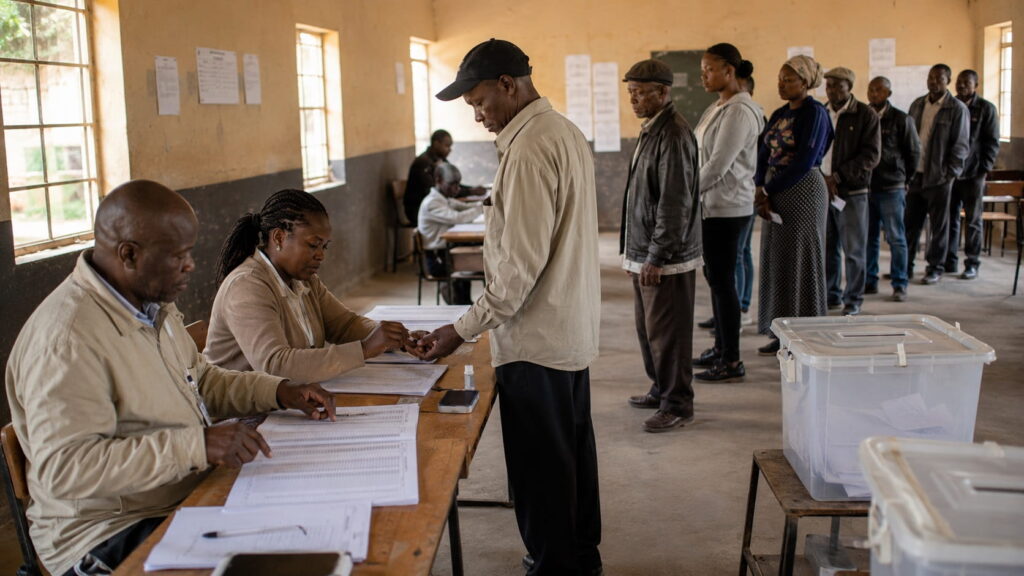
Election Day in Zambia does not run itself. Behind every smoothly operating polling station is a team of carefully trained election officials working in clearly defined roles. Among them, the polling assistant is one of the most visible and most relied upon. Understanding the duties of a polling assistant in Zambia is important, not just for those taking up the role, but for every voter who wants to know what to expect when they walk through the door on election day. These are the people voters interact with first, and the people who keep queues moving, ballots secure, and procedures honest.
So, who exactly is a polling assistant in Zambia? What are they allowed, and not allowed, to do? And what does the law say about their appointment and conduct?
This guide answers all of those questions in one place, drawing directly from the Electoral Process Act No. 35 of 2016 and the official guidelines of the Electoral Commission of Zambia (ECZ).
Quick Answer: A polling assistant in Zambia helps conduct elections by verifying voters against the Register of Voters, applying indelible ink to voters’ thumbs, issuing Presidential, National Assembly, and Local Government ballot papers, directing voters to the correct compartments, protecting ballot boxes, assisting with vote counting, and ushering voters to the correct streams. Polling assistants work under the direct supervision of the Presiding Officer, who is in charge of the polling station, as provided under Section 40 of the Electoral Process Act No. 35 of 2016.
In this Article:
- Who Is a Polling Assistant in Zambia?
- Appointment of Polling Assistants in Zambia
- The Core Duties of a Polling Assistant in Zambia
- What a Polling Assistant in Zambia Is Not Allowed to Do
- The Legal Framework Governing Polling Assistants in Zambia
- Who Is in Charge of the Polling Station in Zambia?
- Who Is Polling Staff in Zambia?
- What Is the Role of the Returning Officer in an Election in Zambia?
- How Polling Assistants Fit Into the Broader Election Structure
- Why the Role of a Polling Assistant in Zambia Matters
- Frequently Asked Questions
- Final Thoughts on the Duties of a Polling Assistant in Zambia
Who Is a Polling Assistant in Zambia?
A polling assistant is a person formally appointed by the Electoral Commission of Zambia to assist at a polling station on election day. Under Section 39 of the Electoral Process Act No. 35 of 2016, the Commission has the authority to appoint polling assistants as election officers for any given election.
Polling assistants work directly under the supervision of the Presiding Officer and, where applicable, the Assistant Presiding Officer. They do not act independently, every function they carry out is in support of the overall conduct of the poll at their assigned station.
It is also worth noting that a polling assistant is formally classified as an election officer under the Electoral Process Act. This means they carry legal obligations, enjoy certain legal protections, and can face legal consequences for misconduct.
Appointment of Polling Assistants in Zambia
Before getting into the duties themselves, it helps to understand how a polling assistant is appointed, because the appointment process shapes the authority they carry.
Section 39 of the Electoral Process Act No. 35 of 2016 gives the Commission the power to appoint polling assistants. In practice, the District Electoral Officer handles appointments at the district level on behalf of the Commission. An appointment can also be revoked by the same authority, meaning polling assistants serve at the ECZ’s discretion.
For a person to qualify for appointment as a polling assistant in Zambia, the ECZ requires the following:
- A Grade 12 Certificate with a pass in English and Mathematics
- A tertiary education qualification (this is an added advantage, not a strict requirement)
- Valid registration as a voter
- Zambian citizenship evidenced by a green National Registration Card
In addition to those qualifications, the ECZ expects certain personal attributes from anyone serving in this role:
- Must be non-partisan — this point cannot be overstated
- Must be sober-minded, self-motivated, and mature
- Must be of high integrity
- Must be a good team player
- Must be able to follow and implement lawful orders at short notice
The non-partisanship requirement is especially important. A polling assistant cannot visibly support any candidate or political party during an election. Doing so is grounds for removal and can expose the official to legal liability under election offence provisions.
The Core Duties of a Polling Assistant in Zambia
Now to the heart of the matter. The ECZ officially lists six key functions that a polling assistant can be assigned on election day. These duties are not rigid in the sense that every polling assistant does all six — rather, the Presiding Officer assigns specific roles from this list based on the needs of the station.
Here is a summary of all the duties at a glance, followed by a full explanation of each one:
| Duty | Description |
|---|---|
| Verify Voters | Check each voter’s details against the Register of Voters |
| Apply Indelible Ink | Mark the voter’s thumb to prevent double voting |
| Issue Ballot Papers | Hand out all applicable ballot papers — Presidential, Parliamentary, Local Government, and (from 2026) Proportional Representation |
| Direct Voters | Guide voters to the correct voting compartments |
| Protect Ballot Boxes | Monitor and ensure the security of ballot boxes throughout the poll |
| Assist with Counting | Help the Presiding Officer sort, tally, and record votes after the poll |
| Usher Voters to Streams | Direct voters to their correct stream at the point of entry |
1. Verifying the Identity of Voters in the Register of Voters
This is often the very first duty a voter encounters when they arrive at the polling station. The polling assistant assigned to voter verification checks each person’s details against the Register of Voters, the official list of registered voters for that polling station.
In Zambia, voter identification during an election is governed by Section 45 of the Electoral Process Act. A voter must present acceptable identification before they are allowed to proceed. The polling assistant at this point confirms that the person presenting themselves is actually on the register for that station.
This step matters enormously. If it is done carelessly, impersonation becomes possible. If it is done correctly, it protects the integrity of every vote cast in that station.
2. Marking Voters’ Thumbs with Indelible Ink
Once a voter’s identity is confirmed, a polling assistant applies indelible ink to the voter’s thumb. This is a straightforward but critical anti-fraud measure. The ink prevents a person from voting more than once, at the same station or at any other.
The ink used is specifically designed to be long-lasting. It does not wash off quickly. Any person who arrives at a polling station already bearing the mark is, therefore, immediately flagged as having already voted.
This duty requires attention to detail and a degree of consistency. The mark must be applied properly every single time, without exception.
3. Issuing Ballot Papers for All Elections
Zambia typically holds multiple elections simultaneously. In a general election, voters cast separate ballots for the Presidential, Parliamentary (National Assembly), and Local Government elections. As of the 2026 general election, a fourth ballot type has been added, a proportional representation (party list) ballot, introduced by the Electoral Process (Amendment) Act, 2026, following constitutional changes that created 40 proportional representation seats in the National Assembly reserved for women, youth, and persons with disabilities.
A polling assistant assigned to ballot issuance therefore handles the distribution of all applicable ballot papers to each voter who has been verified and inked. It is also worth noting that the 2026 Amendment removed the use of the official mark, the stamp previously applied to the back of ballot papers before issuance, so that step no longer forms part of the procedure.
The polling assistant must issue the correct ballot papers to each voter. Issuing the wrong type, issuing duplicates, or failing to follow the prescribed procedure at this stage can create serious problems, both for the voter and for the integrity of the count. Therefore, this role demands focus, accuracy, and strict adherence to instructions.
4. Directing Voters and Guarding the Ballot Boxes
After a voter receives their ballot papers, they need to know where to go. A polling assistant assigned to this function directs voters to the correct voting compartments, ensuring orderly movement inside the station. They also keep an eye on the ballot boxes, making sure no unauthorised person approaches or interferes with them.
This duty is partly about flow management and partly about security. A polling station where voters are milling around without direction quickly becomes chaotic. And a ballot box that is left unmonitored even briefly creates a window for tampering.
Together, these two responsibilities, directing voters and guarding the boxes, help maintain both order and trust in the process.
5. Assisting the Presiding Officer During the Counting of Votes
When the polls close, the work does not end for a polling assistant. One or more assistants are tasked with helping the Presiding Officer count the votes cast at the station. Counting must follow a specific procedure under the Electoral Process Act. Ballot papers are sorted, tallied, and recorded in a way that is transparent and verifiable.
Polling agents of candidates and accredited observers have the right to witness this process. The polling assistant’s job during counting is to support the process accurately and impartially, not to advocate for any outcome. Any errors at this stage can affect the announcement of results and, in contested situations, lead to legal challenges.
6. Ushering Voters to the Correct Polling Streams
Larger polling stations in Zambia are often divided into streams, separate sections handling voters in alphabetical groupings or other arrangements. A polling assistant assigned as an usher guides each voter to the correct stream when they arrive.
This role may sound minor, but it has a real impact on efficiency. When voters end up in the wrong stream, it creates delays, confusion, and sometimes heated disagreements. An attentive usher prevents most of those problems before they start.
What a Polling Assistant in Zambia Is Not Allowed to Do
Understanding the limits of the role is just as important as understanding the duties themselves. Polling assistants must not:
- Act outside their assigned role without direction from the Presiding Officer
- Engage in partisan behaviour of any kind, including wearing party colours, making political comments, or showing preference for any candidate
- Assist a voter who has not been properly verified through the standard procedure
- Handle ballot materials or boxes unsupervised in ways that fall outside their assigned function
- Reveal how any voter voted — Section 91 of the Electoral Process Act imposes strict secrecy obligations on all election officers, including polling assistants
Breaching any of these rules can lead to removal from duty, prosecution under the Electoral Process Act, or both.
The Legal Framework Governing Polling Assistants in Zambia
Several sections of the Electoral Process Act No. 35 of 2016 are directly relevant to polling assistants:
Section 39 — Covers the appointment of polling assistants by the Commission.
Section 40 — Sets out the powers and duties of a polling assistant. This is the core legislative provision for everything discussed in this article.
Section 43 — Provides immunity to election officers, including polling assistants, for acts done in good faith in the performance of their duties. This is an important protection, though it does not cover misconduct.
Section 91 — Imposes the duty of secrecy on all election officers. A polling assistant cannot disclose how any person voted, and doing so is a criminal offence.
Section 92 — Lists offences by election officers, including wilful obstruction or failure to perform duties. Polling assistants are covered by this provision.
The earlier Electoral Act No. 12 of 2006 also provided for polling assistants under broadly similar terms, but the 2016 Act is the principal governing law and replaced its predecessor entirely. The 2016 Act has since been amended by Act No. 32 of 2021 and the Electoral Process (Amendment) Act, 2026. Neither amendment altered the sections specifically governing the appointment and duties of polling assistants, meaning Sections 39 and 40 remain intact as originally enacted.
Who Is in Charge of the Polling Station in Zambia?
This is one of the most commonly asked questions about how elections are run in Zambia, and the answer is straightforward. The Presiding Officer is in charge of the polling station.
Under Section 37 of the Electoral Process Act No. 35 of 2016, the Electoral Commission of Zambia appoints a Presiding Officer for every polling station. That person carries full responsibility for the conduct of the poll at their station from the moment it opens to the moment all materials are packed and dispatched after counting.
The Presiding Officer’s duties are extensive. According to the ECZ, they include:
- Conducting the election according to prescribed electoral procedures
- Ensuring adequate stocks of election materials before deployment
- Taking care of all equipment and materials under their custody
- Communicating problems to the Returning Officer or Assistant Returning Officer
- Recording the proceedings of the poll in a diary
- Counting the votes cast at the station and announcing results
- Maintaining order throughout the day
- Supervising all polling staff, including polling assistants
- Ensuring the return of all election materials and equipment after the poll
When the Presiding Officer is unavailable or needs support, the Assistant Presiding Officer steps in. This person is appointed to assist the Presiding Officer in the coordination and conduct of elections and handles any duties delegated to them.
So, to be clear: if you walk into a polling station in Zambia and something goes wrong, the Presiding Officer is the person responsible for sorting it out. Polling assistants and other station staff operate under their authority at all times.
Who Is Polling Staff in Zambia?
The term “polling staff” is commonly used to describe all the people working at a polling station on election day, but it is worth being precise about who that actually includes.
In Zambia, polling staff broadly refers to the election officers deployed to a polling station to conduct the poll. Based on the ECZ’s framework, polling staff at a station typically consists of:
The Presiding Officer — the officer in charge, responsible for the overall conduct of the election at the station.
The Assistant Presiding Officer — assists the Presiding Officer and acts in their place when needed.
Polling Assistants — the frontline workers who verify voters, apply ink, issue ballot papers, direct voters, guard ballot boxes, usher voters to their streams, and assist during counting. A station may have several polling assistants, each assigned a specific function.
Uniformed Staff (Security Personnel) — while not classified as polling assistants, uniformed personnel are also present at polling stations. Their role is to maintain law and order in the vicinity of and within the station, provide security for all poll staff, voters, equipment, and materials, and carry out any other duties assigned by the Presiding Officer.
Together, these individuals make up the full polling staff team at any given station. Each role is distinct. Each carries its own set of responsibilities. And all of them are answerable to the Presiding Officer.
One important distinction worth noting: polling agents are not polling staff. A polling agent is appointed by a candidate to observe the conduct of the poll on that candidate’s behalf. They have the right to be present and to raise objections, but they do not work for the ECZ and they have no authority over the voting process.
What Is the Role of the Returning Officer in an Election in Zambia?
If the Presiding Officer is in charge of a single polling station, the Returning Officer is in charge of an entire constituency. Their role is broader, more strategic, and critical to the outcome of the election at the constituency level.
The ECZ describes the Returning Officer’s role as coordinating and supervising the conduct of elections in a constituency. More specifically, their responsibilities include:
- Coordinating the packing and distribution of election materials across the constituency
- Coordinating the deployment of all poll staff to their assigned stations
- Receiving nominations from aspiring candidates ahead of the election
- Issuing certificates of authority to vote to election officers working outside their registered polling stations
- Inspecting all polling stations in the constituency to ensure they are suitable for the polls
- Ensuring that all polling staff are adequately trained before election day
- Collating results from all stations within wards and the constituency
- Declaring Local Government and Parliamentary election results for their constituency
- Announcing Presidential election results within the ward and constituency
- Conducting the verification of ballot paper accounts
- Ensuring the return of all election materials and equipment to the District Electoral Officer
In short, the Returning Officer is the person responsible for everything that happens at the constituency level, before, during, and immediately after the election. They are the main link between the polling stations and the district office, and they are accountable to the District Electoral Officer above them.
The Assistant Returning Officer supports the Returning Officer in all of these tasks and takes over when required.
For anyone wondering how election results move from individual polling stations to the official national tally, it is the Returning Officer who collects, verifies, and announces them at the constituency level first. That makes their role one of the most legally significant in the entire electoral process.
How Polling Assistants Fit Into the Broader Election Structure
To fully appreciate the role, it helps to see where polling assistants sit within the overall ECZ structure on election day.
At the top of the station hierarchy is the Presiding Officer, who — as established above — is the person in charge of the polling station. Below them is the Assistant Presiding Officer, who steps in when the Presiding Officer is unavailable and handles delegated tasks.
Polling assistants report to both of these officials. They are the frontline workers, the ones physically engaging with voters throughout the day. Above the station level, Returning Officers coordinate elections across a constituency, and District Electoral Officers oversee everything at the district level.
This chain of command means that when a polling assistant encounters a situation they cannot handle, a disputed voter, a disruption, a material shortage, they escalate it immediately to the Presiding Officer rather than attempting to resolve it unilaterally.
Why the Role of a Polling Assistant in Zambia Matters
It would be easy to underestimate the importance of a polling assistant. After all, they are temporary workers operating at the bottom rung of the election administration hierarchy. But that framing misses something important.
The polling assistant is often the only election official a voter physically interacts with. Their conduct, whether they are patient, fair, efficient, and non-partisan, shapes the voter’s experience of the entire democratic process. A polling assistant who treats voters with respect and follows procedures carefully contributes directly to public confidence in the election. One who is careless, biased, or easily distracted does real damage, not just to the outcome at that station, but to trust in the system as a whole.
Furthermore, because polling assistants are present during the count, their accuracy and integrity at that stage are consequential. Results announced at a polling station are the foundation of everything that follows, ward tallies, constituency results, national figures. Errors or misconduct during counting can cascade.
Frequently Asked Questions
Who is in charge of the polling station in Zambia?
The Presiding Officer is in charge of the polling station in Zambia. They are appointed by the ECZ under Section 37 of the Electoral Process Act No. 35 of 2016 and carry full responsibility for the conduct of the poll at their station, including supervising all polling staff, maintaining order, counting votes, and ensuring the return of all materials.
What is the role of the Returning Officer in an election in Zambia?
The Returning Officer coordinates and supervises elections at the constituency level. Their key responsibilities include deploying poll staff, receiving nominations, inspecting polling stations, collating results from all stations in the constituency, and declaring Parliamentary and Local Government election results. They work above the Presiding Officer and report to the District Electoral Officer.
Who is polling staff in Zambia?
Polling staff refers to all election officers working at a polling station on election day. This includes the Presiding Officer, the Assistant Presiding Officer, polling assistants, and uniformed security personnel. Polling agents, appointed by candidates to observe the poll, are not polling staff and carry no authority over the voting process.
Can a polling assistant refuse an instruction from the Presiding Officer?
A polling assistant is required to follow lawful orders from the Presiding Officer. If an instruction is unlawful, the assistant should not comply, but this is a rare situation. In practice, the Presiding Officer’s instructions are the framework within which the polling assistant operates.
Can a polling assistant be a member of a political party?
The ECZ requires polling assistants to be non-partisan in the performance of their duties. Active partisanship during an election disqualifies a person from serving and can result in removal.
What happens if a polling assistant makes an error during counting?
Section 76 of the Electoral Process Act provides a mechanism for correcting mistakes during the electoral process. The Presiding Officer oversees corrections during counting. Deliberate errors, however, can constitute an offence under Section 92.
Do polling assistants get paid?
Yes. Polling assistants receive an allowance from the ECZ for their service. The specific amount varies by election and is communicated during the appointment process.
Who can become a polling assistant?
Any Zambian citizen who is a registered voter, holds a Grade 12 certificate with passes in English and Mathematics, and meets the personal attribute requirements set by the ECZ is eligible. A tertiary qualification is a bonus.
Final Thoughts on the Duties of a Polling Assistant in Zambia
The duties of a polling assistant in Zambia are defined clearly by both the Electoral Commission of Zambia and the Electoral Process Act No. 35 of 2016. They cover voter verification, ink marking, ballot issuance, voter direction, ballot box security, vote counting support, and stream ushering.
But the polling assistant does not work in isolation. They are part of a structured polling staff team — one that includes the Presiding Officer (who is in charge of the polling station), the Assistant Presiding Officer, and uniformed security personnel. Above the station, the Returning Officer ties everything together at the constituency level, collating results and making formal declarations.
Understanding how all these roles connect is not just useful for civic education. It is what helps voters, candidates, observers, and the general public hold elections to account. When you know who is supposed to do what, you are better placed to notice when something is not being done correctly.
These may seem like operational details, but they are in fact the building blocks of a credible election. Every single time a polling assistant checks a voter’s details against the register, applies ink to a thumb, hands over a ballot paper, or directs someone to the right compartment, they are participating in a constitutional process that belongs to every Zambian.
That is not a small thing. It is, in fact, the whole point.
Sources: Electoral Commission of Zambia (ECZ) — Electoral Officials Page; The Electoral Process Act No. 35 of 2016, Parliament of Zambia; The Electoral Process (Amendment) Act No. 32 of 2021, Parliament of Zambia; The Electoral Process (Amendment) Bill, 2026 — Electoral Commission of Zambia.
Related Posts: