Quick Answer: What are labour laws in Zambia? Labour laws in Zambia are legal rules that govern the relationship between employers and employees. They cover employment contracts, working hours, minimum wages, leave entitlements, termination procedures, gratuity, and worker safety. The primary legislation is the Employment Code Act No. 3 of 2019, which replaced the older Employment Act (Cap. 268) and consolidated most employment rules into a single law.
Last Updated: May 2026 | Figures and provisions should be verified against current Statutory Instruments.
About This Guide This article summarises Zambia’s employment laws in plain English using the Employment Code Act No. 3 of 2019, publicly available Statutory Instruments, and government labour guidance from the Ministry of Labour and Social Security. It is written for educational purposes and does not constitute legal advice. Specific figures — including minimum wages, sick leave durations, and overtime rates — are subject to revision through new Statutory Instruments. Always verify current provisions with the MLSS at mlss.gov.zm, through the official Government Gazette, or by consulting a qualified Zambian labour lawyer.
Reviewed against: Publicly available provisions of the Employment Code Act No. 3 of 2019 and related Statutory Instruments. Last reviewed: May 2026. For legal advice specific to your situation: Contact the Labour Office, the Legal Aid Board of Zambia, or a qualified Zambian labour law practitioner.

Knowing your rights at work is not a luxury, it is a necessity. Whether you are a new employee signing your first contract, an employer setting up a business, a domestic worker trying to understand your entitlements, or an HR officer building a compliant payroll system, Zambia’s labour laws directly affect your daily life.
This guide breaks down the Employment Code Act and related regulations into plain language. It covers everything from minimum wages and leave days to gratuity, overtime, and what happens when employment ends, all drawn from Zambia’s actual legal framework.
Always confirm current figures and recent amendments with the Ministry of Labour and Social Security (MLSS) or a qualified labour lawyer, as regulations and statutory instruments can be updated.
At a Glance: Key Rules Under Zambian Labour Law
| Topic | General Rule (verify current figures with MLSS) |
|---|---|
| Annual Leave | Minimum 24 working days per year |
| Working Hours | Generally 48 hours per week maximum |
| Maternity Leave | 14 weeks on full pay |
| Paternity Leave | 5 working days |
| Gratuity | 25% of total basic pay (fixed-term contracts exceeding 12 months) |
| Weekly Rest Day | At least 1 day per week |
| Notice Period | 2 weeks to 3 months depending on length of service |
| Sick Leave | Short-term: 26 days full pay + 26 days half pay. Long-term: 3 months full pay + 3 months half pay |
| Probation | Typically up to 3 months |
| Overtime | 1.5× normal rate (weekdays); 2× normal rate (Sundays and public holidays) |
These are general guides based on the Employment Code Act No. 3 of 2019 and related subsidiary legislation as of May 2026. Always verify current provisions with the MLSS.
Free Download
Zambia Labour Law Quick Reference
One page. Leave days, gratuity formula, notice periods, overtime rates & official contacts. No sign-up required.
Table of Contents
- Employment Code Act Zambia: What It Covers
- Employment Contracts in Zambia
- Probation Periods Under Zambian Labour Law
- Working Hours in Zambia
- Overtime Laws in Zambia
- Minimum Wage in Zambia
- Salaries and Deductions Under Zambia Labour Law
- Leave Days in Zambia
- Maternity and Paternity Leave in Zambia
- Public Holidays in Zambia
- Gratuity in Zambia: Who Qualifies and How It's Calculated
- Termination of Employment in Zambia
- Notice Periods Under Zambia Labour Law
- Domestic Workers' Rights in Zambia
- Child Labour Laws in Zambia
- Workplace Safety Under Zambia Labour Law
- Labour Disputes and Complaints
- Employee Rights in Zambia
- How Workers Benefit From Understanding Labour Laws
- Know Your Rights: Practical Steps for Workers in Zambia
- Common Labour Law Mistakes Employers Make in Zambia
- Things Employees Should Never Ignore Under Zambian Labour Law
- Quick Legal Questions: Zambia Labour Law Answered
- FAQ: Labour Laws in Zambia
- Latest Labour Law Updates in Zambia
- When to Visit the Labour Office Immediately
- When You Should Contact a Labour Lawyer
Employment Code Act Zambia: What It Covers
The Employment Code Act No. 3 of 2019 is the cornerstone of labour law in Zambia. It came into force to replace the old Employment Act (Chapter 268) and bring multiple pieces of employment legislation under one roof.
Before this Act, Zambia’s employment rules were scattered across several laws — the Employment Act, the Minimum Wages and Conditions of Employment Act, the Factories Act, and others. The Employment Code Act consolidated most of these, making it easier for workers and employers to understand their obligations.
What the Act Covers
The Employment Code Act regulates:
- How employment contracts must be formed and written
- Minimum terms of employment (wages, hours, leave)
- Probation and confirmation of employment
- Termination, dismissal, and redundancy
- Gratuity entitlements
- Maternity and sick leave
- Domestic workers’ rights
- Child labour restrictions
- Remedies for unfair dismissal
The full text of the Employment Code Act No. 3 of 2019 is publicly available at the Zambia Legal Information Institute (ZambiaLII) and the Zambia Parliament website. The Act also gave statutory power to subsidiary legislation — particularly the Minimum Wages and Conditions of Employment (General) Order and the Minimum Wages and Conditions of Employment (Domestic Workers) Order — which set specific minimum wages for different categories of workers.
Important: Zambia’s labour regulations are updated through Statutory Instruments. Always verify current figures with the Ministry of Labour and Social Security or by visiting a Labour Office near you.
Key Takeaways: The Employment Code Act
- The Employment Code Act No. 3 of 2019 is the primary law governing employment in Zambia
- It replaced and consolidated several older employment laws into a single framework
- Minimum wages are set separately through Statutory Instruments, not the Act itself
- Subsidiary legislation — such as Domestic Workers’ Orders — sits under the Act’s authority
- The Act applies to most employees in Zambia, including domestic workers
Employment Contracts in Zambia
Every worker in Zambia is entitled to a written employment contract. The Employment Code Act makes this a legal requirement, not just best practice.

Types of Employment Contracts
| Contract Type | Description |
|---|---|
| Indefinite (Permanent) | No fixed end date; runs until terminated lawfully |
| Fixed-Term | Has a specific start and end date |
| Casual | Short-term, irregular work; different entitlements apply |
| Part-Time | Fewer hours than full-time; proportional entitlements |
What a Contract Must Include
A valid employment contract in Zambia should state:
- The names of the employer and employee
- The place of work
- Job title and description of duties
- Date employment begins
- Remuneration (salary, allowances, payment method)
- Working hours
- Leave entitlements
- Notice period
- Probation period (if applicable)
- Conditions for termination
Practical Example: If your employer tells you verbally that you earn K5,000 a month but your written contract says K4,500, the written contract will generally carry the strongest evidential weight in any dispute — unless there is clear proof of a separately agreed arrangement. Always read your contract carefully before signing.
Fixed-Term Contracts and Continuity
Under the Employment Code Act No. 3 of 2019, protections exist against the abuse of successive fixed-term contracts. Where a fixed-term contract is repeatedly renewed, or where an employee has worked continuously for an extended period doing the same work for the same employer, the employment relationship may in certain circumstances be treated as one of indefinite duration. The precise application of this principle depends on the specific facts and how the Act and any related provisions are interpreted — employees in this situation should seek advice from a Labour Officer or legal practitioner.
Key Takeaways: Employment Contracts
- The Employment Code Act No. 3 of 2019 requires all employment agreements to be in writing
- A contract must cover salary, hours, leave, notice period, and termination conditions
- Verbal contracts can create an employment relationship but are very difficult to enforce in disputes
- Fixed-term contracts repeatedly renewed may, in certain circumstances, be treated as indefinite employment
- Always read and keep a signed copy of your contract before starting work
Probation Periods Under Zambian Labour Law
The Employment Code Act No. 3 of 2019 allows employers to place new employees on probation to assess their suitability for a role.
Rules on Probation
- The probation period must be expressly stated in the written contract
- Section 27 of the Act introduced probation for the first time in Zambian law. The maximum probation period cited in MLSS guidance is three months; however, some legal practitioners’ analyses of the Act reference a period of up to six months. There is a genuine ambiguity in how the section is interpreted — verify the current position directly from the full text of Section 27 of the Employment Code Act No. 3 of 2019 at parliament.gov.zm or with a qualified labour lawyer before relying on either figure
- During probation, either party may generally terminate the contract on shorter notice than the standard post-confirmation notice periods — the specific period should be stated in the contract
- Where an employer does not notify the employee in writing of their confirmation following the probation period, the employee may be deemed confirmed in the position from the date of expiry of the probation period
- Employees on probation retain basic entitlements under the Act; probation does not suspend all legal protections
At the end of probation, the employer should formally confirm the employee’s appointment in writing or bring employment to an end lawfully.
Working Hours in Zambia
Legal Working Hours
Quick Answer: The standard legal working hours in Zambia are generally 48 hours per week for most employees, typically spread over six days. The Employment Code Act No. 3 of 2019 and related subsidiary legislation set these limits. Some sectors or categories of workers may be subject to different provisions under applicable orders — always check the relevant Statutory Instrument for your sector.
| Category | Maximum Hours Per Week |
|---|---|
| General employees | 48 hours |
| Employees in continuous operations (e.g., security, hospitals) | May differ; check applicable order |
| Night workers | Subject to specific conditions |
Employers cannot require employees to work more than the legal maximum without paying overtime.
Rest Periods
Workers are entitled to:
- A rest break during a working day (typically at least 30 to 60 minutes for shifts above a certain length)
- A daily rest period between the end of one shift and the start of the next
- A weekly rest period of at least one day — typically Sunday, though this can vary by industry
Employees are generally entitled to at least one weekly rest day under applicable labour laws and conditions of employment orders. Some industries use lawful rotating schedules or compensatory rest arrangements — the key requirement is that adequate rest is provided in compliance with the applicable order.
Overtime Laws in Zambia
Overtime applies when an employee works beyond their contracted or legal hours. The Employment Code Act and its subsidiary instruments regulate how overtime must be compensated.
Overtime Pay Rules
Under the Employment Code Act and the applicable subsidiary orders, overtime rates are as follows for most categories of employees:
- Overtime worked on ordinary working days must be paid at a rate of at least 1.5 times the normal hourly rate
- Work on a weekly rest day (typically Sunday) must be paid at double the normal rate (2×)
- Work on a public holiday is compensated at the highest applicable rate — typically double time or as specified in the relevant order
These rates reflect the Employment Code Act’s provisions and are confirmed by the applicable subsidiary instruments. Your individual contract or a collective bargaining agreement may provide for higher rates, which must be honoured. If you are unsure which order applies to your category of work, check with the Labour Office.
Documenting Overtime
Workers who regularly work beyond their contracted hours and are not paid for it are entitled to raise this as a labour dispute. Keep records of your actual start and end times each day. Written records, even in a personal notebook, can be useful evidence.
Common Scenario: Unpaid Overtime Mary works at a supermarket in Lusaka from 08:00 to 19:00, six days a week. Her contract states a standard 48-hour week, but she regularly works over 60 hours with no additional pay, just a fixed monthly salary. Under Zambian labour law, those extra hours may qualify for overtime compensation at a rate of at least 1.5 times her normal hourly rate. Mary starts keeping a daily log of her actual hours. When her employer refuses to act on her written complaint, she visits the Labour Office with her log and payslips. A Labour Officer contacts the employer to begin mediation.
Minimum Wage in Zambia
Quick Answer: Zambia’s minimum wage is set by the government through statutory instruments under the Minimum Wages and Conditions of Employment Act. The rates differ by category of worker and are periodically revised.
How Minimum Wage Is Set
The Minister of Labour and Social Security has the power to set minimum wages for different sectors and categories of workers under the Minimum Wages and Conditions of Employment Act. These are published as Statutory Instruments (SI) and take legal effect from the date specified.
Current Minimum Wage Orders
As of January 2024, minimum wages in Zambia are set by three Statutory Instruments issued in 2023:
- Employment Code (General Workers Minimum Wages and Conditions of Employment) Order, 2023 — covers general workers including hotel, catering, and transport
- Employment Code (Shop Workers Minimum Wages and Conditions of Employment) Order, 2023 — covers retail and shop employees
- Employment Code (Domestic Workers Minimum Wages and Conditions of Employment) Order, 2023 — covers household workers, maids, gardeners, and similar
Additional sector-specific orders exist — for example, Statutory Instrument No. 3 of 2025 revised wages for bus and truck drivers. The specific monthly figures within each order should always be verified directly from the Ministry of Labour and Social Security or the official Zambia Government Gazette, as they are subject to revision.
For Workers: If you are being paid below the legal minimum for your category, this is a violation of Zambian labour law. You have the right to report this to the nearest Labour Office.
For Employers: Paying below the minimum wage exposes your business to fines, back-pay orders, and prosecution. The Ministry of Labour and Social Security conducts inspections and can take action against non-compliant employers.
Last Verified Notice: Minimum wage figures in Zambia are revised periodically through new Statutory Instruments. Any specific figures cited online, including on this page, may become outdated following a revision. Always verify the current applicable minimum wage against the latest Statutory Instruments issued by the Ministry of Labour and Social Security, available at mlss.gov.zm or through the official Zambia Government Gazette.
Salaries and Deductions Under Zambia Labour Law
Pay Day Rules
Employers must pay employees on the agreed pay day. Consistently delaying salary payments is a breach of the employment contract.
Lawful Deductions
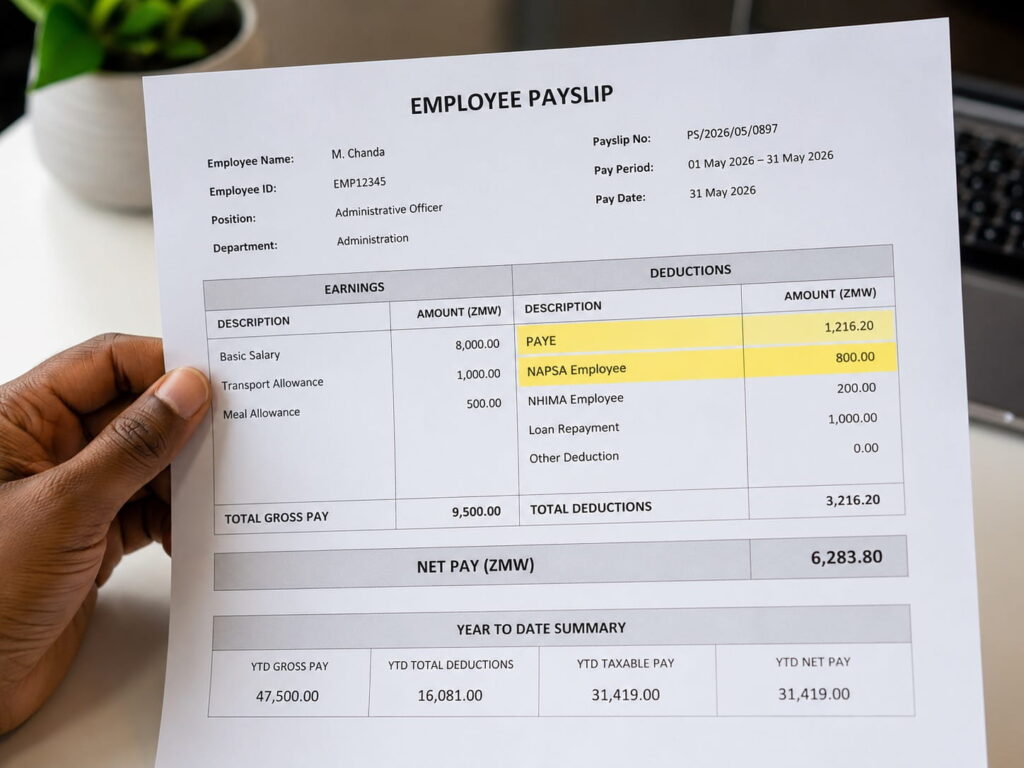
The Employment Code Act limits what employers can deduct from wages. Lawful deductions include:
- PAYE (Pay As You Earn income tax) — remitted to ZRA
- NAPSA (National Pension Scheme Authority) contributions — both employer and employee contribute; verify current rates at napsa.co.zm
- NHIMA (National Health Insurance Management Authority) contributions — verify current rates at nhima.co.zm
- Court-ordered deductions (e.g., maintenance orders)
- Deductions agreed in writing by the employee (e.g., salary advance repayments)
Unlawful Deductions
Employers generally cannot deduct wages as a penalty for poor performance, lateness, or mistakes — unless specifically permitted by a written agreement, collective bargaining agreement, or other applicable legal provision, and even then within legal limits. Deducting wages simply because the employer is displeased, without any legal basis, is unlawful.
Example: A retail shop assistant breaks a display item worth K500. The employer generally cannot simply dock K500 from the next salary without the employee’s written consent and in compliance with the Act’s deduction limits. The appropriate route is to address the matter through the disciplinary process, not through unilateral wage reduction.
Payslips
Employees are entitled to payslips showing gross pay, all deductions (with reasons), and net pay. The Employment Code Act No. 3 of 2019 supports the employee’s right to transparent wage records. If you never receive a payslip, ask your employer — this is a basic right.
Leave Days in Zambia
Leave entitlements under Zambian labour law are among the most commonly misunderstood areas. Workers often do not know how many days they are entitled to, and some employers misrepresent leave policies. See also our dedicated guide: Leave Days in Zambia Explained.
Types of Leave and Entitlements
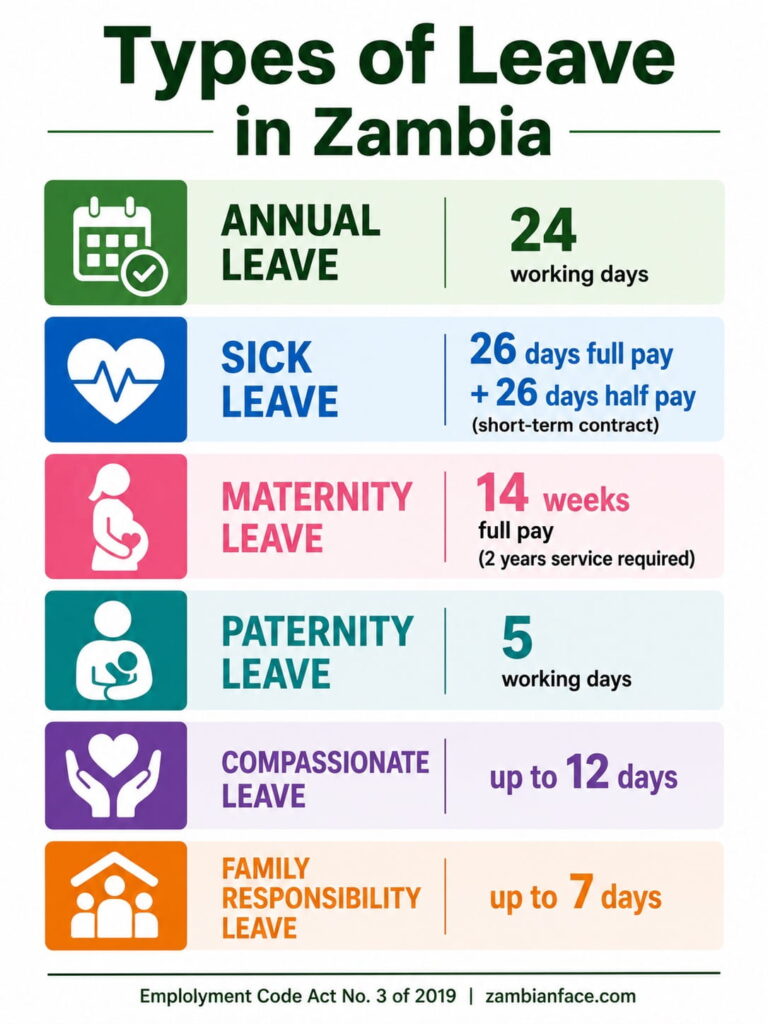
Quick Answer: Employees in Zambia are entitled to a minimum of 24 working days of annual leave per year under the Employment Code Act. Additional leave types include sick leave, maternity leave, and paternity leave.
| Leave Type | Entitlement | Notes |
|---|---|---|
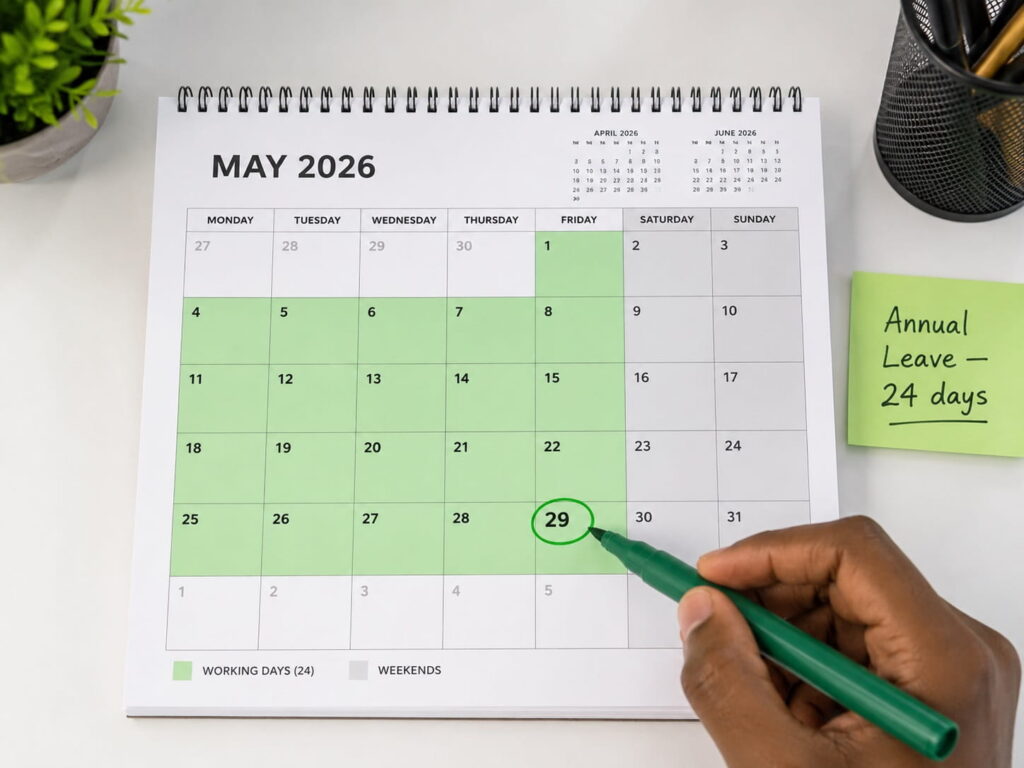
| Annual Leave | Minimum 24 working days per year | Pro-rated for periods less than a year |
| Sick Leave | Short-term contracts: 26 days full pay + 26 days half pay. Long-term contracts: 3 months full pay + 3 months half pay | Medical certificate may be required after 3 consecutive days |
| Maternity Leave | 14 weeks (98 days) on full pay | Requires 2 years continuous service; +4 weeks for multiple births; 6 weeks for miscarriage/stillbirth in third trimester |
| Paternity Leave | 5 working days | For male employees on birth of child |
| Compassionate Leave | Typically 5 working days | For bereavement of close family member |
| Study Leave | By agreement | Not universally mandated |
These entitlements represent the statutory minimums. Individual contracts or collective agreements may provide better terms.
Annual Leave Rules
- Leave must generally be taken — employers are generally not permitted to simply pay workers instead of granting leave while employment continues, unless the employment is ending and untaken leave is being settled
- Unused leave can accumulate, but employers should agree in writing on carry-forward policies
- Leave days should be calculated on working days, not calendar days (weekends and public holidays do not count against your leave)
Example: An employee who works Monday to Friday has an annual leave entitlement of 24 working days. If they take leave from a Monday for three calendar weeks, they use 15 working days of leave (5 days × 3 weeks), not 21 calendar days.
Sick Leave in Zambia
The Employment Code Act provides for paid sick leave for all employees who are unable to work due to illness or injury. The entitlement differs depending on your contract type:
| Contract Type | Sick Leave Entitlement |
|---|---|
| Short-term contract (up to 12 months) | 52 working days total — first 26 days on full pay, next 26 days on half pay |
| Long-term contract (exceeding 12 months) | 6 months total — first 3 months on full pay, next 3 months on half pay |
After a certain number of consecutive sick days — typically three or more — the employer is entitled to request a medical certificate from a registered medical practitioner.
Using sick leave legitimately is not a disciplinary matter. Dismissing an employee solely for being absent on genuine, certified sick leave is potentially unfair dismissal under the Code.
Note: Always confirm current sick leave provisions with the Ministry of Labour and Social Security or a qualified legal practitioner.
Key Takeaways: Leave Days
- According to the Employment Code Act No. 3 of 2019, the minimum annual leave entitlement is 24 working days per year
- Leave is calculated on working days, not calendar days — weekends and public holidays do not count against your balance
- Sick leave differs by contract type: short-term employees get 52 working days (26 full pay + 26 half pay); long-term employees get 6 months (3 months full pay + 3 months half pay)
- Employers generally cannot replace annual leave with a cash bonus or allowance while employment continues
- Leave accumulates pro-rata — if you have worked six months, you have earned 12 working days
Common Scenario: Leave Days Denied Chilufya has worked at a construction company in Ndola for 18 months. He requests two weeks of annual leave in December but his supervisor tells him “there are no leave days here, we pay a small bonus instead.” This arrangement is not lawful. Under the Employment Code Act, Chilufya is entitled to at least 24 working days of annual leave per year, and his employer cannot substitute leave with an informal bonus payment unless employment is ending. Chilufya writes a formal request to HR, citing the Act. The company eventually grants him his leave in January after HR confirms the legal requirement.
Maternity and Paternity Leave in Zambia
Maternity Leave
Female employees are entitled to 14 weeks (98 days) of maternity leave on full pay under the Employment Code Act No. 3 of 2019, provided they have completed at least 2 years of continuous service with the same employer.
Key rules:
- Maternity leave must not be deducted from annual leave
- An employer cannot dismiss an employee for being pregnant or for taking maternity leave — this is unlawful discrimination
- An employee may take a portion of maternity leave before the birth and the rest after
- An employer cannot require an employee to resume work within six weeks of delivery unless a medical doctor certifies the employee fit to return
Extensions to the standard 14 weeks:
- +4 additional weeks where an employee gives birth to more than one baby (twins, triplets)
- +further weeks as recommended by a doctor where a premature birth occurs
- 6 weeks’ leave where an employee suffers a miscarriage in the third trimester or gives birth to a stillborn child, upon medical certification
Note: The 2-year qualifying service period is set in the Act. If you have worked for less than 2 years, verify your specific entitlement with the Labour Office, as different terms may apply.
Paternity Leave
Male employees who have worked for their employer for at least 12 months are entitled to 5 working days of paternity leave on full pay, to be taken within 7 days of the child’s birth. Like maternity leave, this cannot be counted as annual leave.
For Employers: Refusing maternity or paternity leave, or penalising workers for taking it, is a serious legal violation that can lead to labour complaints and compensation orders.
Common Scenario: Threatened With Dismissal for Pregnancy Nsansa is a receptionist at a private clinic in Lusaka. When she informs her manager she is three months pregnant, she is told her “contract will not be renewed” because the clinic “cannot afford to manage maternity cover.” Under the Employment Code Act, dismissing or refusing to renew a contract on grounds of pregnancy is unlawful discrimination. Nsansa’s fixed-term contract has eight months remaining. She documents the conversation in writing and files a complaint with the Labour Office. The employer is ordered to honour the remainder of her contract and provide the full 14 weeks of maternity leave when due.
Public Holidays in Zambia
Zambia observes a number of gazetted public holidays each year. Working on a public holiday without additional compensation is generally not permitted.
Public holidays in Zambia include:
- New Year’s Day (1 January)
- Independence Day (24 October)
- Heroes Day and Unity Day (July — exact dates may vary)
- Farmers’ Day (August)
- Youth Day (March)
- Good Friday and Holy Saturday
- Labour Day (1 May)
- Africa Day (25 May)
- Christmas Day (25 December)
The government occasionally adds or adjusts public holidays. Always check the official Zambia Government Gazette for the confirmed list each year.
If a public holiday falls on a Sunday, typically the following Monday is observed as the public holiday.
Gratuity in Zambia: Who Qualifies and How It’s Calculated
Gratuity is one of the most frequently searched topics in Zambia’s employment law landscape — and one of the most misunderstood. For a complete step-by-step breakdown with worked examples, see our guide: How Gratuity Is Calculated in Zambia.
Quick Answer: What is gratuity under Zambian labour law? Gratuity is a lump-sum payment made to an employee at the end of a fixed-term contract upon completion of a qualifying period of service. Under Section 73 of the Employment Code Act No. 3 of 2019, employees on long-term fixed-term contracts — meaning contracts exceeding 12 months — are entitled to gratuity at a rate of not less than 25% of total basic pay earned during the contract period. Exact qualification conditions, including exemptions for certain categories, should be verified with the MLSS or a qualified legal practitioner.
Who Qualifies for Gratuity?
Under the Employment Code Act No. 3 of 2019, gratuity is payable at the end of a long-term fixed-term contract — defined under the Act as a fixed-term contract whose duration exceeds 12 months. The entitlement applies where:
- The employee has served under such a contract and it has expired or been terminated
- The termination is not due to serious misconduct that would disentitle the employee
The Act’s Exemption Regulations (SI 48 of 2020) do exempt certain categories — including expatriate employees and, in some cases, employees in management or the domestic and agricultural sectors where specific written contract provisions apply. Where there is any doubt about qualification, seek guidance from the Labour Office or a qualified practitioner before assuming entitlement.
How Gratuity Is Calculated
The formula is straightforward:
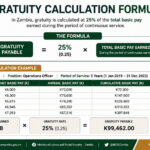
Gratuity = 25% × Total Basic Pay Earned During the Contract
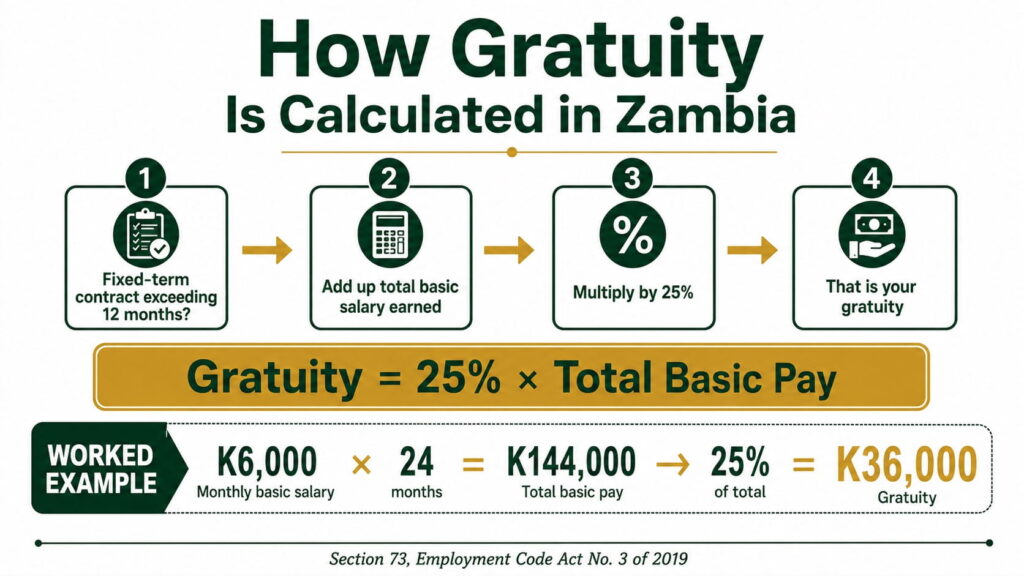
Example: An employee earns K8,000 per month as basic salary on a three-year fixed-term contract. Total basic pay over three years = K8,000 × 36 = K288,000. Gratuity = 25% × K288,000 = K72,000.
Important Notes on Gratuity
- Allowances (such as housing or transport allowances) are generally not included in the basic pay calculation for gratuity unless the contract specifies otherwise
- Gratuity is separate from terminal benefits and any notice pay
- Pro-rata gratuity: If a fixed-term contract is terminated before its expiry date — for reasons other than serious misconduct — the employee is entitled to receive gratuity on a pro-rated basis for the period actually served
- If an employee is dismissed for serious misconduct before the contract ends, gratuity entitlement may be affected — this depends on the specific circumstances and contract terms
- If an employer fails to pay gratuity, the employee can file a complaint with the Labour Office
Common Scenario: Gratuity Withheld at Contract End Misozi completed a two-year fixed-term contract as an administrative officer at a private school in Kitwe, earning K6,000 per month basic salary. When her contract expired, her employer told her she was not entitled to gratuity because “the contract never mentioned it.” Under Section 73 of the Employment Code Act, a long-term fixed-term contract exceeding 12 months qualifies for gratuity — it is a statutory right that does not need to be written into the contract. Misozi’s entitlement was 25% of her total basic pay: 25% × (K6,000 × 24 months) = K36,000. She filed a complaint at the Labour Office, which ordered the employer to pay the full amount within 30 days.
Gratuity vs. Severance Pay: What Is the Difference?
These two terms are often confused. They are legally distinct and carry different qualifying conditions.
| Term | When It Applies | Basis |
|---|---|---|
| Gratuity | End of long-term fixed-term contract (exceeding 12 months) | 25% of total basic pay earned |
| Severance Pay | Redundancy/retrenchment of permanent employees | Calculated differently under the Act |
Key Takeaways: Gratuity
- Under Section 73 of the Employment Code Act No. 3 of 2019, gratuity applies to long-term fixed-term contracts — those exceeding 12 months in duration
- The statutory rate is not less than 25% of total basic salary earned during the contract period
- Allowances such as housing and transport are generally excluded from the gratuity calculation
- Certain categories (expatriates, some management and domestic/agricultural sector employees) may be exempt under the Exemption Regulations (SI 48 of 2020)
- Gratuity is a statutory right — it does not need to be separately negotiated into a contract to apply
- If your employer refuses to pay gratuity, file a complaint at the Labour Office; time limits apply
Termination of Employment in Zambia
Not all job endings are the same under the Code. The Employment Code Act No. 3 of 2019 distinguishes between several types of employment termination, each with different legal consequences.
Types of Termination
| Type | Description |
|---|---|
| Resignation | Employee voluntarily leaves, with proper notice |
| Termination by employer (lawful) | With proper notice and valid reason |
| Summary dismissal | Immediate termination for serious misconduct |
| Redundancy / Retrenchment | Job eliminated due to operational reasons |
| Fixed-term contract expiry | Contract ends at the agreed date |
| Constructive dismissal | Employee forced to resign due to employer’s conduct |
Redundancy and Severance Pay
Where an employee is made redundant, they are entitled to a severance payment under Section 54 of the Employment Code Act. The formula is:
Severance Pay = 2 months basic pay × each year of service
Important exclusions: Under the Act, employees on long-term fixed-term contracts are generally not entitled to severance pay on redundancy — they receive gratuity instead (25% of total basic pay). Casual employees, temporary employees, and employees on probation are also excluded from severance pay. The severance provisions apply primarily to employees on short-term and permanent contracts.
An employer declared redundant cannot re-fill that position with a new employee within 9 months of the notice of termination taking effect without first offering the former employee the role.
Lawful Grounds for Dismissal
An employer can dismiss an employee for:
- Serious misconduct (theft, violence, gross insubordination, fraud)
- Repeated minor misconduct after warnings
- Incapacity (the employee is genuinely unable to perform their duties)
- Operational requirements (redundancy)
Procedural Fairness
Even when the reason for dismissal is valid, the process must also be fair. The Code requires:
- The employee must be notified of the allegations against them
- The employee must be given a chance to respond (a disciplinary hearing)
- The decision must be communicated in writing
Dismissal without following this procedure — even for genuine misconduct — may constitute procedurally unfair dismissal, entitling the employee to remedies.
Common Scenario: Dismissed Without a Hearing Cholwe, a cashier at a shop in Livingstone, is accused of miscounting change during a busy shift. His manager calls him into the office the next morning and hands him a letter saying his employment is terminated with immediate effect. No disciplinary hearing was held, and Cholwe was given no chance to explain himself. Even if the allegation were true, the dismissal may be procedurally unfair under Zambian law — the employer appears to have skipped the required hearing process. Cholwe takes his case to the Industrial Relations Court and argues procedural unfairness. The court may find in his favour on procedural grounds and could award compensation or reinstatement, depending on the specific circumstances and evidence presented.
Unfair Dismissal Remedies
An employee who is unfairly dismissed may seek:
- Reinstatement to their former position
- Re-engagement in a comparable position
- Compensation (an award of money in lieu of reinstatement)
Claims for unfair dismissal are made to the Labour Commissioner’s Office or the Industrial Relations Court — the specialist court that handles employment disputes in Zambia.
Key Takeaways: Termination of Employment
- Zambian law recognises several types of employment endings, each with different legal consequences
- Even when a dismissal reason is valid, the employer must still follow a fair disciplinary process
- Summary dismissal — immediate termination without notice — is only lawful for serious misconduct
- An employee dismissed without a hearing may have grounds for procedural unfair dismissal at the Industrial Relations Court
- Remedies for unfair dismissal include reinstatement, re-engagement, or financial compensation
Notice Periods Under Zambia Labour Law
When employment ends, whether initiated by the employer or the employee, notice is generally required. The Employment Code Act No. 3 of 2019 provides minimum notice periods that vary depending on the type of contract, payment method, and length of service. The table below is an illustrative guide only based on the Act’s general structure — employers and employees should verify the exact applicable notice period under the Act and any sector-specific orders before relying on these figures.
| Length of Service | Illustrative Minimum Notice Period |
|---|---|
| Less than 3 months (during probation) | At least 2 weeks (verify in contract) |
| 3 months to 2 years | Generally at least 1 month |
| More than 2 years | Generally at least 3 months |
These represent statutory minimums under the general framework. Your individual contract or a collective bargaining agreement may provide for longer notice periods, which must be honoured.
Note: Notice period provisions in the Employment Code Act should be read alongside any applicable subsidiary instruments for specific sectors. If in doubt about which provisions govern your employment, seek advice from the labour authorities or a qualified practitioner.
Payment in Lieu of Notice: Where neither party wishes to serve out the notice period, the employer may pay the employee a sum equivalent to their salary for the notice period — known as “pay in lieu of notice.” The reverse applies if the employee wishes to leave immediately; they may be required to pay the employer an equivalent amount, subject to the terms of the contract.
Domestic Workers’ Rights in Zambia
Domestic workers, including household workers, maids, gardeners, cooks, and nannies, are among the most vulnerable workers in Zambia. Many are unaware of their legal rights, and some employers exploit this. The Employment Code Act No. 3 of 2019, read alongside the Minimum Wages and Conditions of Employment (Domestic Workers) Order, provides the legal framework protecting this category of workers. For a full breakdown of their entitlements, see our supporting guide: Domestic Workers’ Rights in Zambia.
Quick Answer: What rights do domestic workers have in Zambia? Domestic workers in Zambia are legally protected under the Employment Code Act and the Employment Code (Domestic Workers Minimum Wages and Conditions of Employment) Order, 2023. They are entitled to a minimum wage, leave days, rest periods, and protection against unfair dismissal. Verify current rates at mlss.gov.zm.
Minimum Wage for Domestic Workers
Domestic workers are covered by the Employment Code (Domestic Workers Minimum Wages and Conditions of Employment) Order, 2023, which took effect from January 2024. This sets the minimum monthly wage for household workers. Because the figures within this Order may be revised by subsequent instruments, always verify the current rate with the Ministry of Labour and Social Security — figures cited elsewhere online may no longer be current.
Key Rights of Domestic Workers
- Written contract: A domestic worker is entitled to a written contract of employment
- Minimum wage: Employers must pay at least the gazetted minimum for domestic workers
- Annual leave: At least 24 working days per year
- Sick leave: As provided under the Employment Code Act
- Rest days: At least one full day off per week
- Maternity leave: Female domestic workers are entitled to 14 weeks’ maternity leave on full pay
- Accommodation: If accommodation is provided, it must be habitable — employers cannot deduct unreasonable amounts for housing
- Safe working environment: The home is a workplace under Zambian law; domestic workers must not be subjected to abuse or unsafe conditions
What Domestic Workers Should Do If Their Rights Are Violated
- Keep records of hours worked, pay received, and any issues
- Write to your employer about the specific complaint
- If unresolved, visit the nearest Labour Office and file a formal complaint
- The Labour Office can investigate, mediate, and refer cases to the Industrial Relations Court if necessary
Note: Domestic workers sometimes fear losing their jobs if they complain. The law protects workers from being dismissed for making legitimate labour complaints, dismissing someone for complaining is itself a labour law violation.
Common Scenario: Domestic Worker With No Rest Day Chanda works as a live-in maid for a family in Lusaka’s Kabulonga neighbourhood. She works every day of the week from 06:00 to 20:00 with no day off and no overtime pay. Her employer claims that because she lives in the home, she is “always at work” and does not qualify for leave or rest days. This is incorrect. Zambian law entitles domestic workers to at least one full rest day per week and a minimum wage regardless of live-in arrangements. Chanda contacts the Labour Office after a neighbour advises her of her rights. An inspector visits the household and instructs the employer to comply immediately with the Domestic Workers’ Order.
Child Labour Laws in Zambia
The Employment Code Act sets clear restrictions on child labour in line with Zambia’s international obligations.
Key Rules
- Children under 15 years of age cannot be employed in any form of work
- Young persons between 15 and 18 years can only be employed in light work that does not harm their health, development, or schooling
- No person under 18 may be employed in hazardous work (mining, construction, exposure to dangerous chemicals, night shifts, etc.)
Employers who hire underage workers face serious legal consequences, including prosecution. Schools and community members are encouraged to report child labour to the Labour Office or social welfare authorities.
Workplace Safety Under Zambia Labour Law
Every worker has the right to work in a safe environment. Workplace safety in Zambia is regulated by several laws, including the Occupational Health and Safety Act and provisions within the Employment Code Act.
Employer Responsibilities for Safety
Employers must:
- Provide safe working conditions and equipment
- Train workers on safety procedures
- Maintain machinery and facilities to prevent accidents
- Report workplace accidents to the relevant authority
- Carry workers’ compensation insurance
Workers’ Rights on Safety
An employee can refuse unsafe work without facing dismissal. If you are asked to perform a task that presents a clear and immediate danger to your health or life, Zambian law allows you to decline and report the issue to your supervisor or the Occupational Health and Safety Inspector.
Labour Disputes and Complaints
Disagreements between workers and employers are common. Zambia’s employment authorities have established clear processes for resolving them without requiring costly court cases.
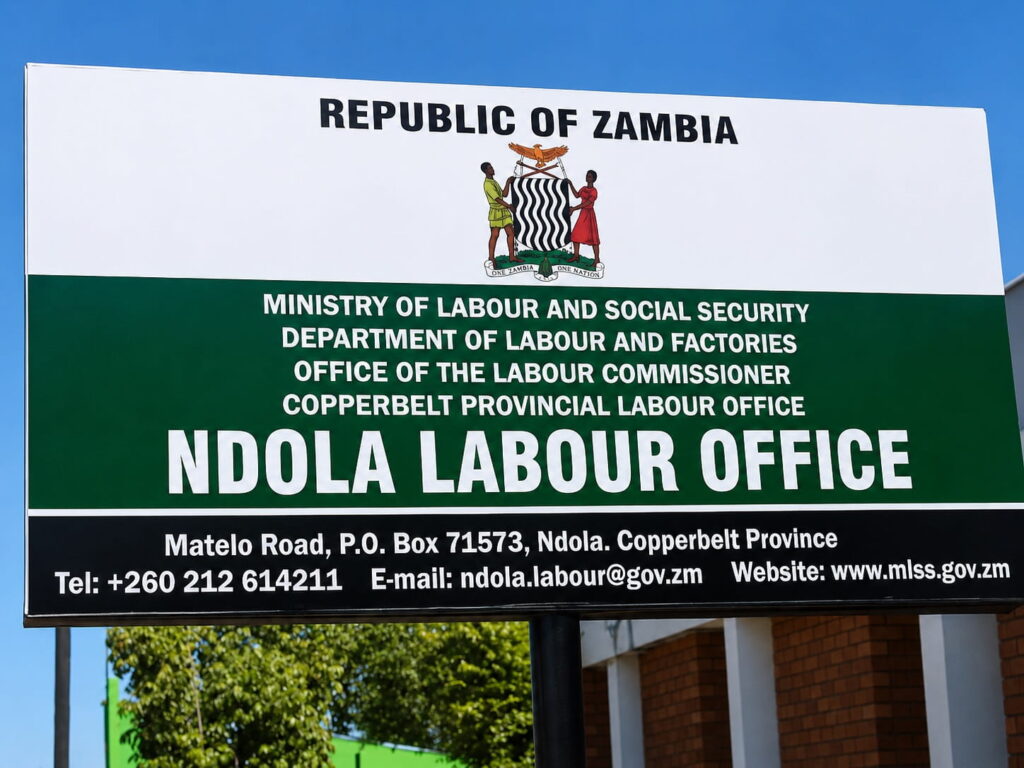
How to Resolve a Labour Dispute
Step 1 — Internal Resolution Try to resolve the matter internally. Write a formal letter to your employer or HR department outlining the specific issue.
Step 2 — Labour Office Complaint If internal efforts fail, visit the nearest Labour Office under the Ministry of Labour and Social Security. Bring:
- Your employment contract (if you have it)
- Any pay slips you have received
- Records of the issue (dates, amounts, written communications)
- Your National Registration Card (NRC) or other identification
A Labour Officer will attempt to mediate between you and your employer.
Step 3 — Industrial Relations Court If mediation fails, the case can be referred to the Industrial Relations Court (IRC), which has the power to make binding orders — including reinstatement and payment of outstanding wages or benefits.
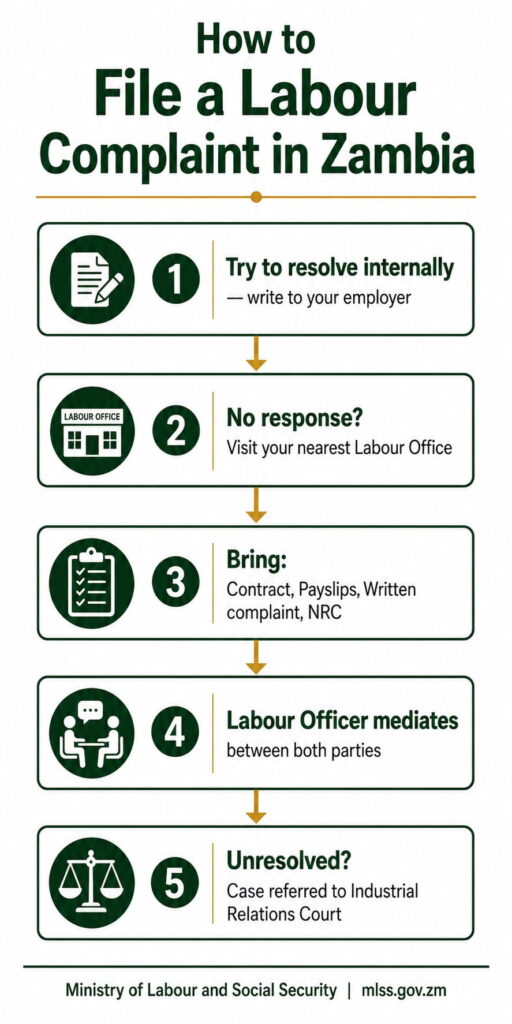
Labour Office Locations
The Ministry of Labour and Social Security has Provincial Labour Offices across Zambia’s provinces. You can find contact details at mlss.gov.zm.
Time Limits for Complaints
Labour complaints have time limits. If you delay too long, you may lose your right to pursue certain claims. As a general rule, file complaints as soon as reasonably possible after the issue arises.
Employee Rights in Zambia
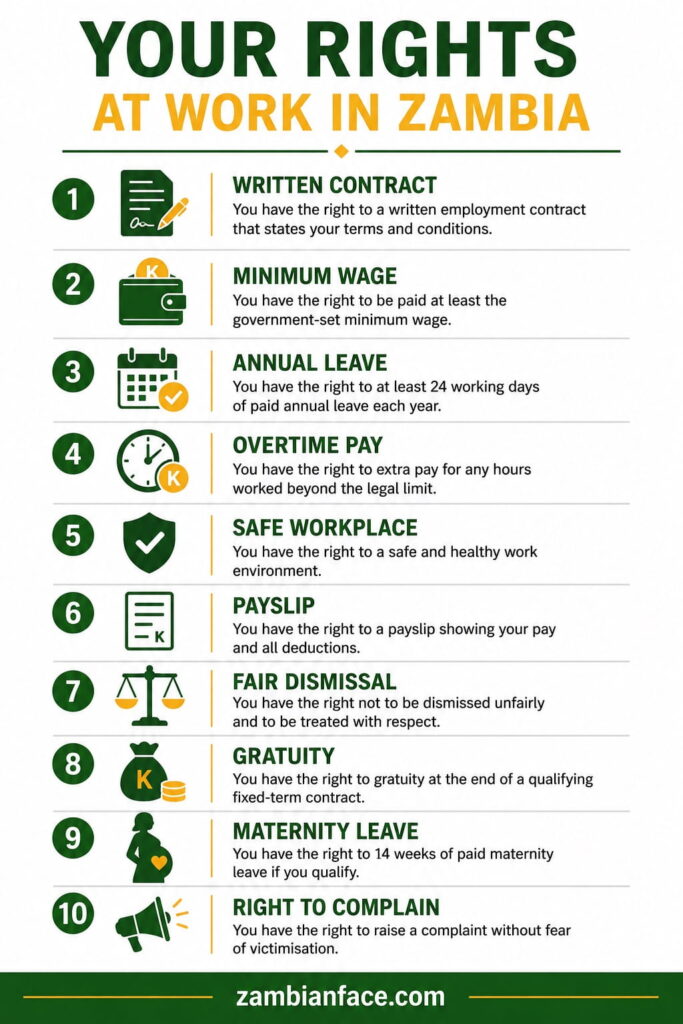
Summary of Key Employee Rights
| Right | What It Means |
|---|---|
| Right to a written contract | Cannot be denied a written employment agreement |
| Right to minimum wage | Cannot be paid below the gazetted minimum |
| Right to leave | Annual, sick, maternity, and paternity leave entitlements |
| Right to overtime pay | Extra pay for work beyond legal hours |
| Right to a safe workplace | Employer must provide safe conditions |
| Right to fair dismissal | Cannot be dismissed without cause or process |
| Right to gratuity | Payable on long-term fixed-term contracts exceeding 12 months |
| Right to a payslip | Entitled to a written record of pay and deductions |
| Right to join a union | Freedom of association is protected |
| Right to lodge complaints | Cannot be penalised for making legitimate labour complaints |
Summary of Key Employer Responsibilities
| Responsibility | Legal Requirement |
|---|---|
| Written contracts | Must provide before or on commencement of work |
| Pay at least minimum wage | Legal requirement for all categories |
| Pay on time | Cannot withhold or delay wages without cause |
| Provide leave | Must allow employees to take leave entitlements |
| Pay statutory deductions | PAYE, NAPSA, and NHIMA contributions |
| Keep payroll records | Maintain records for inspection |
| Conduct fair disciplinary processes | Follow procedure before dismissing |
| Pay gratuity when due | Cannot withhold gratuity on fixed-term contract expiry |
| Report workplace accidents | Duty to report to relevant authority |
How Workers Benefit From Understanding Labour Laws
Understanding Zambia’s labour laws is not just for lawyers. It has real, practical benefits for every working person.
For Workers
When you know your rights, you can:
- Spot when a contract is missing required information — and ask for corrections before you sign
- Calculate whether you are being paid the correct minimum wage
- Know exactly how many leave days you are owed and track them yourself
- Recognise when overtime is going unpaid — and document it
- Understand whether a dismissal is lawful — and know when to fight it
- Claim gratuity you may not have known you were entitled to
For Employers
Knowing the law equally protects employers:
- Prevents costly back-pay orders and fines from Labour Office investigations
- Reduces risk of Industrial Relations Court cases
- Creates clear policies that reduce disputes with staff
- Builds a professional, trustworthy workplace reputation
For Domestic Workers Specifically
Domestic workers who understand their rights are better protected from exploitation. Knowing that a weekly rest day is a legal requirement — not a favour — changes the employment relationship.
Know Your Rights: Practical Steps for Workers in Zambia
Activity 1: Review Your Employment Contract
Take your written contract and check for:
- Your exact salary and all allowances listed separately
- Your leave entitlement (should be at least 24 working days annual leave)
- Your notice period
- Probation period and its duration
- Overtime and working hours clauses
- Gratuity clause (if on a fixed-term contract)
What to do if something is missing: Ask your employer or HR department in writing to provide the missing information or a corrected contract.
Activity 2: Calculate Your Leave Balance
If you have worked for 12 months, you are entitled to at least 24 working days of leave.
If you have worked for less than 12 months, calculate your leave pro-rata:
Formula: (Months worked ÷ 12) × 24 = Leave days earned
Example: Worked 9 months → (9 ÷ 12) × 24 = 18 working days
Activity 3: Verify Minimum Wage Compliance
- Identify your worker category (general worker, clerical worker, domestic worker, etc.)
- Check the current minimum wage for your category from the MLSS website or a Labour Office
- Compare it to what you are actually being paid
Activity 4: Document Your Working Hours
For one week, record:
- Your actual start time each day
- Your actual end time each day
- Any unpaid break time
At the end of the week, calculate total hours worked. Compare this to your contracted hours. If you consistently work more than contracted, you may be owed overtime.
Activity 5: Prepare a Labour Complaint Record
If you have a complaint against your employer, prepare a written record including:
- Your name, employer name, and workplace address
- Nature of the complaint (e.g., “unpaid overtime from January to March 2024”)
- Specific amounts owed, if applicable
- Dates of incidents
- Names of any witnesses
- Copies of relevant documents (payslips, contract clauses, correspondence)
This record will be useful if you visit the Labour Office.
Want a one-page summary?
Download the free Zambia Labour Law Quick Reference PDF — print it, share it with your team, or keep it on your phone.
Common Labour Law Mistakes Employers Make in Zambia
1. Not Providing Written Contracts
Many small businesses and households that employ domestic workers still operate on verbal agreements. This leaves both parties unprotected and creates disputes over what was agreed.
2. Deducting Wages for Minor Mistakes
Deducting wages for broken goods, customer complaints, or small errors — without legal authority and written consent — is unlawful.
3. Ignoring Overtime
Some employers believe that paying a monthly salary means the employee must work as many hours as required. This is not how Zambian law works. Hours beyond the legal maximum must be compensated.
4. Treating Annual Leave as Optional
Some employers pressure workers not to take leave, or try to pay a small allowance instead. This does not satisfy the legal obligation. Employees must actually be allowed to take their leave.
5. Failing to Pay Gratuity
Employers sometimes argue that gratuity was “included in the salary” — but this must be clearly stated and compliant with the Code. Simply paying a higher salary and claiming it includes gratuity may not hold up legally when challenged.
6. Dismissing Without Process
Immediate dismissal without a disciplinary hearing — even for genuine misconduct — exposes the employer to unfair dismissal claims.
Things Employees Should Never Ignore Under Zambian Labour Law
Unsigned or No Written Contract
If you have been working for more than a month without a written contract, ask for one in writing. An employer’s refusal to provide one is itself a red flag.
No Payslip
Without a payslip, you cannot verify that deductions are legal or that your contributions to NAPSA and NHIMA are actually being made.
Maternity Leave Threats
Any threat of dismissal for pregnancy or maternity leave is illegal. Document the threat and report it.
Working Seven Days a Week Without a Day Off
You are entitled to at least one rest day per week. Working without any rest day, especially for domestic workers, is a violation.
Gratuity Withheld on Contract Expiry
If your fixed-term contract exceeding 12 months has ended and no gratuity has been paid, do not accept this silently. File a complaint at the Labour Office.
Quick Tips
- Always keep a personal copy of your signed employment contract
- Never sign a blank document at your employer’s request
- Keep payslips — they are evidence of your employment terms
- If you are given a disciplinary letter, respond in writing and keep a copy
- Before applying for jobs, make sure your application letter is strong, see our guide on how to write an application letter for a job in Zambia
Quick Legal Questions: Zambia Labour Law Answered
Zambia labour laws cover far more than most workers and employers realise. Beyond the main provisions of the Employment Code Act No. 3 of 2019, everyday workplace situations raise specific legal questions that are not always easy to find answers to. This section addresses the most commonly searched labour law questions in Zambia, from salary reductions and verbal contracts to dismissal without warning, NAPSA obligations, and domestic worker rights. Each answer is grounded in the Employment Code Act and related subsidiary legislation. For situations specific to your employment, always confirm with the Ministry of Labour and Social Security or a qualified Zambian labour lawyer.
Can an Employer Fire You Without Notice in Zambia?
Only in cases of serious misconduct — such as theft, fraud, or physical violence — can an employer terminate employment without giving notice. Even then, a fair disciplinary hearing must be held first. For all other dismissals, the Employment Code Act No. 3 of 2019 requires minimum notice periods based on length of service. Firing someone with no notice and no hearing is almost always unlawful and can result in unfair dismissal claims at the Industrial Relations Court.
How Is Gratuity Calculated in Zambia?
Gratuity is calculated at not less than 25% of total basic salary earned over the duration of a qualifying fixed-term contract. Under the Employment Code Act No. 3 of 2019, a qualifying contract is one that exceeds 12 months in duration, referred to in the Act as a “long-term contract.” For example, an employee earning K7,000 per month basic salary over a two-year contract would be entitled to: 25% × (K7,000 × 24) = K42,000. Allowances such as housing or transport are generally excluded. Note that certain categories of employees, including expatriates and, under the Exemption Regulations, some domestic and agricultural sector workers — may have different treatment; verify your specific situation with the Labour Office or a legal practitioner.
What Is the Minimum Wage for Maids in Zambia?
Domestic workers, including household maids, are covered by the Employment Code (Domestic Workers Minimum Wages and Conditions of Employment) Order, 2023, which took effect from January 2024. This sets the minimum monthly wage for all household workers regardless of whether a written contract exists. Because the figures within this Order may be revised by subsequent instruments, always verify the current rate directly with the Ministry of Labour and Social Security or at the nearest Labour Office.
Are Payslips Mandatory in Zambia?
Yes. Employers in Zambia are required to provide employees with a payslip, or a written statement of earnings — showing gross pay, each deduction made (and the reason for it), and the net amount paid. This requirement supports transparency and enables employees to verify that statutory deductions like NAPSA and NHIMA contributions are being correctly applied. If you are not receiving payslips, request them in writing. Persistent refusal by an employer to provide payslips is itself a matter you can raise with the Labour Office.
Can an Employer Refuse to Give You Leave Days in Zambia?
Generally, no. Annual leave is a statutory entitlement under the Employment Code Act No. 3 of 2019. An employer can schedule when leave is taken — for example, to manage operational needs, but is generally not permitted to refuse leave entirely or to substitute it with a cash payment while employment continues. If your employer is consistently blocking or denying your leave, you have the right to raise this as a formal complaint at the Labour Office.
Can an Employer Reduce Your Salary Without Consent?
Generally, no — not without your written consent. Salary is a core term of your employment contract, and a unilateral reduction without agreement would ordinarily constitute a breach of that contract. If your employer reduces your pay without your consent, you can raise this with the Labour Office. Accepting a reduced salary in silence for an extended period may weaken your legal position — act promptly and in writing if this happens to you.
Is a Verbal Employment Contract Legal in Zambia?
Technically, a verbal agreement can create an employment relationship, but the Employment Code Act requires employers to provide a written contract. Without a written contract, disputes about salary, leave, and notice periods become much harder to resolve because there is no agreed written record. If your employer has refused to give you a written contract after a reasonable time, you can raise this with the Labour Office. Always push for written terms before you start working.
Can You Be Fired Without a Warning in Zambia?
For serious misconduct — such as theft, fraud, or violence — an employer can dismiss an employee without prior warning, but a fair disciplinary hearing must still be held first. For lesser issues like poor performance or minor rule-breaking, the employer is expected to follow a process of warnings before dismissal. Firing someone on the spot with no hearing, no letter, and no process is almost always procedurally unfair under Zambian law and can be challenged at the Industrial Relations Court.
What Happens If an Employer Refuses to Pay NAPSA?
Employers are legally required to deduct employee NAPSA contributions and add their own employer contribution, then remit both to the National Pension Scheme Authority. Failure to do so is a criminal offence under the National Pension Scheme Act. An employee whose employer has not been making NAPSA contributions risks losing their pension entitlement. If you suspect your employer is deducting NAPSA from your salary but not remitting it, contact NAPSA directly or visit a NAPSA office to verify your contribution history.
Can Domestic Workers Sleep at Their Employer’s Home?
Yes, many domestic workers in Zambia live on their employer’s property, and this is common and lawful. However, the employer must provide habitable accommodation at no cost, or at a reasonable cost that complies with the relevant domestic workers’ order. The accommodation must have basic amenities. An employer cannot use poor living conditions as a way to informally penalise a domestic worker, and the value of accommodation cannot be deducted from wages in a way that brings take-home pay below the legal minimum.
Can Your Employer Force You to Work on a Public Holiday?
An employer can require employees to work on a public holiday if the nature of the business demands it — for example, hospitals, security firms, and essential services. However, employees who work on a public holiday must be compensated at a higher rate than normal pay, as required by the applicable subsidiary legislation. Simply being told to work on a public holiday with no extra pay is a violation. Check your contract or collective agreement for the specific rate applicable to your sector.
What Is the Difference Between Retrenchment and Dismissal?
Dismissal is when an employer ends employment because of the employee’s conduct or performance. Retrenchment (also called redundancy) is when an employer ends employment because the job itself is no longer needed — due to restructuring, automation, or financial difficulty.
Under Section 54 of the Employment Code Act, employees on short-term or permanent contracts who are made redundant are entitled to severance pay of 2 months basic pay for each year served. Note that employees on long-term fixed-term contracts are generally excluded from severance pay — they receive gratuity (25% of total basic pay) instead. An employer who declares a position redundant generally cannot re-fill that same position within 9 months without first offering it back to the former employee.
Does Zambian Law Protect Employees Who Report Wrongdoing?
Zambian law includes protections against victimisation of employees who raise legitimate workplace complaints. An employer who dismisses or penalises a worker for reporting a labour law violation — such as unpaid wages, unsafe conditions, or non-payment of NAPSA — may face additional claims for victimisation alongside the original complaint. Workers who fear retaliation should document everything and consider seeking advice from a Labour Office or a legal aid provider before acting.
FAQ: Labour Laws in Zambia
Q1: What is the Employment Code Act?
The Employment Code Act No. 3 of 2019 is the main law governing employment in Zambia. It consolidated previous employment legislation and sets minimum standards for contracts, wages, leave, working hours, termination, gratuity, and more.
Q2: How many leave days am I entitled to in Zambia?
Employees are entitled to a minimum of 24 working days of annual leave per year. This is in addition to sick leave, maternity or paternity leave, and public holidays.
Q3: What is gratuity, and who qualifies?
Gratuity is a lump sum paid at the end of a fixed-term contract. Under Section 73 of the Employment Code Act No. 3 of 2019, gratuity generally applies to long-term fixed-term contracts exceeding 12 months, subject to the Act and applicable exemption regulations. The rate is not less than 25% of total basic pay earned over the contract period. Certain categories — including expatriates and, under the Exemption Regulations (SI 48 of 2020), some domestic and agricultural sector workers — may be treated differently. Verify your specific situation with the Labour Office.
Q4: What are the legal working hours in Zambia?
The standard maximum is 48 hours per week. Any hours beyond this must be compensated as overtime.
Q5: What is the minimum wage in Zambia?
Minimum wage varies by worker category and is set through Statutory Instruments. The figures are periodically updated. Always verify the current rate from the Ministry of Labour and Social Security or the official Government Gazette.
Q6: Can my employer dismiss me without notice?
Only in cases of serious misconduct (summary dismissal). In all other cases, proper notice must be given, or payment in lieu of notice made. Even summary dismissals require a fair disciplinary process.
Q7: What rights do maids and domestic workers have?
Domestic workers are entitled to a written contract, minimum wage, annual leave (24 working days), sick leave, maternity leave, one rest day per week, and protection against unfair dismissal.
Q8: Can my employer deduct money from my salary for mistakes I made at work?
Generally, no — not without your written consent and within legal limits. Unilateral deductions as punishment are unlawful.
Q9: What should I do if my employer owes me unpaid wages?
First, attempt to resolve it internally in writing. If that fails, file a complaint at the nearest Labour Office under the Ministry of Labour and Social Security.
Q10: Is maternity leave paid in Zambia?
Yes. Under the Employment Code Act No. 3 of 2019, female employees who have completed at least 2 years of continuous service are entitled to 14 weeks of paid maternity leave on full pay. This cannot be deducted from annual leave and cannot be a basis for dismissal. Extensions apply for multiple births, premature births, and in cases of miscarriage or stillbirth in the third trimester.
Q11: How do I calculate my annual leave if I have not worked a full year?
Pro-rate it: (Months worked ÷ 12) × 24. For example, 6 months worked = 12 working days of leave earned.
Q12: Where can I find a copy of the Employment Code Act?
The full text is available from the Zambia Parliament website and the Zambia Legal Information Institute (ZambiaLII). You can also contact the Ministry of Labour and Social Security directly.
Latest Labour Law Updates in Zambia
Zambia’s labour regulations are not static. The Ministry of Labour and Social Security periodically issues new Statutory Instruments to revise minimum wages, update conditions of employment, or respond to economic changes. Staying informed protects both workers and employers from unknowing non-compliance.
Recent Developments to Watch
- Minimum wage revisions — 2023 Orders now in force: In November 2023, the government issued three new minimum wage orders effective from 1 January 2024: the Employment Code (General Workers Minimum Wages and Conditions of Employment) Order, 2023, the Employment Code (Shop Workers Minimum Wages and Conditions of Employment) Order, 2023, and the Employment Code (Domestic Workers Minimum Wages and Conditions of Employment) Order, 2023. These replaced older schedules. In January 2025, Statutory Instrument No. 3 of 2025 further revised minimum wages for bus and truck drivers. Always verify the current applicable order for your category at mlss.gov.zm.
- Employment Code Amendment Bill — withdrawn: The Employment Code (Amendment) Bill, which was released for stakeholder consultation in early 2024, was subsequently withdrawn following widespread objections from trade unions and worker groups, who raised concerns that the proposed changes would undermine protections on gratuity, forced leave, and contract transfers. As of May 2026, the Employment Code Act No. 3 of 2019 remains fully intact and unamended. A revised draft bill may be released in the future; monitor the MLSS website and the Government Gazette for updates.
- Labour inspections and enforcement: The MLSS confirmed in April 2025 that it will conduct integrated inspections with statutory bodies to enforce minimum wage compliance, with sanctions for non-compliant employers.
- NAPSA Amendment Act No. 1 of 2023: The National Pension Scheme Authority (Amendment) Act No. 1 of 2023 now enables employees who have contributed for at least five years and made at least 60 monthly contributions (or reached age 45) to make a one-off withdrawal of 20% of indexed contributions and accrued interest. Verify current NAPSA contribution rates at napsa.co.zm.
- NHIMA health insurance: NHIMA deductions apply to formal employees. Rates and coverage terms are subject to review — check nhima.co.zm for current information.
⚠️ This section is subject to change. Labour regulations and statutory instruments in Zambia are updated regularly. Readers should treat the information here as a starting point and verify all figures and current regulations with the Ministry of Labour and Social Security or a qualified Zambian labour lawyer.
When to Visit the Labour Office Immediately
Some situations should not wait. If any of the following applies to you, go to the nearest Labour Office as soon as possible, delays can affect your right to pursue a claim.
Go to the Labour Office immediately if:
- Your employer has not paid your salary for more than one month with no written explanation
- You have been dismissed without any letter, hearing, or reason given
- Your employer is threatening you because you complained about a labour issue
- Your fixed-term contract ended and no gratuity was paid within a reasonable period
- You are a domestic worker being denied rest days, leave, or minimum wage
- Your employer is making deductions from your salary without your consent and without explanation
- You are pregnant or on maternity leave and your employer is threatening your position
- You have been injured at work and your employer is refusing to report it or assist you
What to bring: Your employment contract (if you have it), any payslips, a written note of what happened and on which dates, your NRC or passport, and the names of any witnesses.
You do not need a lawyer to visit the Labour Office. Labour Officers are there to assist workers directly, and the service is free.
When You Should Contact a Labour Lawyer
The Labour Office handles most workplace disputes effectively. However, some situations are complex enough that professional legal advice gives you a significant advantage.
Consider contacting a qualified labour lawyer if:
- You are facing an Industrial Relations Court hearing and need representation
- Your employer is a large company with its own legal team
- You believe your dismissal involved discrimination based on pregnancy, union membership, or ethnicity
- You are owed a large amount in unpaid gratuity, back-wages, or severance pay and the employer is contesting the claim
- Your employer has obtained a court order against you related to employment
- You signed a settlement or separation agreement and are unsure whether its terms are lawful
- You are an employer defending a complex unfair dismissal claim
- Your case involves multiple legal issues — for example, both unpaid wages and wrongful dismissal
Where to find legal help in Zambia:
- Legal Aid Board of Zambia — provides free or subsidised legal assistance to qualifying individuals
- Law Association of Zambia (LAZ) — can refer you to a qualified labour law practitioner
- University of Zambia Legal Aid Clinic — student-led legal advice under qualified supervision
- Private labour law firms in Lusaka, Ndola, Kitwe, and other major centres
Always confirm a lawyer’s credentials and experience in Zambian labour law before engaging them.
📥
Before You Go — Download the Free Quick Reference
Everything in this guide condensed to one printable page. Leave days, gratuity, notice periods, overtime, and official contacts — all in one place.
↓ Download PDF — FreeNo email required · Opens in new tab · Last reviewed May 2026
Related Posts: