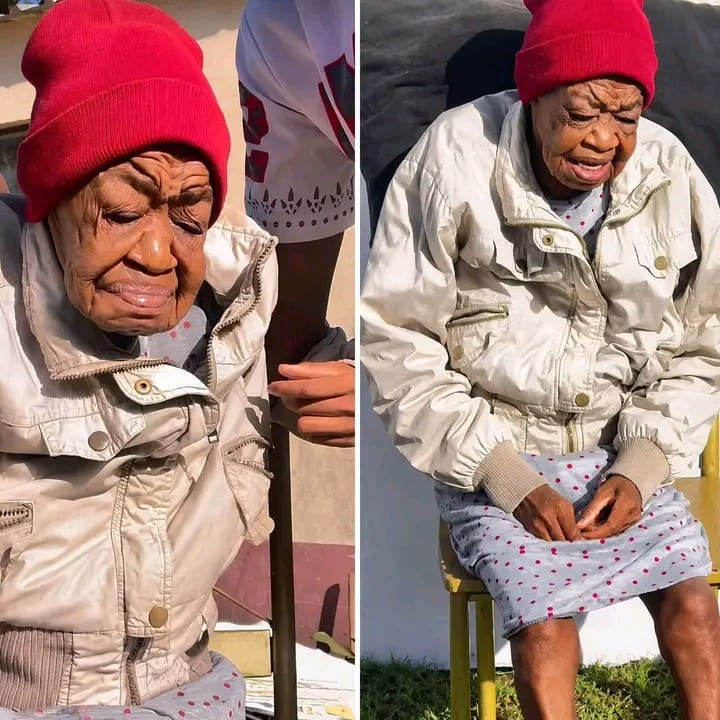
By now, you have probably seen the video. A 31 year old woman sits quietly, her skin deeply wrinkled, her hair grey and thinned, her face carrying the lines of someone who has lived eight or nine decades. The footage spread rapidly across TikTok, Facebook, Instagram, and YouTube, leaving millions of people across Africa and the world both heartbroken and confused.
Her name is Snenhlanhla Khoza. She is a mother. She is from Khulwa village in Mtubatuba, KwaZulu-Natal, South Africa. And her story deserves far more than the speculation it has received.
Table of Contents
- 31 Year Old Woman Turning Old Like a 90 Year Old Viral Video
- Who Is the 31 Year Old Woman That Went Viral?
- What Caused a 31 Year Old Woman to Age Overnight? The Medical Explanation
- Symptoms That Showed This 31 Year Old Woman Was Aging Rapidly
- Witchcraft or Werner Syndrome? What Experts Say About This 31 Year Old Woman
- How South Africa Reacted to the 31 Year Old Woman Who Looks 90
- Why the Story of This 31 Year Old Woman Matters for Rare Disease Awareness
- 31 Year Old Woman Aging Story: Key Facts at a Glance
- The 31 Year Old Woman's Story: What Happens Next
31 Year Old Woman Turning Old Like a 90 Year Old Viral Video
Snenhlanhla Khoza, a 31 year old woman from Mtubatuba in KwaZulu-Natal, speaks about her rapid aging condition believed to be Werner Syndrome, a rare genetic disorder affecting roughly 1 in 1 million people worldwide.
Watch the full viral video here: 31 Year Old Woman Who Ages Like a 90 Year Old Viral Video
Who Is the 31 Year Old Woman That Went Viral?

Snenhlanhla Khoza grew up like any other child in KwaZulu-Natal. She developed normally throughout her childhood and into her early twenties. By all accounts, she was healthy, active, and physically unremarkable in the best possible way.
But around the age of 27, something began to change.
Her skin started wrinkling. Her hair turned grey and began thinning. And her overall appearance shifted, rapidly and visibly, until she looked not like a woman in her late twenties, but like someone’s elderly grandmother. When a representative from an organisation called Thuleleni travelled to Khulwa village on 20 May 2026 to visit her family, he sat across from a 31-year-old woman who appeared to be in her eighties or nineties. Her own mother, sitting beside her, looked dramatically younger by comparison.
The family had already tried everything they knew. They had sought help from medical doctors. They had consulted traditional healers. Nothing had worked.
What Caused a 31 Year Old Woman to Age Overnight? The Medical Explanation
Here is what the science says, and it matters.
Medical experts and commentators who reviewed Khoza’s case believe she may be living with a condition called Werner Syndrome, sometimes referred to as adult-onset progeria. While this diagnosis has not been officially confirmed in public reports, Werner Syndrome is the condition most consistent with everything that has been observed in her case.
What Is Werner Syndrome?
Werner Syndrome is a rare genetic disorder named after Otto Werner, the German medical student who first described it. The condition is caused by mutations in the WRN gene, which is responsible for DNA repair and maintenance in the body. When this gene is damaged, the body loses its ability to properly maintain and replicate cells, and the aging process accelerates dramatically.
The disorder affects roughly 1 in 1 million people worldwide. That is not a typo — it is extraordinarily rare. Because of this, many doctors, especially in regions without specialised genetic medicine infrastructure, have never encountered it before.
When Does It Start and What Does It Look Like?
People with Werner Syndrome typically grow and develop normally right through childhood and into their early teens. Then, usually in their late teens to early twenties, the aging process begins to accelerate. By the time they reach their thirties, many patients look several decades older than their biological age.
The six cardinal symptoms used to diagnose the condition include:
- Premature greying or loss of hair — often the earliest sign, beginning on the scalp and eyebrows
- Bilateral cataracts — clouding of the lens in both eyes
- Atrophied or tightened skin — the skin becomes thin, shiny, and hardened
- Soft tissue calcification — calcium deposits forming in tissues and blood vessels
- Sharp, pinched facial features — producing an aged appearance
- An abnormal, high-pitched voice — a distinctive and lesser-known symptom
Beyond these core signs, patients also commonly develop type 2 diabetes, cardiovascular disease, osteoporosis, reduced fertility, and in some cases, certain cancers, all at a far younger age than would normally be expected.
There is currently no cure for Werner Syndrome. Treatment focuses entirely on managing symptoms as they emerge, cataract surgery, blood sugar control, wound care, and cancer screening.
Symptoms That Showed This 31 Year Old Woman Was Aging Rapidly
Snenhlanhla’s mother described how her daughter’s health deteriorated rapidly. The early signs reportedly included severe vomiting, difficulty walking, and intense body pain. Her family noticed a strange mark appeared on her face before her condition began worsening more dramatically.
These symptoms, taken together, are consistent with what happens when a young body is aging far faster than it should, when the cellular machinery designed to keep a person well begins breaking down in its twenties rather than its seventies.
Witchcraft or Werner Syndrome? What Experts Say About This 31 Year Old Woman
It would be unfair to report on this story without acknowledging a difficult reality.
When Khoza’s story spread across social media, a significant portion of the reaction, particularly in some local communities, linked her condition to witchcraft, curses, or spiritual punishment. Traditional practitioners reportedly suggested the condition could be connected to “ilumbo”, a term used in some communities to describe a spiritual affliction associated with a past relationship.
This is not surprising, and it is not unique to South Africa. Across the world, throughout human history, communities have reached for spiritual or supernatural explanations when confronted with medical realities they have never seen before and cannot explain. That is a profoundly human response.
However, medical experts have been clear: Werner Syndrome is not contagious. It cannot be spiritually transmitted. It is not a curse. And it is a genetic condition, present in a person’s DNA from birth, waiting to be triggered by the specific mutations in the WRN gene.
As one commentator put it online, and it is worth repeating — “Sadly, people are more comfortable inventing supernatural explanations than admitting how little we invest in rare disease research and long-term care.”
The real conversation this story should spark is not about witchcraft. It is about why rare diseases remain so deeply underfunded and poorly understood, particularly on the African continent.
How South Africa Reacted to the 31 Year Old Woman Who Looks 90
South Africans were deeply moved by Khoza’s story. Across Twitter/X, Facebook, TikTok, and Instagram, thousands of users responded with messages of sympathy, shock, and genuine concern.
Some users called for medical professionals to step in and assist her directly. Others reflected on how quickly human health can change. “Be grateful for good health, people. It’s tough out there. Hopefully, this lady can find help somewhere,” wrote one commenter — a sentiment that resonated with many who saw the video.
At the same time, many others pushed back against the supernatural framing. “I honestly think it’s a medical condition. I wish professionals would intervene and assist bakithi,” wrote another user — bakithi meaning “my people” in Zulu, a word that carries warmth and communal care.
The discourse, taken as a whole, reflects two things: the enormous compassion that ordinary South Africans showed toward a stranger in pain, and the ongoing need for better public health education around rare genetic disorders.
Why the Story of This 31 Year Old Woman Matters for Rare Disease Awareness
Snenhlanhla Khoza’s story is not just trending content. It is a window into what it means to live with a condition so rare that most of the world, including most doctors, will never encounter it. It is a reminder that the human body can carry extraordinary challenges entirely silently until one day it cannot.
For Snenhlanhla herself, the most urgent need right now is access to specialised medical care. Werner Syndrome requires input from geneticists, endocrinologists, ophthalmologists, cardiologists, and other specialists working together. That kind of coordinated, expert care is not easy to access from a rural village in KwaZulu-Natal. That gap, between what a patient needs and what is available to them, is what demands the most serious attention from this story.
Furthermore, her appeal to the public for help is a reminder that behind every viral video is a real person, a mother, a daughter, a sister, who wakes up every day managing a reality that most of us will never fully understand.
31 Year Old Woman Aging Story: Key Facts at a Glance
| Detail | Information |
|---|---|
| Name | Snenhlanhla Khoza |
| Age | 31 years old |
| Location | Khulwa village, Mtubatuba, KwaZulu-Natal, South Africa |
| Condition (suspected) | Werner Syndrome (adult-onset progeria) |
| Symptoms began | Around age 27 |
| Condition rarity | Approximately 1 in 1 million people worldwide |
| Cure available? | No — treatment manages symptoms only |
| Cause | Mutations in the WRN gene; not contagious, not spiritual |
| Story went viral | May 2026, across multiple social media platforms |
The 31 Year Old Woman’s Story: What Happens Next
A 31 year old woman who looks like a 90-year-old grandmother is shocking to see. It is supposed to be. Human beings are wired to notice when something about the body defies our expectations of age and time.
But shock alone is not enough. After the video stops playing, what Snenhlanhla Khoza needs, and what stories like hers deserve, is informed understanding, genuine compassion, and sustained attention from the people and institutions who can actually help.
If you know someone in the medical or humanitarian space who could assist families like hers, share this story. And if nothing else, let it remind you of something simple: the body we live in is extraordinary, fragile, and never something to take for granted.
Related Posts: