Quick Answer: Zambia’s $1.36 billion bond buyback is a 2026 sovereign debt deal where the government repurchased its entire 2053 Eurobond using a $600 million AfDB-backed loan plus its own resources. The offer achieved 97.85% investor acceptance, avoided a potential $2.6 billion interest burden, and unlocked $275 million for energy grid investment, making it the world’s first debt-for-development swap focused on a country’s energy sector.
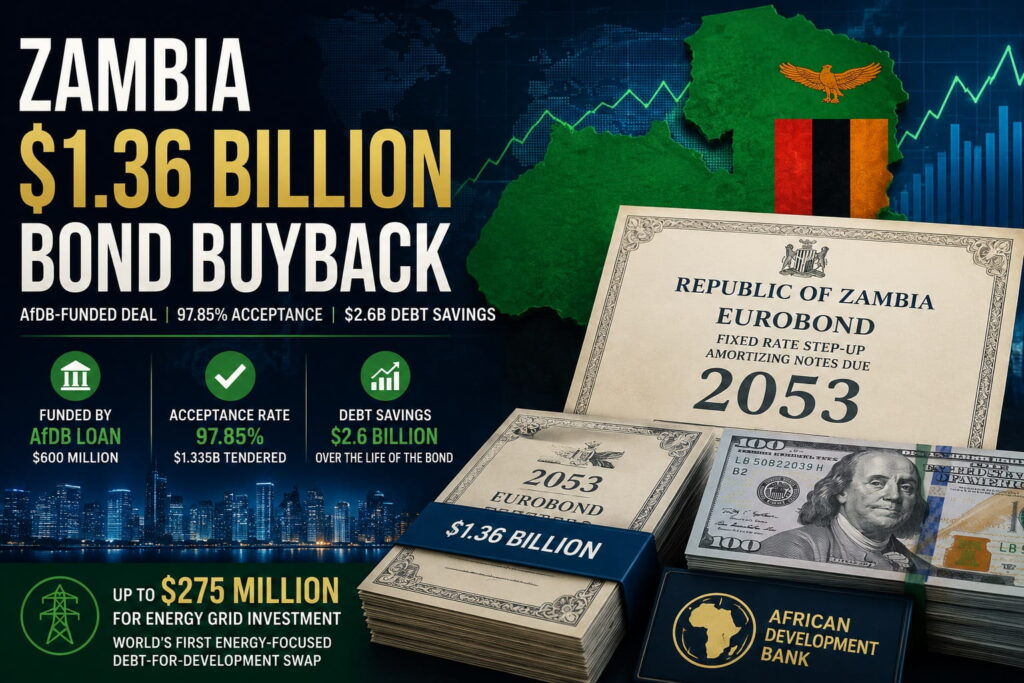
Zambia just pulled off one of the most consequential debt management moves in African sovereign finance in years. According to Zambia’s Ministry of Finance and National Planning, with the transaction confirmed by reporting from Bloomberg and Reuters, the deal marks one of the most significant sovereign debt operations Africa has seen in 2026. In late May, the government launched a cash tender offer to retire its entire $1.36 billion Eurobond maturing in 2053. By June 10, 97.85% of bondholders had agreed to sell. The deal is done, and the ripple effects will be felt across Zambia’s economy for decades.
But getting here was not straightforward. Between the launch and the finish line, there were bond price swings, creditor pushback, emergency negotiations, and a sweetened offer. This is the complete story of the Zambia $1.36 billion bond buyback, told in the order it happened, without jargon.
Why Zambia Launched the $1.36 Billion Bond Buyback Before the Coupon Exploded
To understand the urgency behind this Zambia Eurobond buyback, you need to know a small but powerful clause buried in Zambia’s 2024 debt restructuring agreement.
When Zambia emerged from its 2020 sovereign default, one of the first African defaults of the COVID era, it restructured its external debts under the G20 Common Framework for Debt Treatment. As part of that deal, bondholders accepted a drastically reduced coupon of just 0.5% per year on the 2053 bond. In return, they got a sweetener: if Zambia’s economy recovered strongly enough to meet an IMF debt-sustainability composite indicator (CI) score for two consecutive half-year periods, the coupon would automatically jump from 0.5% to 7.5%.
That is a 15-fold increase. In practice, it would push Zambia’s annual interest cost on this one bond from roughly $6.8 million to $102 million. Over the life of the instrument through 2053, the difference adds up to nearly $2.6 billion.
Thanks to surging copper prices and a dramatically stronger kwacha, Zambia was getting dangerously close to hitting that trigger. Analysts expected the first CI threshold to be met as early as June 2026. If confirmed, the coupon step-up clock would begin. Standard Chartered’s emerging markets strategist noted at the time that the government’s move signalled it saw a real probability of meeting the metric, which made acting fast not just wise, but necessary.
The math was simple: buy back the Zambia debt relief 2053 bond now at a discount, before the coupon explodes.
How the Zambia $1.36 Billion Bond Buyback Worked: The Launch
On May 29, 2026, Zambia’s Ministry of Finance and National Planning officially launched the cash tender offer. The government offered bondholders $780 for every $1,000 of face value if they tendered before the early deadline of June 5, falling to $740 per $1,000 for later participants.
Funding for the buyback came from two sources: a $600 million concessional loan from the African Development Bank (AfDB) and the government’s own resources. That AfDB loan, at far cheaper rates than the 7.5% coupon looming on the horizon, made the arithmetic work for Lusaka.
Markets responded immediately. The 2053 bond jumped 5.9 cents to 79.6 cents on the dollar on launch day, making it the best-performing emerging-market sovereign dollar bond that Friday. Investors read the Zambia Eurobond buyback as a signal that the country’s finances were on solid footing, and they were right.
This move also fit into a broader African trend. Angola and the Republic of Congo had recently completed similar operations. Zambia, as the continent’s second-largest copper producer, was in an exceptionally strong position to follow suit. The kwacha had already gained around 20% against the dollar in 2026, the strongest performance of any currency in the world that year.
Timeline of the Zambia $1.36 Billion Bond Buyback: Day by Day
Understanding the sequence of events is key to appreciating just how much pressure the government was under, and how effectively it navigated that pressure.
May 29, 2026 — Launch. Zambia announces the cash tender offer. The 2053 bond surges 5.9 cents on the day.
June 1, 2026 — Creditor pushback. An ad hoc bondholder group, advised by New York law firm Cleary Gottlieb Steen & Hamilton, publicly opposes the offer, calling its terms “materially adverse” to investor interests. The group warns it is building a blocking position.
June 2–3, 2026 — Blocking position assembled. The creditor group gathers support from holders of more than 25% of outstanding notes, preventing Zambia from triggering the clean-up call unilaterally. The government heads to the negotiating table.
June 4, 2026 — Offer amended and sweetened. Zambia formally amends the tender offer, extending the early participation deadline to June 9 and adding a $65 million pooled incentive fee to bring in holdout creditors. The revised final price rises to approximately $828.68 per $1,000 of principal plus accrued interest, comprising $740 tender consideration, a $40 early tender fixed fee, and ~$48.68 pro rata share of the pooled fee.
June 9, 2026 — Early deadline passes. Valid tenders total $1.335 billion — 97.85% of outstanding principal. Participation exceeds 75%, triggering the right to activate the clean-up call.
June 10, 2026 — Official announcement. The Ministry of Finance publishes early results on the London Stock Exchange. The Zambia $1.36 billion bond buyback is effectively complete.
June 15, 2026 (expected) — Settlement. Final settlement expected on or around June 15, or the date of AfDB loan drawdown, whichever is later. Zambia also intends to exercise the clean-up call to redeem all remaining holdout bonds no later than June 25, 2026.
How Creditors Tried to Block the Zambia $1.36 Billion Bond Buyback
Not everyone was happy with the sovereign debt restructuring Zambia carried out.
By June 1, the ad hoc creditor group had two main objections. First, they argued the government launched the offer without consulting bondholders in advance. Market practice, they said, requires dialogue with a representative committee before any tender is launched. Zambia had skipped that step entirely.
Second, and more worrying for them, was the “clean-up call” provision in the bond’s terms. If Zambia secured tenders from holders of more than 75% of the outstanding notes, it could compulsorily redeem all remaining bonds, forcing holdouts to sell at the offered price. The creditor group saw this as a mechanism to strip away their option on the future coupon step-up, which they believed was undervalued at $780 per $1,000.
Consequently, the group moved quickly to assemble a blocking position. By holding more than 25% of notes, they could prevent the clean-up call from being triggered. The standoff was on.
Meanwhile, the bond kept climbing, reaching 81.4 cents on the dollar by June 2. Even critics of the offer terms were pricing in a high probability the deal would eventually get done.
The $65 Million Sweetener: How Zambia Resolved the Bond Buyback Standoff
Rather than dig in, Zambia’s government took the pragmatic route. On June 4, the Ministry of Finance formally amended the tender offer, extending the early participation deadline from June 5 to June 9, and adding a $65 million pooled incentive to pull in the holdout creditor group. The government’s goal was clear: get participation past the 75% threshold that would activate the clean-up call, and ideally reach near-unanimous support.
The revised terms gave investors approximately $828.68 per $1,000 of principal plus accrued interest, broken down as $740 in tender consideration, a $40 early tender fixed fee, and roughly $48.68 as a pro rata share of the pooled fee. That was well above the original $780 offer price and above the secondary market price at the time of the initial launch.
The sweetener did the job. Participation surged past the critical 75% threshold by June 9, and Zambia’s path to a full redemption was clear.
Ratings agencies took note. S&P Global affirmed Zambia’s CCC+ rating and characterised the buyback as an opportunistic liability management exercise rather than a distressed debt event, noting Zambia likely had the capacity to service the bond under either scenario. Fitch similarly confirmed the transaction was not a distressed debt exchange, pointing out that the buyback price was above the pre-announcement secondary market price and that holdouts would continue to receive full service on original terms.
This outcome reflected something important: both sides had strong incentives to reach a deal. Zambia needed to retire the bond before the coupon step-up hit. And most bondholders recognised that locking in ~83 cents on the dollar was a strong outcome, especially given that the bonds had traded in distressed territory for years during the default period.
Impact of the Zambia $1.36 Billion Bond Buyback on Debt and the Economy
On June 10, 2026, the Ministry of Finance announced that valid tenders totalled $1.335 billion — representing 97.85% of total outstanding notes. The announcement was made on the London Stock Exchange as part of Zambia’s broader debt management programme.
But what makes this deal genuinely historic goes beyond the acceptance rate. Embedded in the Zambia $1.36 billion bond buyback is a commitment to spend up to $275 million over 15 years on strengthening and modernising Zambia’s electricity grid. The government describes this as the world’s first “debt-for-development swap” focused on a country’s energy sector — debt-service savings, in other words, converted directly into infrastructure investment.
For a country that has suffered repeated load-shedding crises due to drought-hit hydroelectric capacity, that is no small commitment. Reliable electricity underpins mining output, manufacturing, and household welfare. Redirecting the savings from cheaper AfDB debt into the national grid turns past financial distress into future productive capacity.
The immediate fiscal impact is equally significant. Annual debt service on this bond drops from a potential $102 million to zero, the government avoids a $2.6 billion increase in total interest obligations over the bond’s life, and concessional AfDB financing replaces an instrument that was about to become one of Zambia’s most expensive external liabilities.
Beyond the numbers, the deal marks the formal closure of Zambia’s default era. The sovereign debt restructuring Zambia undertook from 2020 through 2024, involving the G20 Common Framework, bilateral creditors including China, and private bondholders, is now complete. It places Zambia alongside Angola and the Republic of Congo as African sovereigns that have used proactive liability management to exit distressed debt positions. Elsewhere on the continent, South Africa received a Fitch sovereign credit upgrade and Nigeria moved to clear domestic contractor arrears, all signs of a broader African sovereign debt stabilisation trend taking hold in 2026.
What the Zambia $1.36 Billion Bond Buyback Means for Economic Recovery
The emerging market bond buyback Africa trend has accelerated in 2026, and Zambia’s position within it is strong. The kwacha gained around 20% against the dollar — the best performance of any currency globally. Local bond market returns hit 39%, also topping world rankings according to Bloomberg data. Gross international reserves peaked at $6.5 billion in February 2026, the highest in the country’s history.
These are not the indicators of a distressed sovereign. They reflect surging copper revenues, with LME copper above $13,800 per tonne, tighter fiscal management following the successful completion of Zambia’s IMF Extended Credit Facility programme in January 2026, and growing investor confidence. Zambia’s mining sector FX receipts reached $915.7 million in Q1 2026 alone. Inflation fell to 6.6% in May, its lowest level since 2018, comfortably within the Bank of Zambia’s 6–8% target band.
Going forward, the government has signalled intentions to return to international capital markets, with bondholders invited to engage with Citigroup about a potential new bond offering, expected after the August 2026 elections and IMF consultations in the second half of the year.
Critics of the Zambia $1.36 Billion Bond Buyback: What the Sceptics Argue
Not everyone agrees the deal was perfectly structured. Some analysts pointed out that the $275 million energy commitment is funded from gross, nominal, undiscounted savings. When discounted at Zambia’s domestic borrowing cost of around 17.5%, the present value of those savings may be considerably lower than the headline figure.
Others noted that if bondholders rotate their dollar proceeds into kwacha bonds, Zambia would effectively substitute one form of debt service for another, adding new domestic obligations while removing the external ones.
These are legitimate points. That said, they do not diminish the core achievement: Zambia completed a complex, contested transaction on a compressed timeline, with near-unanimous investor support, and without resorting to coercion or protracted legal confrontation.
Zambia $1.36 Billion Bond Buyback: Key Facts at a Glance
| Detail | Figure |
|---|---|
| Bond retired | $1.36B Fixed Rate Step-Up Amortizing Notes due 2053 |
| Offer launched | May 29, 2026 |
| Offer amended | June 4, 2026 (deadline extended + $65M sweetener added) |
| AfDB loan | $600 million (concessional) |
| Early offer price | $780 per $1,000 of face value |
| Final price (after sweetener) | ~$828.68 per $1,000 + accrued interest |
| Final acceptance rate | 97.85% ($1.335B of $1.365B tendered) |
| Expected settlement | On or around June 15, 2026 |
| Clean-up call deadline | No later than June 25, 2026 |
| Coupon avoided | 0.5% → 7.5% step-up (~$2.6B lifetime cost) |
| Energy commitment | Up to $275M over 15 years |
| S&P ruling | Opportunistic liability management — not a default |
| Fitch ruling | Not a distressed debt exchange |
| Deal classification | World’s first energy-focused debt-for-development swap |
Frequently Asked Questions: Zambia $1.36 Billion Bond Buyback
What is the Zambia $1.36 billion bond buyback?
It is a 2026 sovereign debt operation in which Zambia’s government used a $600 million AfDB loan plus its own resources to repurchase the entire outstanding amount of its $1.36 billion Eurobond maturing in 2053. The deal achieved 97.85% bondholder participation and avoids a potential $2.6 billion increase in lifetime interest costs.
Why did Zambia buy back its Eurobond?
The 2053 bond contained a coupon step-up clause: if Zambia met an IMF debt-sustainability metric for two consecutive periods, the interest rate would jump from 0.5% to 7.5%. With Zambia’s economy recovering strongly, driven by copper revenues and a surging kwacha, the trigger was imminent. Buying back the bond before the step-up activated saved the government billions in future interest costs.
Who funded the Zambia bond buyback?
The AfDB loan Zambia 2026, worth $600 million at concessional rates, provided the primary funding, supplemented by Zambia’s own resources. The final buyback price of ~$828.68 per $1,000 comprised three components: $740 in base tender consideration, a $40 early tender fixed fee, and approximately $48.68 as a pro rata share of the $65 million pooled incentive fee. The AfDB financing was far cheaper than the 7.5% coupon the bond would have attracted, making the transaction financially viable.
Was the buyback considered a default or distressed debt event?
No. Both S&P Global and Fitch explicitly ruled otherwise. S&P affirmed Zambia’s CCC+ rating and described the buyback as an opportunistic liability management exercise, noting Zambia likely had the capacity to service the bond without the buyback. Fitch confirmed it was not a distressed debt exchange, pointing out that the buyback price exceeded the pre-announcement secondary market price and that holdouts would continue receiving full service on original terms.
What does the 97.85% acceptance rate mean?
It means holders of 97.85% of the bond’s outstanding principal — $1.335 billion out of $1.365 billion — agreed to sell their notes back to the government. This is well above the 75% threshold needed to trigger the clean-up call, allowing Zambia to redeem any remaining holdout bonds compulsorily.
How much debt did Zambia save from this deal?
By retiring the bond before the coupon step-up triggers, Zambia avoids annual interest costs rising from $6.8 million to $102 million. Over the bond’s life through 2053, that represents a saving of approximately $2.6 billion in interest obligations.
What is the debt-for-development swap Zambia announced?
As part of the buyback deal, Zambia committed to spending up to $275 million over 15 years on electricity grid modernisation. The government describes this as the world’s first “debt-for-development swap” focused on a country’s energy sector, channelling debt-service savings into infrastructure investment rather than creditor returns.
Was the Zambia Eurobond buyback contested?
Yes. An ad hoc creditor group, advised by Cleary Gottlieb Steen & Hamilton, initially opposed the offer as “materially adverse” and assembled a blocking position of over 25% of outstanding notes. After negotiations and a sweetened offer of an extra $65 million, the group agreed to participate, enabling near-unanimous acceptance.
Final Verdict: Why the Zambia $1.36 Billion Bond Buyback Is a Turning Point
The Zambia $1.36 billion bond buyback is a textbook case of proactive sovereign debt management, executed under pressure, contested by creditors, resolved through negotiation, and completed with near-unanimous investor support. It draws a line under a default era that began in 2020 and sets the stage for a cleaner, more sustainable debt profile.
Whether the $275 million energy investment commitment translates into tangible grid improvements, and whether Zambia sustains its macroeconomic momentum through the 2026 elections and beyond, will determine how history ultimately judges this transaction. For now, the numbers speak clearly: 97.85% acceptance, a $2.6 billion coupon disaster avoided, and a world-first deal structure that puts development at the heart of debt management. That is worth paying attention to.
Sources: Bloomberg, Reuters, Open Zambia, Ecofin Agency, CNBC Africa, IMF Sixth ECF Review, S&P Global via Investing.com, Fitch via Dmarket Forces, Ministry of Finance and National Planning press releases.
Related Posts: